Table of Content
Importing an industrial copper granulator into the United States introduces complex cross-border logistics, shifting federal tariff stacks, and strict workplace electrical safety codes that catch unprepared buyers completely off guard.
Total landed cost is a multi-tier chain calculated on divergent legal bases: ad valorem customs duties and statutory user fees apply strictly to equipment transaction value excluding documented ocean freight, while Section 301 tariffs, customs brokerage, port drayage, and OSHA 1910.303 electrical compliance represent separate operational requirements.
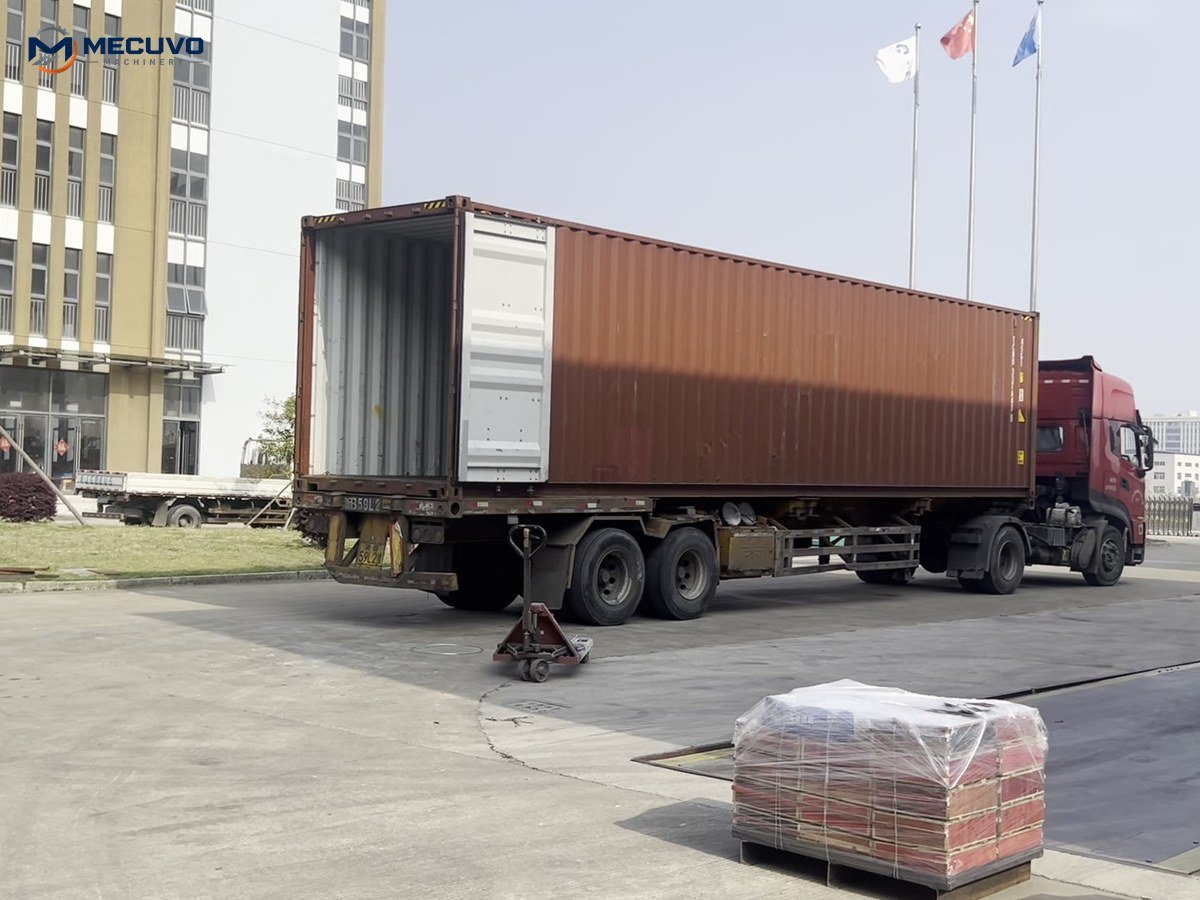
To budget accurately when purchasing machinery from abroad, scrap processors must understand how statutory customs valuation operates, how federal user fees are capped, and what physical modifications are required on the yard floor.
How Does the U.S. Landed Cost Calculation Chain Actually Work from Factory Gate to Yard Floor?
Landed machinery cost encompasses every expense required to move equipment from an overseas production facility to fully operational status on your recycling plant floor.
Calculating landed cost requires evaluating distinct cost tiers independently rather than applying a blanket markup percentage, because customs duties apply only to verified transaction value while freight, terminal handling, and site installation remain separate contract items.
Understanding Sequential Cost Layers and Valuation Rules
When evaluating international equipment procurement, treating landed cost as a simple uniform markup over an export quote is a costly mistake. True landed cost represents a sequential cost chain where each tier is governed by distinct legal definitions, commercial contracts, and statutory formulas.
The commercial foundation begins with trade delivery terms codified under the Incoterms 2020 rules published by the International Chamber of Commerce. Under Incoterms Article A9/B9, commercial obligations are strictly divided: an Ex-Works (EXW) or Free on Board (FOB) contract places international transit, marine insurance, and port handling under the buyer's direct account, whereas Cost, Insurance, and Freight (CIF) bundles ocean carriage and baseline marine cover into the seller's quotation.
Crucially, U.S. Customs and Border Protection establishes strict valuation principles in its Informed Compliance Publication on Proper Deductions of Freight and Other Costs from Customs Value. Under federal customs law (19 U.S.C. § 1401a), dutiable transaction value represents the price actually paid or payable for the merchandise, exclusive of international transportation, marine insurance, and related shipping services incident to international transit. However, CBP mandates that international freight and insurance can only be deducted from a CIF invoice if those costs are actual, verifiable, and supported by carrier documentation. If actual freight figures cannot be substantiated with primary carrier invoices upon entry audit, customs officials disallow the deduction, forcing the importer to pay ad valorem duties and fees across the total invoice value.
Beyond customs clearance, downstream domestic expenditures represent independent operational contracts. Port terminal handling charges (THC), container demurrage contingencies, customs broker entry filing fees, inland container drayage to your facility, heavy rigging, and licensed electrical drops each require direct vendor budgeting. Reviewing our technical guide on startup costs to budget highlights how ancillary operational expenses affect comprehensive payback timelines.
| Cost Component | Calculation Basis | Governing Rule / Statutory Authority | Key Primary Document |
|---|---|---|---|
| Machinery Purchase Price | Contract agreed commercial invoice | Commercial Sales Agreement | Signed Commercial Invoice & Packing List |
| International Ocean Freight | Actual container carrier tariff | Incoterms 2020 Article A9/B9 | Rated Ocean Bill of Lading (B/L) |
| Marine Cargo Insurance | Insured cargo value (Institute Clauses) | Incoterms 2020 CIF / CIP provisions | Marine Cargo Insurance Policy / Certificate |
| Dutiable Customs Value | Price paid minus documented ocean freight | CBP Informed Compliance Publication (March 2000) | CBP Form 7501 (Entry Summary) |
| Merchandise Processing Fee (MPF) | 0.3464% ad valorem (min $34.58, cap $670.86) | CBP User Fee Table (checked 2026-10-16) | CBP Entry Summary Line 49 |
| Harbor Maintenance Fee (HMF) | 0.125% ad valorem on maritime entries | CBP User Fee Table (checked 2026-10-16) | CBP Entry Summary Line 50 |
| Customs Brokerage Filing | Flat professional service fee per entry | Independent Customs Broker Agreement | Broker Service Billing & Delivery Order |
| Port Terminal Handling & Drayage | Terminal tariff schedule & mileage rate | Intermodal Drayage Carrier Agreement | Terminal Delivery Receipt & Trucking Waybill |
| Electrical Inspection & Field Approval | Hourly or project professional rate | OSHA 29 CFR 1910.303 & Local AHJ | Electrical Permit & Field Evaluation Report |
| Equipment Anchoring & Utility Hookup | Concrete anchor hardware and labor | OSHA 29 CFR 1910.212(b) | Plant Mechanical Installation Log |
What Federal Customs Fees and Tariff Classifications Apply to Imported Granulator Machinery?
Navigating federal customs clearance requires precise accounting for statutory user fees and rigorous verification of tariff classification lines before dispatching international shipments.
Formal commercial entries incur an ad valorem Merchandise Processing Fee of 0.3464% bounded between $34.58 and $670.86, a 0.125% Harbor Maintenance Fee, and applicable ad valorem duties determined strictly by the confirmed 8-digit HTS subheading.
Statutory Customs User Fees and Section 301 Tariff Structures
Every formal commercial entry processed by U.S. Customs and Border Protection is subject to federal user fees that follow non-linear statutory fee schedules. According to the official CBP User Fee Table (verified active as of October 16, 2026), formal merchandise entries are assessed a Merchandise Processing Fee (MPF) of 0.3464% ad valorem. Crucially for equipment buyers, MPF is bounded by strict statutory limits: it enforces a minimum fee of $34.58 and a maximum statutory cap of $670.86.
Through direct arithmetic calculation, this statutory boundary means any commercial shipment with an entered customs value below approximately $9,983 pays the flat $34.58 minimum. Conversely, for any capital equipment shipment exceeding approximately $193,665 in entered customs value, the MPF is completely capped at $670.86, regardless of how much higher the equipment valuation climbs. For ocean freight shipments arriving at covered U.S. marine terminals, CBP also assesses the Harbor Maintenance Fee (HMF) at a flat 0.125% ad valorem on entered customs value with no upper ceiling. Note that statutory fee schedules are adjusted periodically by Congress and federal rulemaking; figures stated here were re-verified on 2026-10-16 and remain subject to change.
While user fees are predictable, the dominant financial uncertainty in importing foreign recycling machinery is the applicable tariff stack. Under the Harmonized Tariff Schedule of the United States, industrial recycling equipment such as copper wire granulators generally falls under heading 8479. However, the U.S. International Trade Commission reference publication on China Tariffs (last updated January 1, 2026) demonstrates that multiple 8-digit subheadings under 8479—including 8479.82.00 and subheadings throughout 8479.89—are covered by additional ad valorem trade remedies under Section 301 of the Trade Act of 1974. Furthermore, the USITC documentation points importers directly to Chapter 99 provisions for specific trade remedy rates, exclusions, and active modifications.
Importers must understand that neither foreign equipment manufacturers nor sales agents possess legal authority to determine binding customs classifications. CBP explicitly maintains sole statutory authority over tariff treatment. We make no claim regarding which specific HTS code or duty percentage applies to MECUVO machinery; importers should read our general overview on tariff classification, sea freight and voltage and engage a licensed customs broker or submit an electronic ruling request via CBP eRulings before executing a commercial sales agreement. Bundling auxiliary components—such as spare sorting screens or cutting blades—also requires itemized invoice pricing so customs brokers can apply appropriate subheadings to consumable wear parts.
What OSHA Electrical Standards and NRTL Approvals Must Foreign Machinery Meet in the United States?
Connecting foreign industrial machinery to an American electrical distribution system involves rigorous federal safety standards and local municipal electrical code enforcement.
Under OSHA 29 CFR 1910.303, all industrial electrical equipment must be approved, marked with manufacturer specifications, installed with dedicated working-space clearances, and carry a certification mark from an OSHA-recognized testing laboratory or obtain an on-site field evaluation.
Navigating Workplace Electrical Standards and Field Evaluations
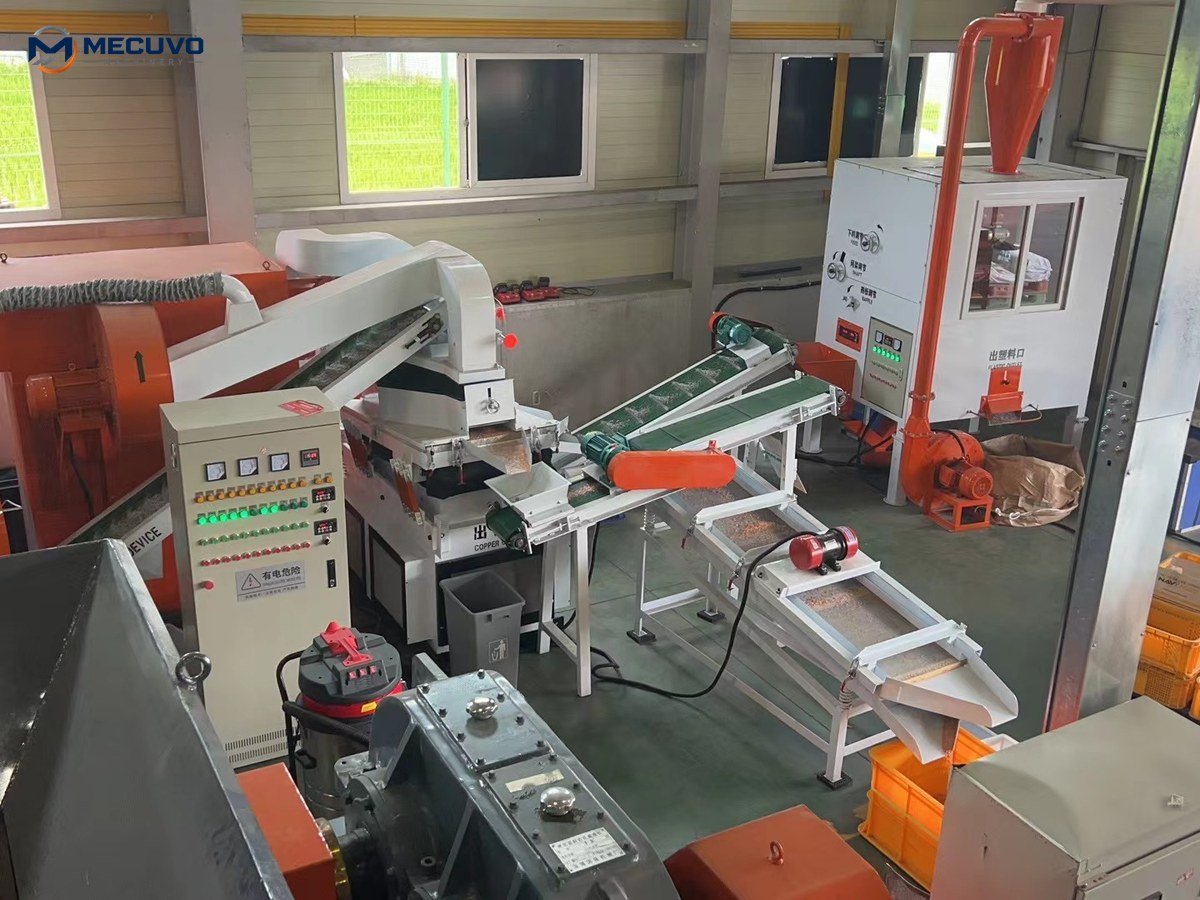
Physical delivery of a granulator container to your scrap yard is only half the importation process; the machine must safely connect to your facility's power infrastructure without violating workplace safety laws. In the United States, industrial electrical installations are federally governed by OSHA 29 CFR 1910.303 and enforced locally by municipal electrical inspectors acting as the Authority Having Jurisdiction (AHJ).
Under 29 CFR 1910.303(a), electrical conductors and equipment are acceptable only if approved as defined under 29 CFR 1910.399. Furthermore, 1910.303(b)(2) mandates that listed or labeled equipment must be installed and used in accordance with instructions included in the listing or labeling. Crucially, the OSHA Nationally Recognized Testing Laboratory Program establishes that product approvals must stem from an accredited testing organization (such as UL, CSA, or Intertek/ETL). Foreign machinery built exclusively to overseas standards often carries CE self-declaration markings; however, CE marks are not recognized by OSHA or American electrical inspectors as proof of third-party electrical safety certification.
When importing overseas machinery, scrap operators should explicitly ask what electrical approvals or registered NRTL markings the control cabinet and internal switchgear carry. If an imported control cabinet does not arrive with a recognized NRTL label, the local electrical inspector will generally require a third-party field evaluation before issuing a permanent operating permit. An accredited field evaluation body inspects wire sizing, branch circuit overcurrent protection, grounding continuity, and short-circuit current ratings (SCCR) directly on your facility floor, applying a field label upon compliance. Budgeting for this field evaluation in your initial landed-cost worksheet prevents unexpected startup shutdowns.
Facility layout planning must also comply with OSHA 1910.303 Table S-1, which enforces mandatory working-space clearances around industrial electrical enclosures. For equipment operating up to 600 volts nominal, Table S-1 requires a minimum clear working-space depth of 3.0 ft (0.9 m) in front of electrical control panels, with an enclosure door opening arc of at least 90 degrees. Under 1910.303(g)(1), this operational space may never be utilized for scrap cable storage or staging. Equipment must also display permanent, legible nameplates indicating manufacturer identity, voltage, phase, full-load amperage, and frequency under 1910.303(e)(1). To explore industrial utility planning further, read our technical analysis on powering a granulator across single-phase and three-phase infrastructure.
How Should You Prepare Facility Power, Equipment Anchoring, and Pre-Shipment Verification?
Achieving successful machinery startup requires verifying factory electrical parameters, anchoring dynamic equipment securely, and confirming processing capabilities before the container departs.
Buyers must order compatible 60 Hz industrial voltage, secure machines to reinforced concrete foundations per OSHA 29 CFR 1910.212(b) to withstand separation table vibration, and provide scrap cable samples to validate granulation performance before shipment.
Foundation Anchoring, Grid Voltage, and Pre-Shipment Trials
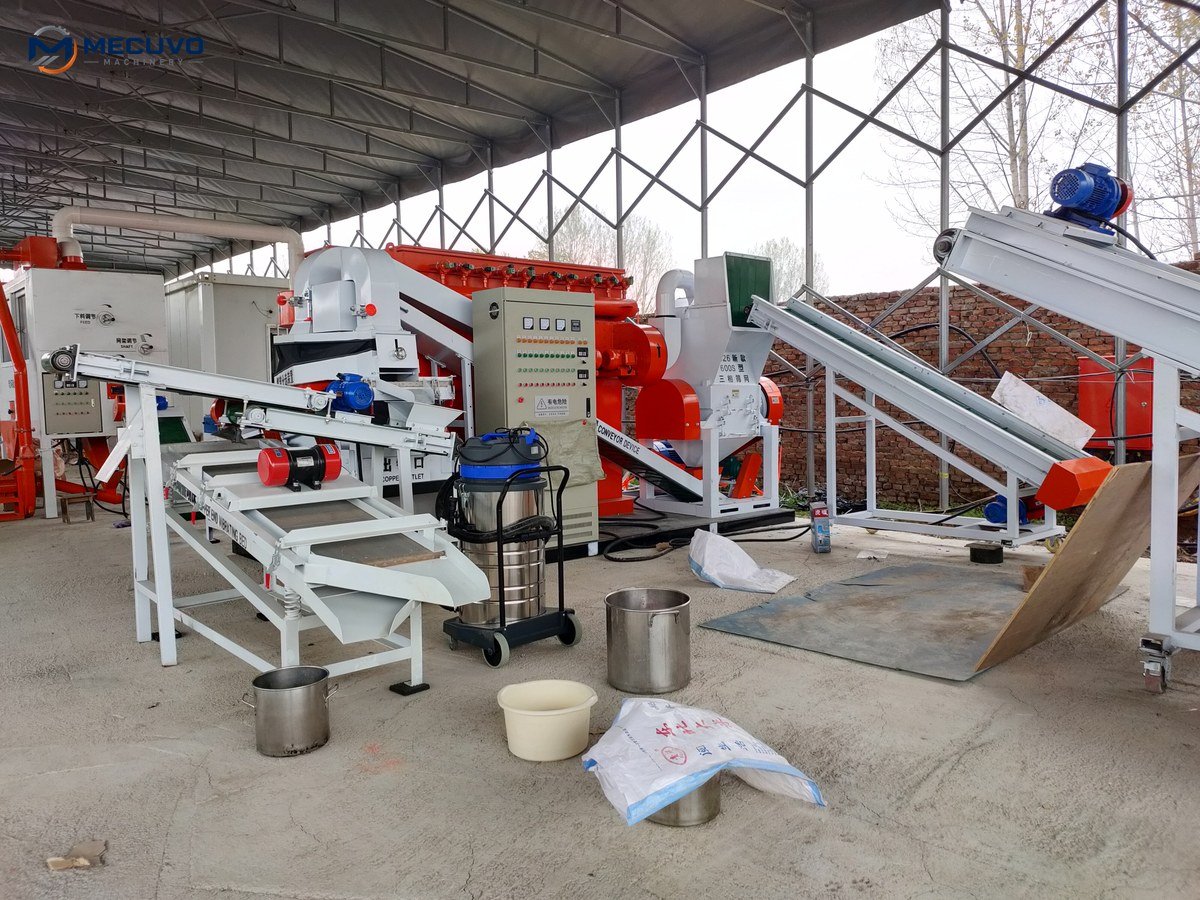
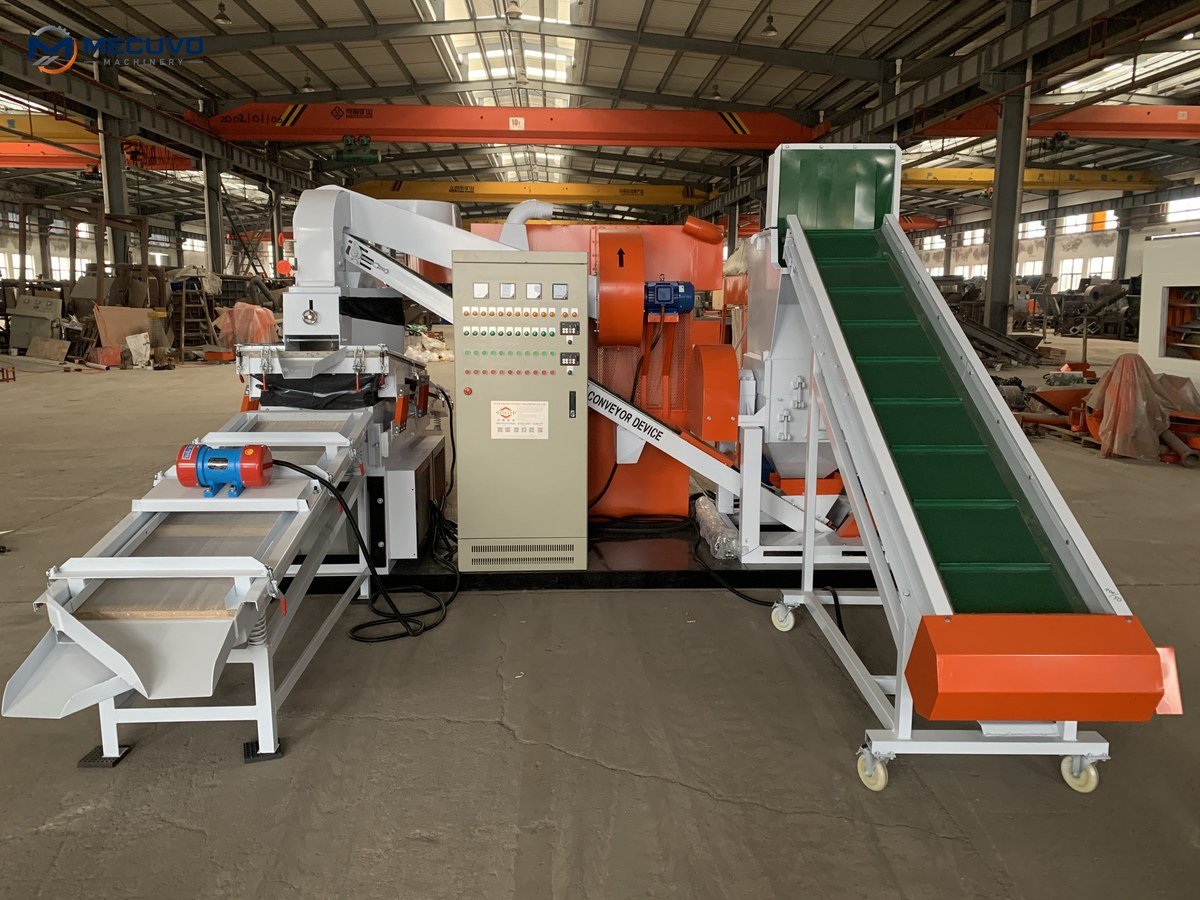
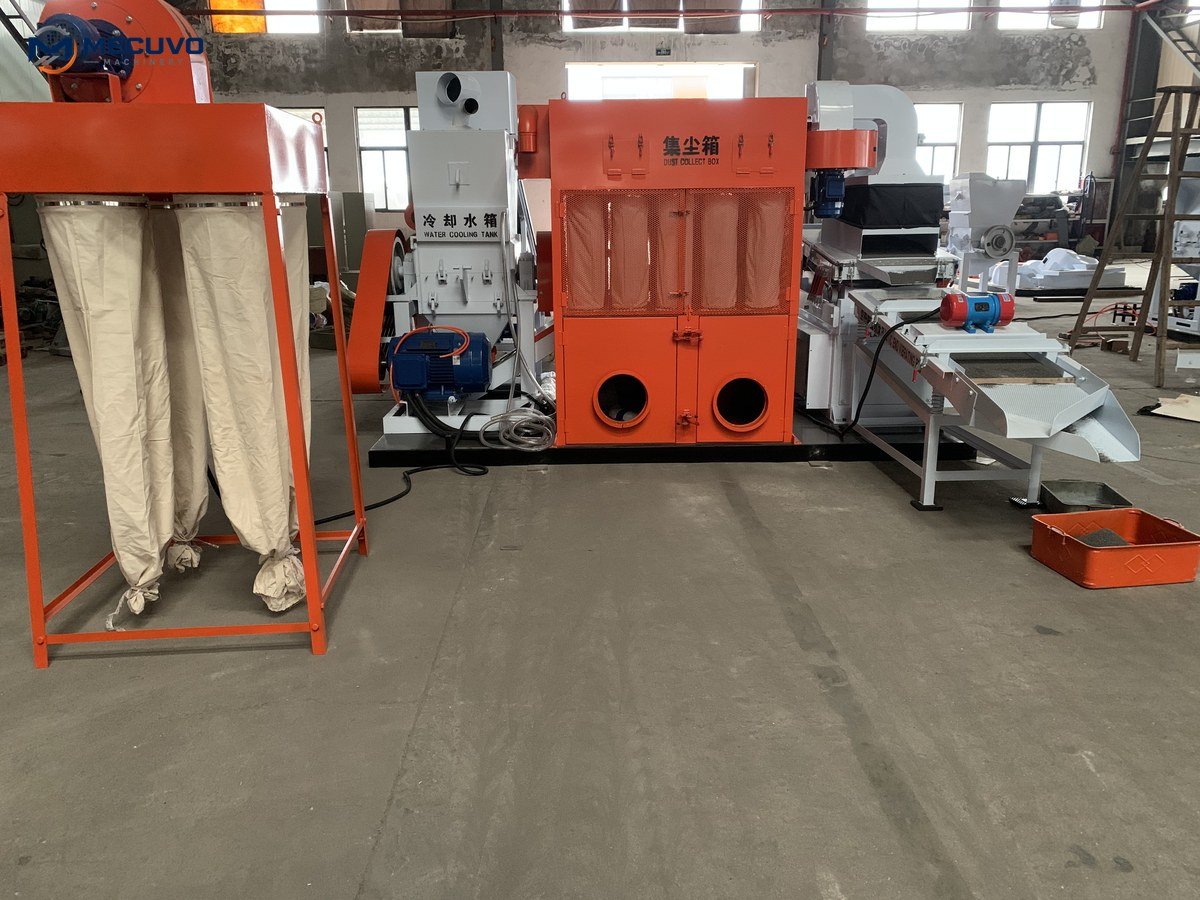
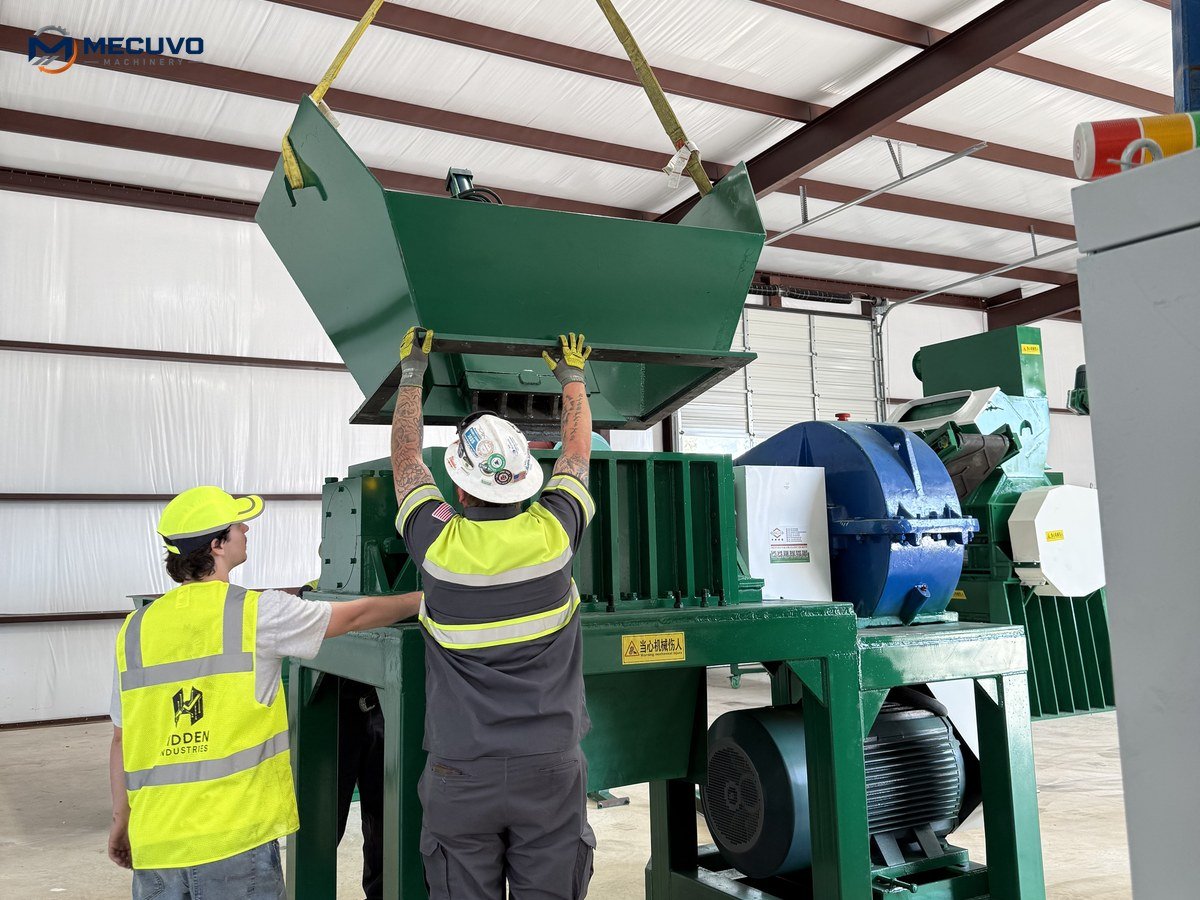
Preparing your facility for machinery arrival requires coordinating mechanical anchoring, utility service drops, and pre-shipment performance trials. Industrial copper granulators integrate high-speed rotary cutting chambers alongside eccentric oscillating air-separation tables. Under OSHA 29 CFR 1910.212(b), machines designed for a fixed location shall be securely anchored to prevent walking or moving during operation. Bolting granulator frames to a level, reinforced concrete floor using heavy-duty mechanical expansion anchors prevents structural walking, dampens acoustic resonance, and protects internal knife alignments from vibration-induced drift.
Electrical supply characteristics represent another essential pre-shipment specification. Standard utility service across North American industrial parks operates at 60 Hz (commonly 208V, 240V, or 480V 3-phase), whereas foreign manufacturing grids typically run at 50 Hz (such as 380V 3-phase). As stated on the MECUVO copper granulator reference specifications page, all listed model specifications—from compact starter units to high-capacity processing plants—represent reference configurations, to be confirmed in the final quotation. Actual processing throughput depends heavily on cable type, copper content, and feeding consistency; operating voltage, auxiliary equipment, and physical machine dimensions are confirmed individually per customer order.
Prior to releasing final balance payments or loading containers, scrap buyers should conduct pre-shipment verification. Sending authentic feedstock samples or detailed photos of your target scrap cable ensures factory engineers configure appropriate knife profiles and sorting screen diameters for your specific material stream. U.S. recyclers investing in capital equipment should also evaluate tax depreciation strategies by reviewing equipment financing for US recyclers under IRS Section 179 rules.
When preparing to import recycling machinery, send photos of your representative scrap cable, your target hourly throughput, and your yard's exact three-phase utility voltage and available amperage to our technical team via contact MECUVO for engineering review and quotation normalisation.
Conclusion
Executing a successful overseas machinery purchase requires calculating true landed costs across divergent legal bases, confirming tariff classification with a broker, and preparing facility power and anchoring before delivery.
— YOUR RECYCLING PROJECT
Find the right machine for your material.
Tell us your material and required capacity.
Or email sales@mecuvo.com