Table of Content
I regularly talk with scrap yard managers who produce clean-looking copper chops only to face unexpected price deductions or rejected loads at the smelter scales. Secondary copper smelters demand a minimum of 99.0% to 99.5% copper purity with chlorine under 50 ppm for No. 1 ISRI Clove chops, paying 96% to 98% of spot; exceeding 500 ppm chlorine downgrades loads to Cobra, deducting $40 to $80 per ton. Below, I detail commercial ISRI commodity grading, harmful chemical penalty thresholds, mill acceptance standards, and granulator operating protocols.
What purity percentage defines No. 1 copper chops under ISRI Clove specifications?
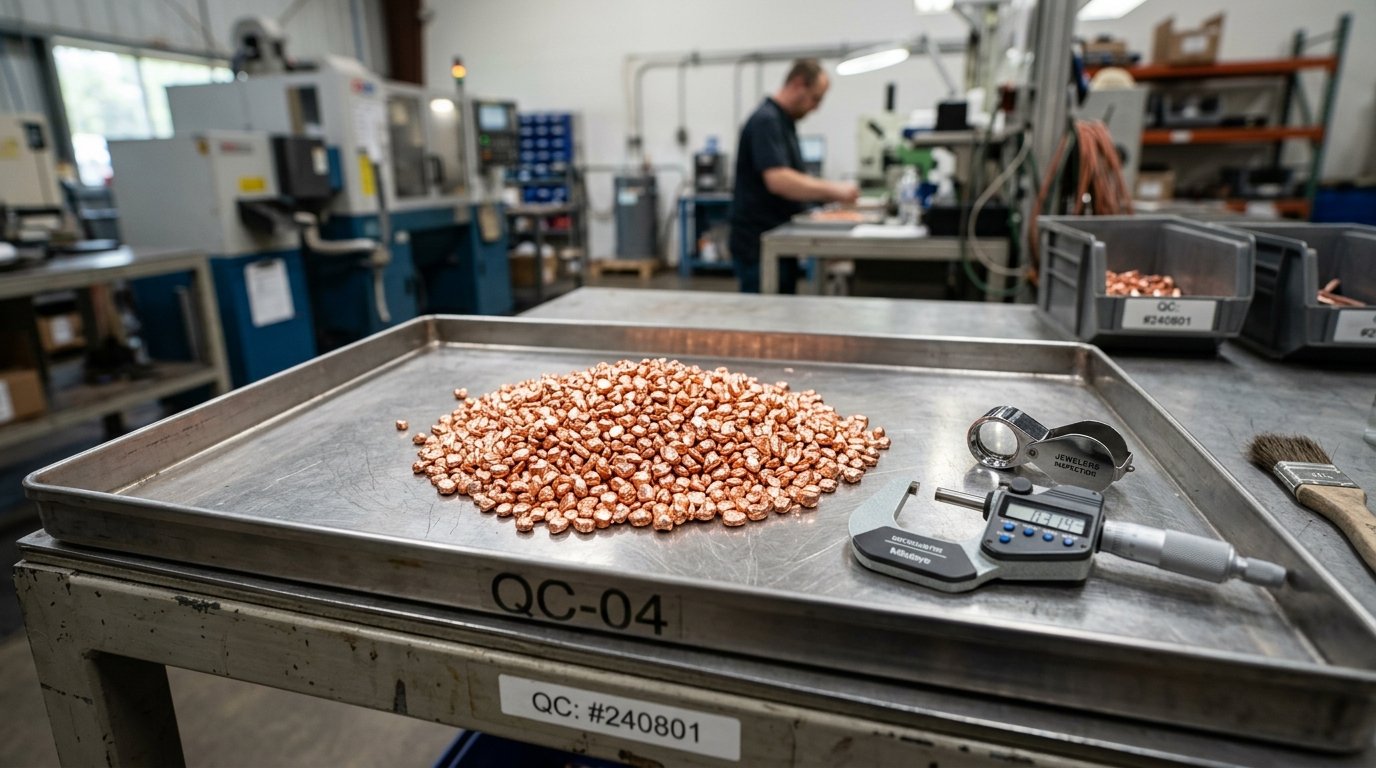
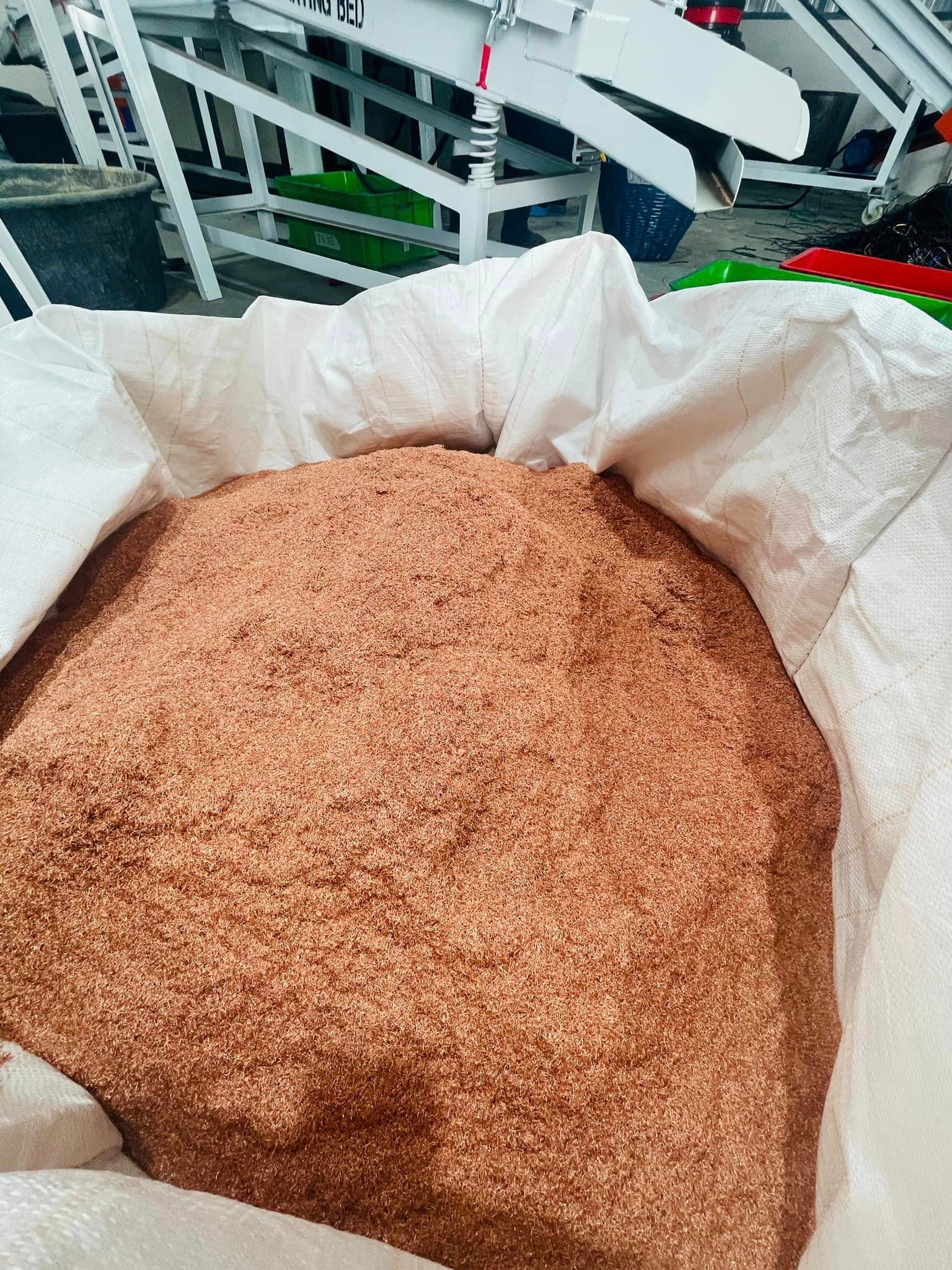
I advise scrap processors to benchmark their output strictly against established commodity grading rules rather than visual inspection alone. Under ISRI Clove specifications, No. 1 copper wire nodules must contain a minimum 99% pure copper, be unalloyed, dry, and free of tin, lead, solder, excess aluminum, and non-metallic polymer contamination.
Deconstructing ISRI commodity standards for chopped copper nodules
In global non-ferrous secondary metals trade, visual appearance is only the starting point for valuation. Commercial transactions rely on grading standards codified in the ISRI Scrap Specifications Circular, published by the Recycled Materials Association. Within these specifications, granulated copper nodules derived from mechanical cable chopping are classified under specific item codes, with “Clove” representing the commercial benchmark for premium No. 1 copper wire nodules.
To qualify as ISRI Clove, material must satisfy five strict metallurgical criteria:
- Minimum 99.0% Copper Purity: The metallic fraction must consist entirely of unalloyed, uncoated copper wire. Modern secondary brass mills and copper tube fabricators increasingly contract for 99.5% minimum Cu content on commercial delivery receipts.
- Clean and Uncoated Surfaces: Granules must originate from clean electrical conductors. The feed cannot contain tinned wire, nickel-plated lead-ins, enameled magnet wire, or lead-sheathed power cables.
- Stringent Non-Metallic Foreign Matter Limits: Total non-metallic material—primarily residual shredded PVC, polyethylene insulation, nylon cord, and dust—cannot exceed 0.10% by dry weight. Higher levels trigger immediate contamination penalties.
- Controlled Particle Size and Bulk Density: Granules should pass cleanly through 10-mesh to 4-mesh sizing (roughly 1.5 mm to 4.5 mm diameter) with minimal fines or tangled wire curls. Bulk density must exceed 3.2 g/cm³ to ensure efficient handling in induction charging hoppers.
- Zero Excess Ferrous Content: Free magnetic iron from steel messenger strands or armor tape must test below 0.05% by mass.
| Quality Tier | ISRI Code | Minimum Cu % | Max Chlorine (Cl) | Permissible Foreign Matter | Realized Payout (% of Spot) |
|---|---|---|---|---|---|
| No. 1 Copper Wire Nodules | Clove | Min 99.0% Cu (Unalloyed, uncoated) | < 50 ppm | Free of excessive non-metallics & fines | 96%–98% of Spot (Indicative) |
| No. 1 Tinned Copper Nodules | Cocoa | Min 99.0% Cu (Max 0.25% Tin) | Max 0.25% Sn | Clean tinned conductors; free of solder | 90%–94% of Spot (Contract-specific) |
| No. 2 Copper Wire Nodules | Cobra | Min 97.0% Cu | Max 0.50% Al, trace Sn | Secondary nodules meeting mutual spec | 86%–90% of Spot (Indicative) |
| Off-Spec / Refinery Feed | N/A | < 97.0% Cu | Elevated halogens / cross-metals | Excessive plastic, aluminum, or moisture | Bilateral toll-smelting or discount |
Note: Commodity grading definitions conform to the official Recycled Materials Association (ReMA / formerly ISRI) Scrap Specifications Circular. Pricing percentages, halogen limits, and foreign matter thresholds represent illustrative commercial benchmarks; actual commercial settlement rules are governed exclusively by individual bilateral sales agreements.
What chlorine and plastic contamination thresholds trigger smelter price deductions?
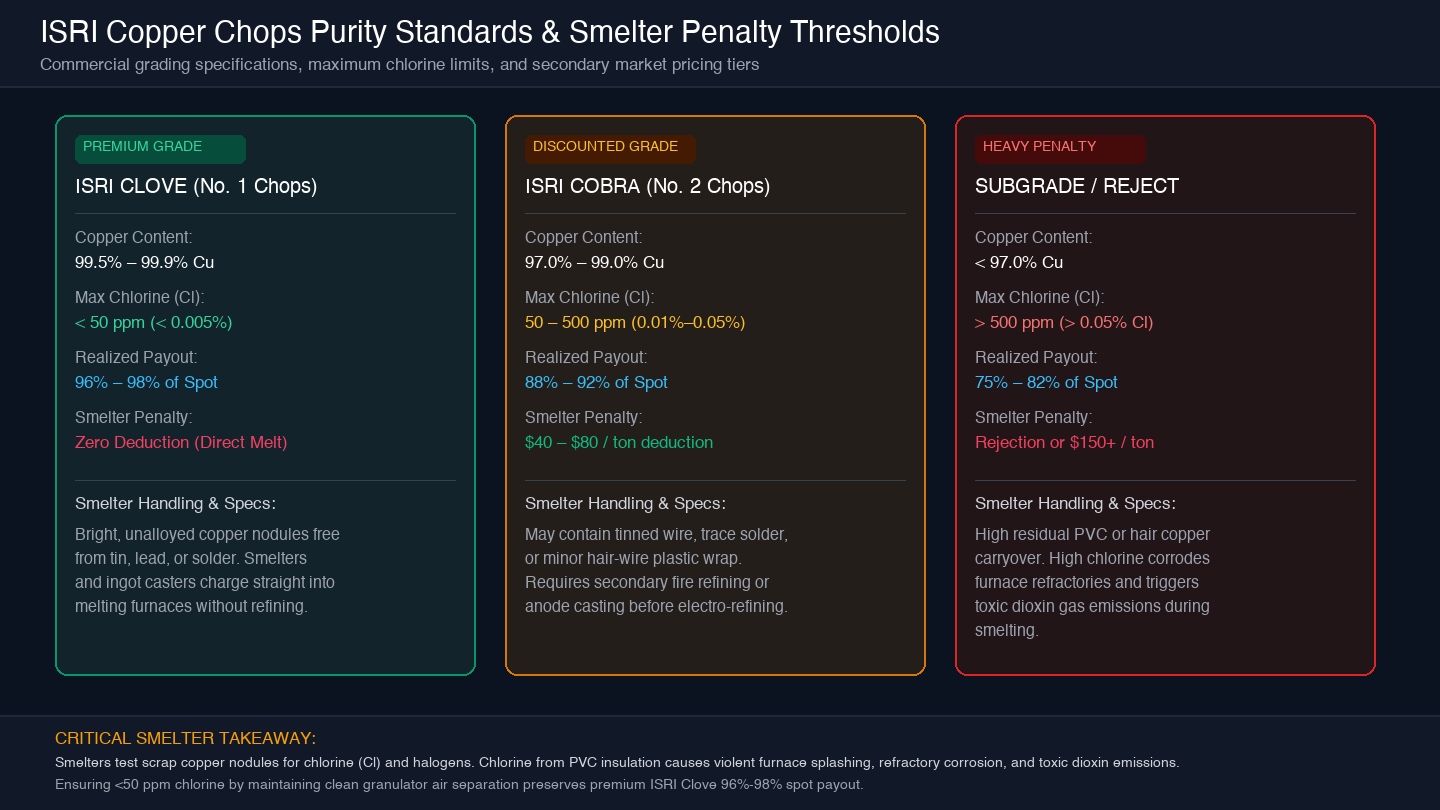
I emphasize that secondary smelting furnaces cannot tolerate halogen compounds because decomposing polymers release corrosive gases during melting. Smelters enforce strict chlorine limits under 50 ppm because burning residual PVC releases hydrogen chloride, causing explosive bath turbulence, slag foaming, refractory brick erosion, and environmental dioxin discharge; exceeding 500 ppm incurs $50 to $150 per ton deductions.
Thermochemical consequences of halogen contamination in molten copper
When a secondary copper smelter, brass foundry, or continuous cast-rod plant charges scrap copper nodules into an induction or gas-fired shaft furnace at 1,150°C to 1,200°C, polymer contamination creates severe operational hazards. As documented in technical guidance by the European IPPC Bureau for Waste Treatment, secondary non-ferrous melting processes operate under stringent environmental emission limits and furnace integrity constraints.
Polyvinyl chloride (PVC), the most prevalent cable insulation polymer, contains roughly 56% elemental chlorine by molecular weight. When residual PVC flakes enter a molten copper bath, three destructive reactions occur:
- Thermal Pyrolysis and Hydrogen Chloride Outgassing: Between 250°C and 350°C, PVC undergoes rapid dehydrochlorination, releasing massive quantities of gaseous hydrogen chloride (HCl). HCl vapor causes violent bath foaming, bath spitting, and pressure spikes inside enclosed melting hoods.
- Refractory Lining Erosion: Gaseous HCl and volatile cuprous chlorides (CuCl) react chemically with alumina-silica and magnesia refractory bricks. This chemical attack strips furnace linings prematurely, turning a routine melt into a $40,000 emergency relining shutdown.
- Dioxin and Furan Synthesis: In the furnace off-gas cooling zone (200°C–450°C), chlorine reacts with aromatic carbon precursors to synthesize highly toxic polychlorinated dibenzo-p-dioxins and dibenzofurans (PCDD/Fs). Smelters face immediate environmental fines or operating permit suspensions if off-gas dioxin concentrations breach regulatory limits.
To safeguard operations, secondary smelters implement automated penalty schedules. While chlorine levels below 50 ppm (0.0050% elemental Cl, corresponding to roughly 0.0088% pure PVC resin equivalent based on 56.8% chlorine in uncompounded PVC) typically incur zero deductions, elevated halogen levels trigger smelter processing surcharges. In illustrative commercial contracts, loads testing between 50 and 250 ppm Cl may incur sample refining charges of $30 to $60 per metric ton, while exceeding 500 ppm triggers severe penalties or outright delivery rejection. Actual deduction schedules vary by individual buyer contract and furnace off-gas abatement capabilities. For operational methods to eliminate polymer flecks from copper streams, review our guide on how to stop copper loss in granulator plastic tailings.
How do brass mills and secondary ingot casters differentiate Berry, Clove, and Cobra grades?
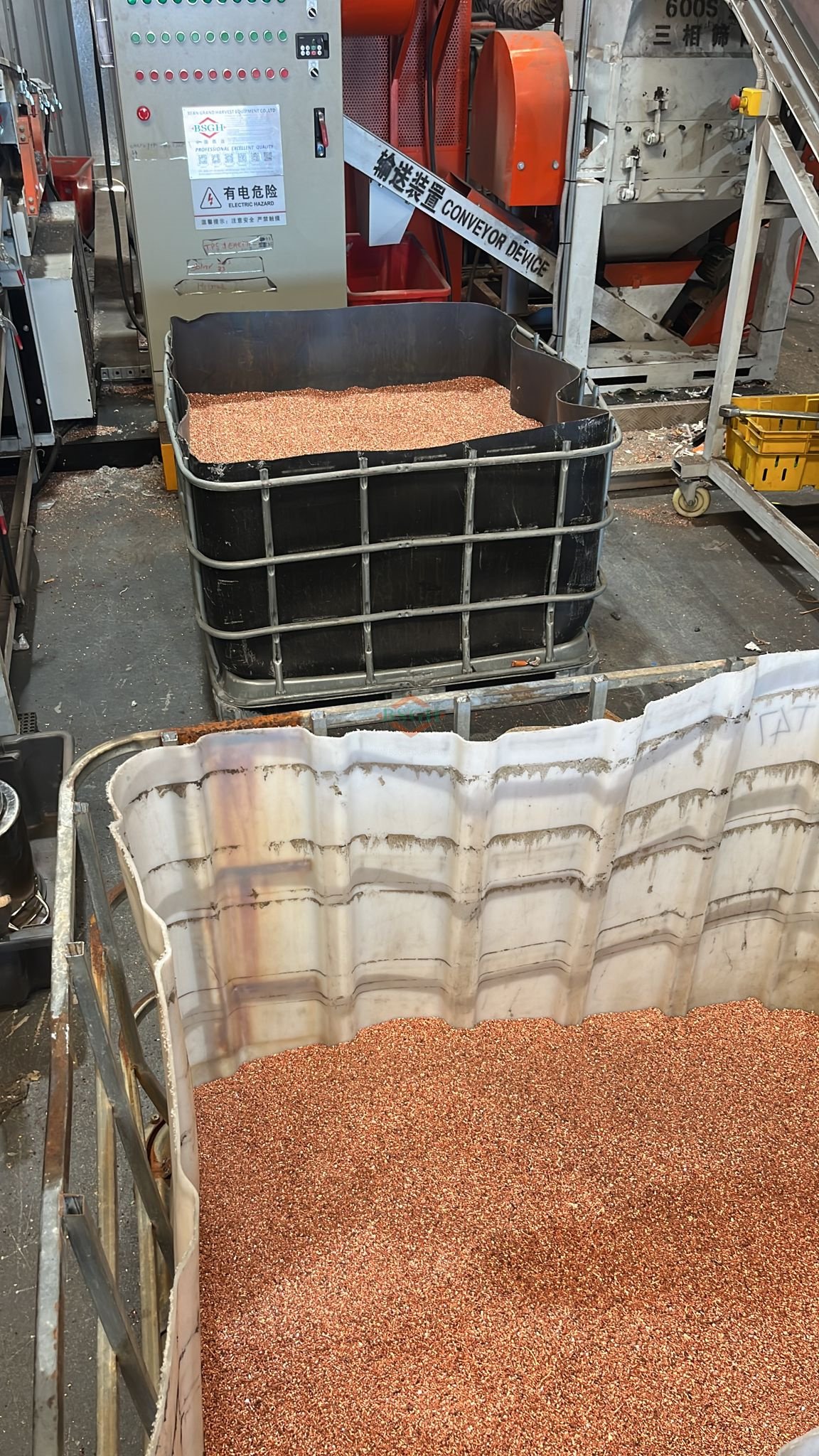
I help recyclers route material to the highest-paying downstream buyer based on individual furnace metallurgy requirements. Berry consists of heavy bare bright stripped wire for direct wire-rod casting; Clove comprises chopped No. 1 nodules for brass ingot foundries; Cobra contains No. 2 tinned or soldered chops requiring fire-refining anodes.
Commercial buyer requirements across the metallurgical spectrum
Not all secondary copper consumers operate the same melting technology. Understanding how different industrial end users classify incoming scrap enables recycling yards to market their granulator output for maximum financial return, as outlined in metallurgical publications by the Copper Development Association.
Three primary commercial buyer categories absorb chopped copper scrap:
- Continuous Cast-Rod Mills (ISRI Berry Consumers): These high-precision facilities manufacture electrical-grade 8 mm copper rod for re-drawing into fine magnet wire and building conductors. They demand 99.95%+ pure electrolytic-grade copper with zero allowable chlorine, oxygen content below 300 ppm, and total metallic impurities under 65 ppm. Continuous casting operations almost exclusively buy stripped No. 1 Bare Bright wire (ISRI Berry) because even minor microscopic non-metallics in chopped wire can cause wire breaks during ultra-fine wire drawing.
- Brass and Bronze Ingot Foundries (ISRI Clove Consumers): These secondary alloy manufacturers produce standard brass ingots (such as CDA 360 free-cutting brass or CDA 836 red brass). Because brass contains zinc, tin, and lead, foundries easily tolerate trace metallurgical alloying elements. However, they require clean, dry No. 1 Clove chops with 99.5% copper content and <50 ppm chlorine to melt directly in induction furnaces without producing porous casting defects or slag inclusion.
- Secondary Smelters and Anode Casters (ISRI Cobra Consumers): These facilities operate primary reverberatory furnaces or converter vessels designed to refine lower-grade copper scrap (ISRI Cobra, No. 2 copper chops, tinned wire, and shredded electronic copper). They accept material with 97% to 99% Cu and up to 500 ppm chlorine because the molten copper undergoes subsequent fire refining and electrolytic refining into 99.99% Grade A cathode. However, they deduct significant tolling charges ($300 to $600 per ton) for the energy and chemical reagents required to refine off-spec scrap.
To analyze how machine investment and purity targets influence net facility profitability, consult our guide on whether a copper wire granulator is worth it for a scrap yard.
How do granulator operators achieve 99.5% copper purity consistently?
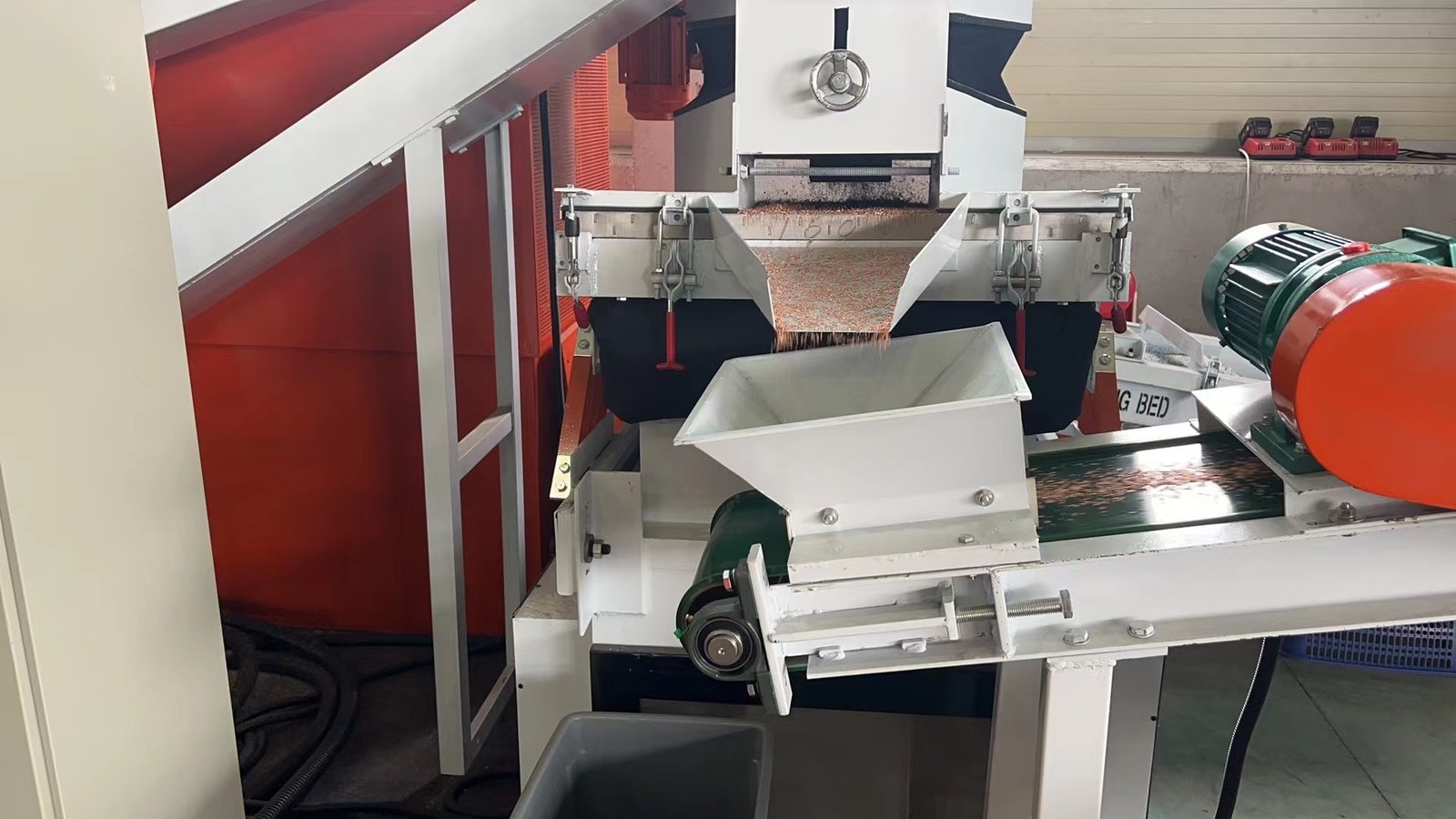
I train recycling operators to use multi-stage screening, magnetic separation, and fluidizing air deck tuning to guarantee Clove quality. Achieving 99.5% copper purity requires maintaining sharp granulator knives with 0.2 mm clearance, installing rare-earth cross-belt magnets to pull tinned steel, fine-tuning air deck fluidization dampers, and running plastic tailings through electrostatic cleaners.
Operational discipline for consistent No. 1 Clove production
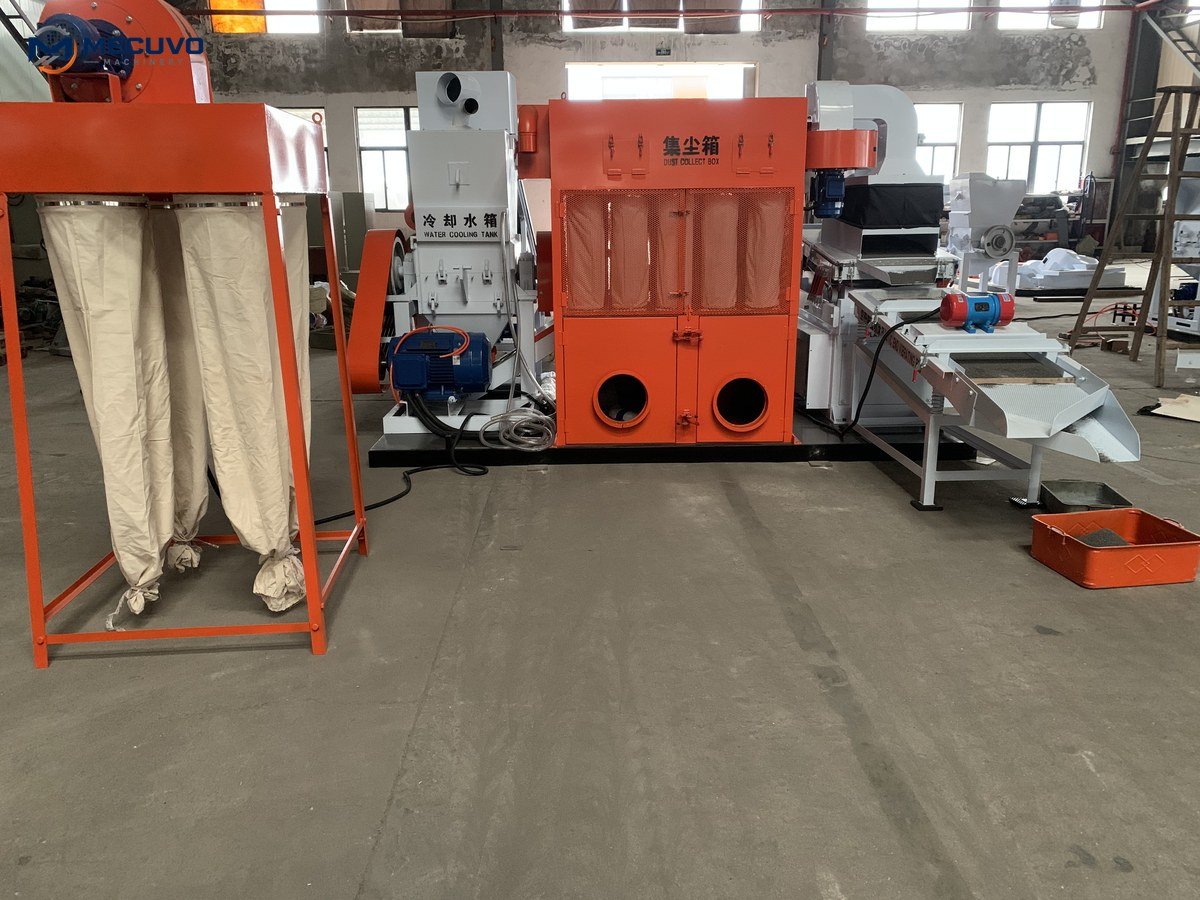
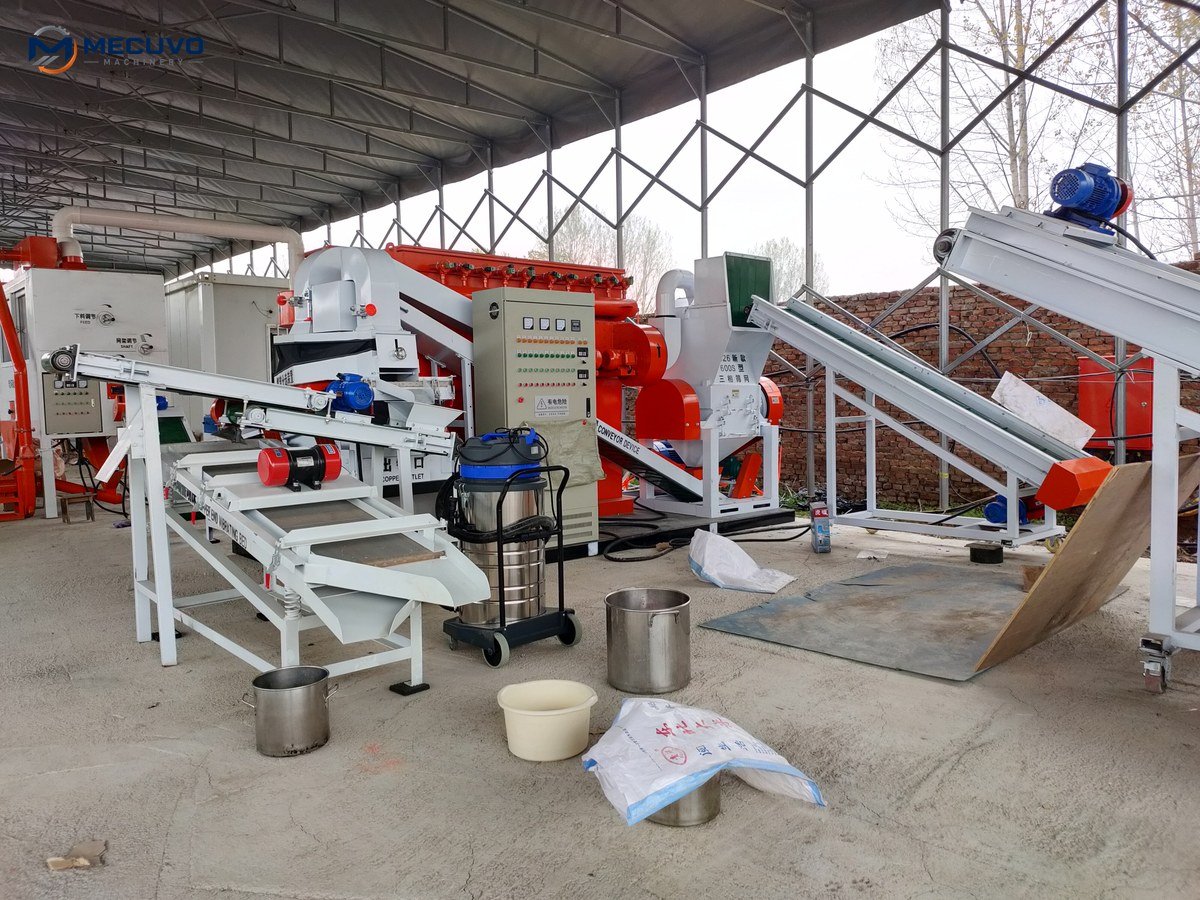
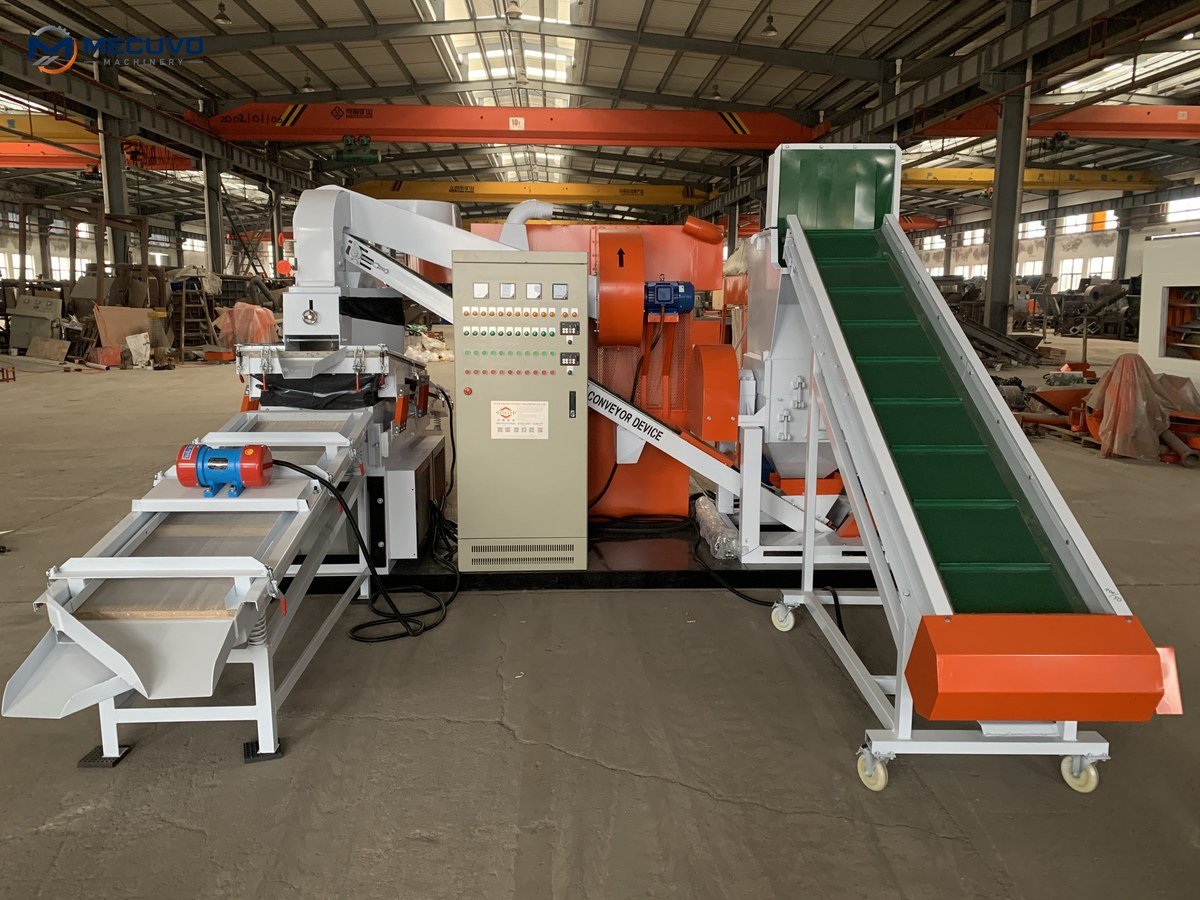
Consistently hitting 99.5% copper purity on commercial granulator lines requires disciplined feedstock management and mechanical calibration. Relying on downstream sorting cannot overcome sloppy upfront processing. When operating MECUVO copper granulator machines, recycling operators maintain peak purity by executing five core standard operating procedures:
- Upfront Infeed Cable Segregation: Never mix contaminated industrial harness feeds with standard building wire. Cables with heavy tinned shielding, steel armor, oil-impregnated paper, or lead jackets should be processed in dedicated secondary campaigns for No. 2 Cobra sales rather than contaminating clean Clove runs.
- Sharp Blade Geometry and Feeler-Gauge Clearances: When cutting knives dull, wire copper is pinched into flat flakes that encapsulate shredded PVC shards. Maintaining sharp D2 or SKD-11 knives with a precise 0.15 mm to 0.20 mm gap ensures clean shearing, allowing copper cores to liberate freely from insulation sleeves.
- Rare-Earth Overband Magnetic Separation: Install high-gradient neodymium cross-belt magnets above the granulator discharge conveyor. This pulls ferrous steel wires, terminal pins, and armored fragments before they enter the vibrating air density table.
- Air-Density Table Fluidization Tuning: Balance deck incline (5°–7°) and fluidizing fan velocity so that copper granules stratify directly against the stainless wire mesh, advancing uphill under eccentric vibration while light PVC fluff floats downhill over the lower weir.
- Routine Screen Aperture Cleaning: Clean separation deck apertures every 4 to 6 operating hours using a soft brass wire brush. A plugged screen creates dead airflow zones, allowing plastic dust to contaminate the clean copper discharge chute.
To balance recovery yield against purity requirements, explore our comprehensive technical framework on copper wire granulator purity vs recovery or contact the MECUVO engineering team for cable test processing and purity verification.
Key Takeaways
Delivering 99.5%+ pure copper chops with chlorine under 50 ppm guarantees top-tier ISRI Clove smelter payouts, protecting $40 to $80 per ton over discounted Cobra grades.
— YOUR RECYCLING PROJECT
Find the right machine for your material.
Tell us your material and required capacity.
Or email sales@mecuvo.com