Table of Content
A clean copper sample can make a granulator look convincing. It does not tell you how much copper stayed in the other outputs.
No. Purity measures the copper share of the collected product. Recovery measures the share of incoming copper captured in that product. A purchasing test needs both figures, the same defined feed batch, and a record of every output stream.
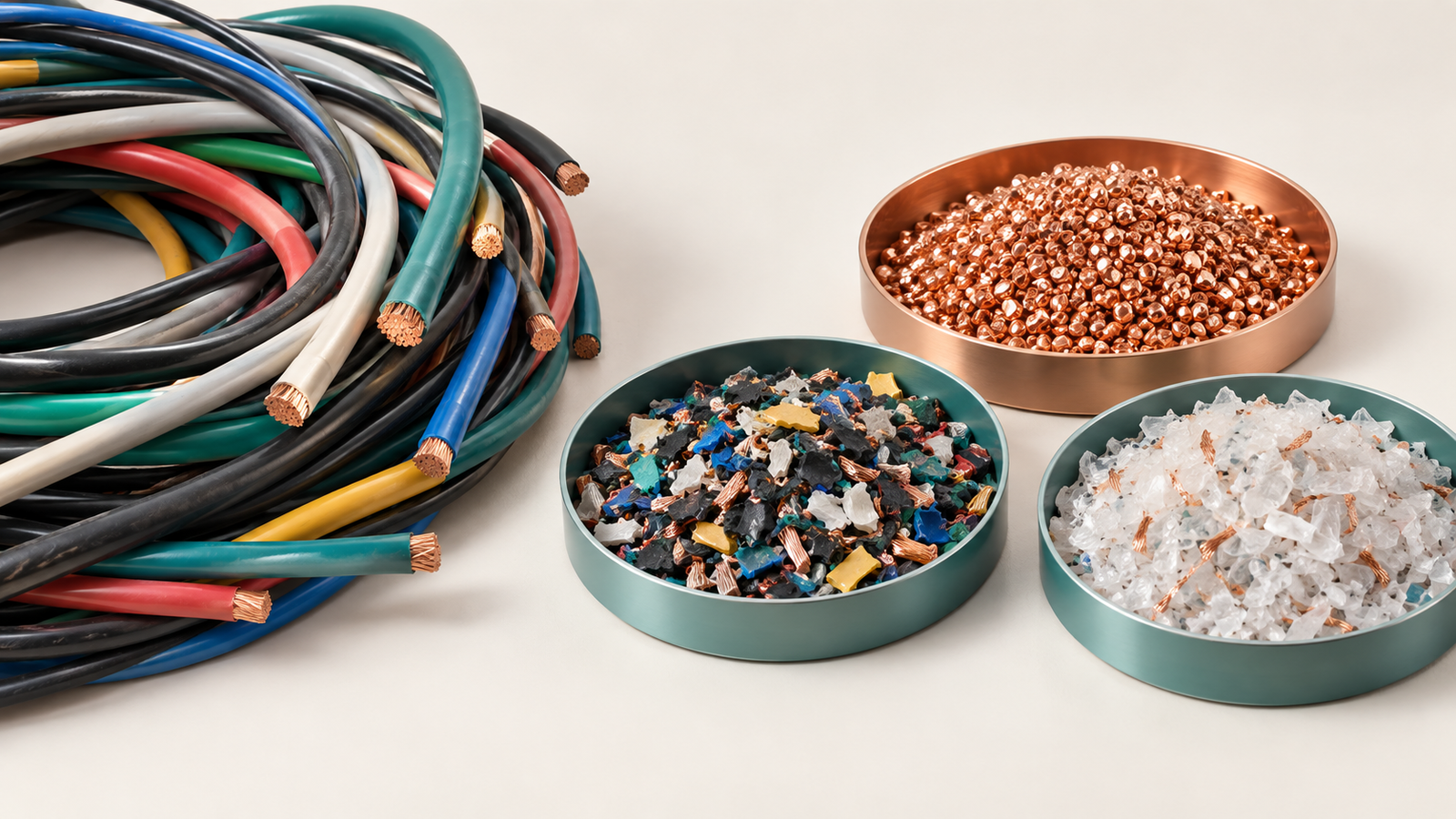
I would compare a trial as a complete batch, not as a photograph of its best sample. Here is how to separate the two numbers, check the calculation, and turn the result into a useful equipment enquiry.
What is the difference between copper purity and recovery?
Two suppliers can both quote 99% and still be describing different results. An undefined percentage makes their offers hard to compare.
Purity divides copper mass in the product by total product mass. Recovery divides copper mass in the defined recovered product by copper mass in the incoming batch. The denominators differ, so neither percentage establishes the other.
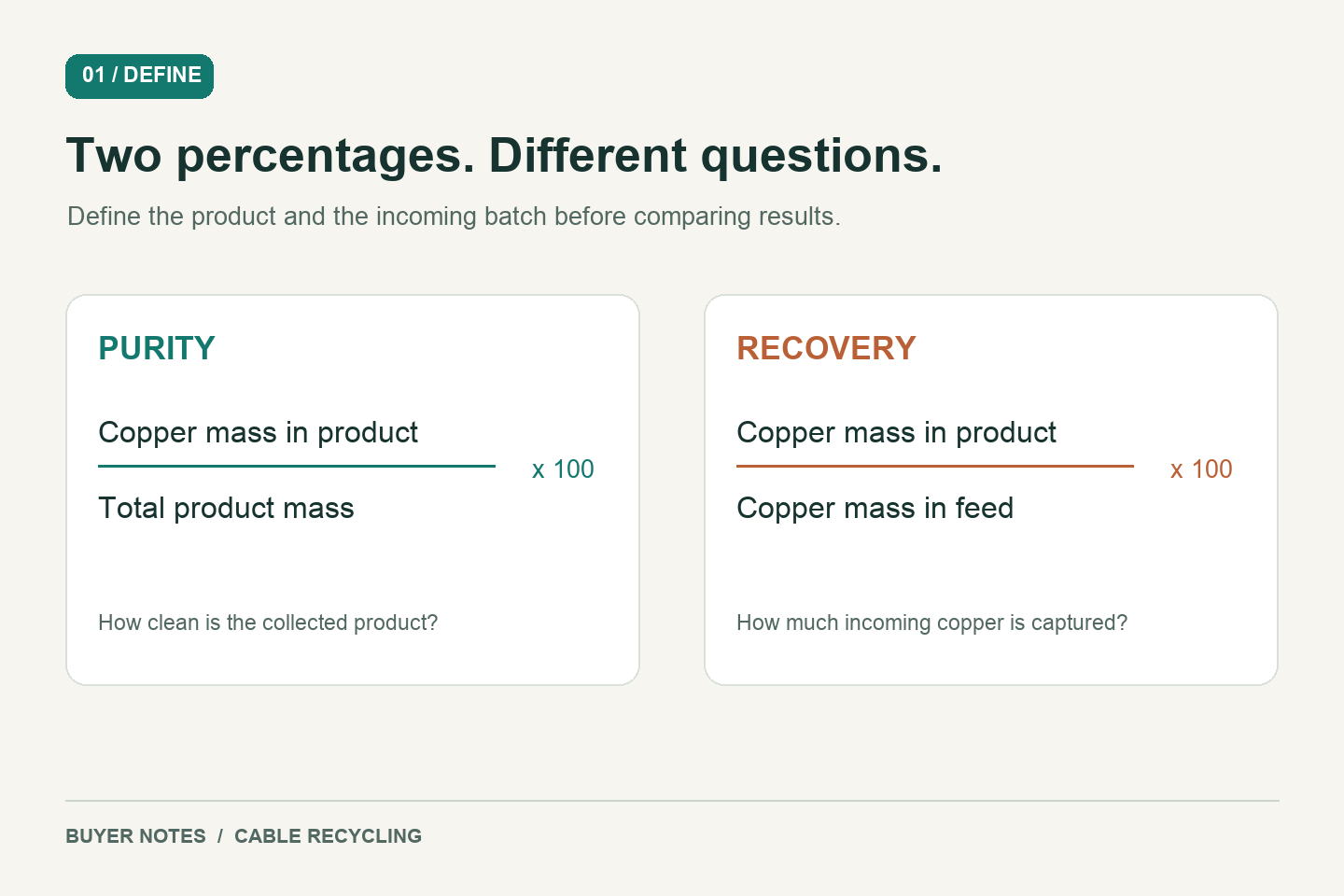
Define the product before comparing percentages
For this guide, the product is the main collected copper fraction. If a supplier includes another saleable metal fraction in recovery, identify it separately and agree the calculation before testing. Copper waiting in a return bin is work in progress; it is not yet finished product.
I use two definitions: purity = copper in the product ÷ total product mass, and recovery = copper in the product ÷ copper in the feed. Multiply each ratio by 100 to express it as a percentage. A third number, product mass divided by feed mass, is the product mass yield. It is not copper recovery because insulated cable contains material other than copper.
Copper can remain outside the main product. A University of Belgrade study of waste-cable electrostatic separation identified conductive, non-conductive and intermediate fractions, with copper also present in the intermediate fraction. This supports checking every output; it does not predict the fraction split of your proposed machine.
The buying implication is simple: ask what the percentage measures, which output it covers, and how composition was measured. Keep input and output measurements on a consistent moisture basis. A visibly clean handful may help identify a problem, but it does not establish the mass composition of a whole batch. EPA's waste-sampling guidance explains why a sample must reflect the average properties of the material it represents. That general principle supports representative sampling; it is not a copper-granulator acceptance standard. Agree the sampling method and acceptance test with the supplier and your intended material buyer.
How do you calculate copper recovery from a trial batch?
Weighing the copper bin is only half the calculation. Without a credible estimate of copper entering the machine, recovery remains unknown.
Multiply the feed weight by its copper content to calculate incoming copper. Multiply the product weight by its measured copper purity to calculate recovered copper. Divide recovered copper by incoming copper, and reconcile the remaining copper across the other streams.
A worked example with explicit assumptions
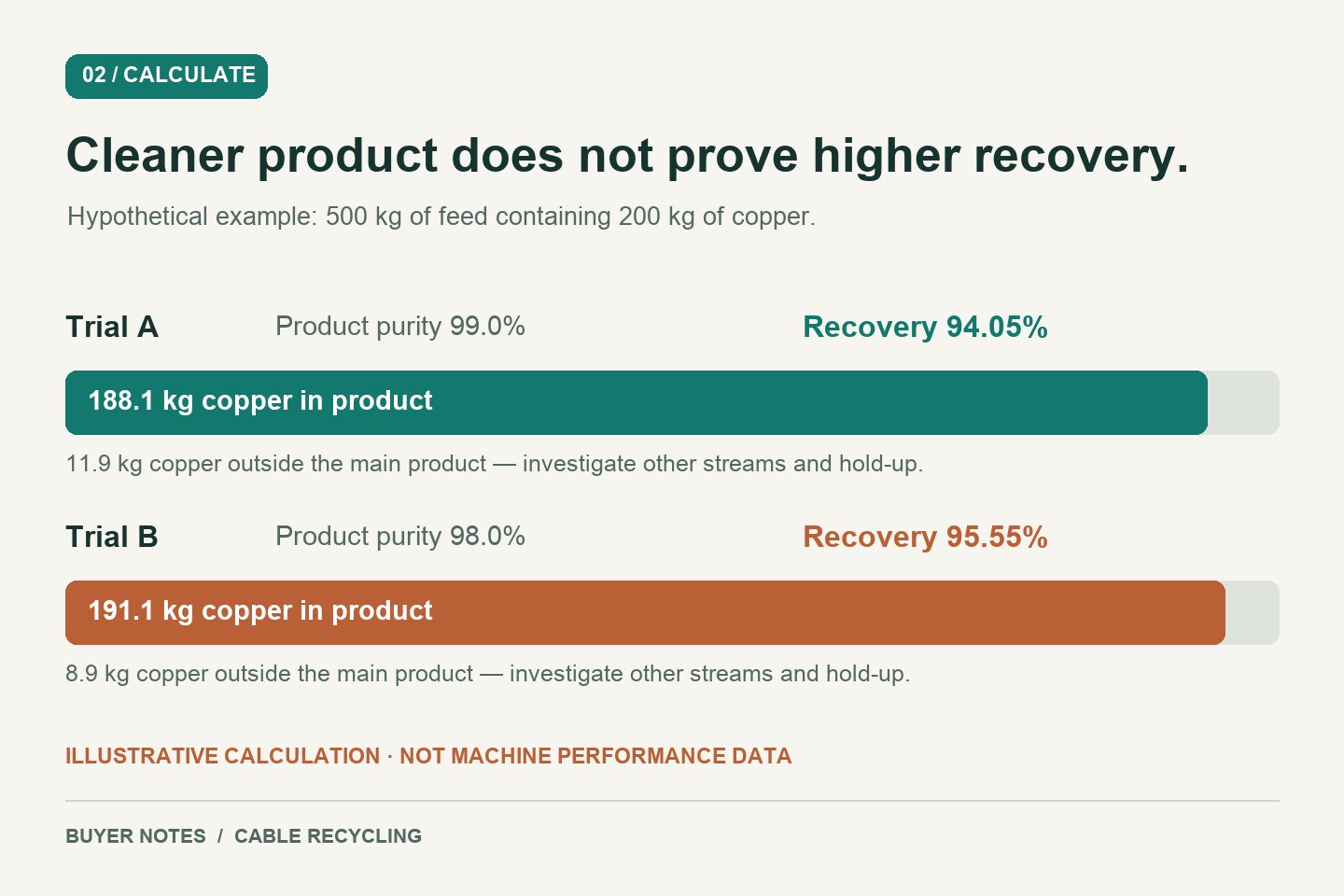
The following figures are hypothetical calculations, not MECUVO test results or industry averages. Assume a 500 kg batch with a measured copper content of 40% by mass, giving 200 kg of incoming copper. Both trials use equivalent feed and the same measurement basis.
| Measurement | Trial A | Trial B |
|---|---|---|
| Feed mass | 500 kg | 500 kg |
| Copper in feed | 200 kg | 200 kg |
| Collected product mass | 190 kg | 195 kg |
| Product copper purity | 99.0% | 98.0% |
| Copper in product | 188.1 kg | 191.1 kg |
| Recovery into main product | 94.05% | 95.55% |
| Copper outside main product | 11.9 kg | 8.9 kg |
Trial A gives 190 × 0.99 = 188.1 kg of copper. Its recovery is 188.1 ÷ 200 = 94.05%. Trial B gives 195 × 0.98 = 191.1 kg, or 95.55% recovery. B captures 3 kg more copper even though its product is less pure. This is a mathematical possibility, not a prediction that lowering purity will improve a particular machine.
Neither result automatically wins. If the buyer rejects B's grade, that extra copper does not make B a suitable operating target. Conversely, a small purity improvement may be unattractive if it sacrifices recoverable copper without earning a sufficient price increase.
The final row is an amount to investigate, not proof that all of it is permanently lost. It may include copper in insulation, intermediate material, collected fines or machine hold-up, along with sampling and measurement differences. Record these separately. The metal-accounting principles discussed in the SAIMM journal emphasize measured mass and metal content, input–output reconciliation, and explicit treatment of in-process inventory. I apply those principles here as a measurement framework, not as a machine certification. Do not silently count retained material as recovered, or assign every difference to plastic without checking.
Feed composition is often the hardest input to establish. The recovery calculation is only as credible as the batch sampling and copper-content estimate behind it. If that estimate is unavailable, report product mass and measured purity while leaving recovery unverified.
What should a copper granulator acceptance test include?
A brief run on easy cable may not represent your normal workload. Missing outputs and unrecorded reruns can make a demonstration look better than daily operation.
Agree the feed mix, preparation, sampling method, product grade, recovery definition and timing boundary before the trial. Weigh every output, record return material and reruns, and measure throughput while the output meets the agreed quality target.
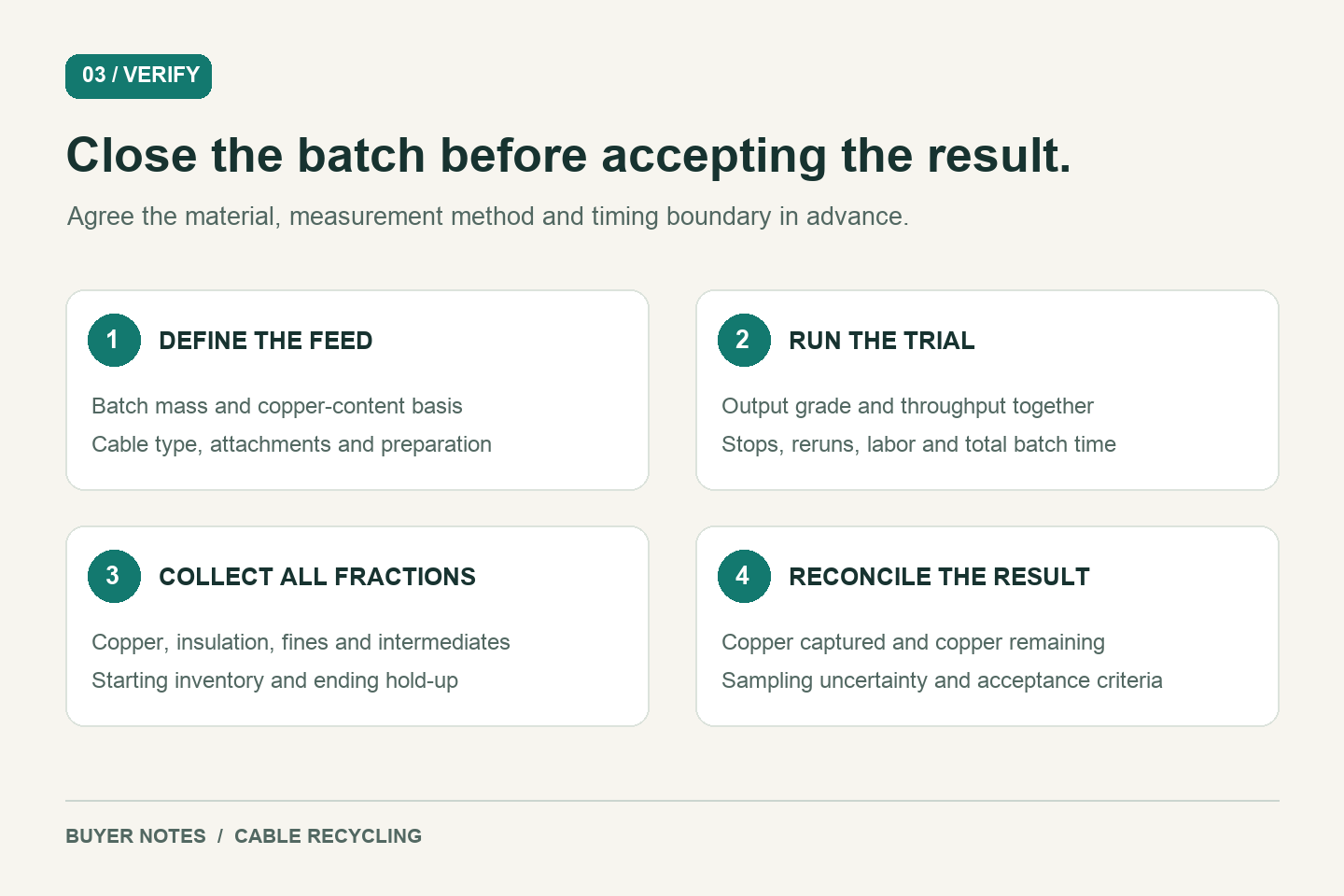
Measure the boundary of the job you are buying
Start with your regular cable supply. Describe conductor construction, fine strands, insulation, attachments and material condition. Keep unusual or excluded material separate. A trial on one prepared feed type supports a decision about that feed; it cannot establish performance on every mixed load your yard might receive.
Record the feed condition and preparation used in the trial. Keep the stated process route with the result so that you can compare it with the quoted configuration. If the demonstration includes preparation or repeated passes that your planned workflow does not include, ask for a test on the intended basis before treating its output as representative.
Before the run, agree how you will account for material already in the equipment and material remaining after the test. Use suitable scales, consistent tare weights, and labeled collection containers. Keep the main product, insulation, intermediate material and collected fines identifiable. Sampling must reflect the output stream rather than only its cleanest visible portion.
| Test item | Record | Purchasing question it answers |
|---|---|---|
| Incoming feed | Weight, composition basis, preparation | Was this representative of our supply? |
| Main copper product | Weight, composition method, grade | Will our buyer accept it? |
| Other fractions | Weight and copper assessment | Where did the remaining copper go? |
| Return material | Starting and ending amounts, rerun time | Is recovery dependent on additional work? |
| Time and resources | Defined run time, preparation, stops, labor | Can the workflow clear our workload? |
Residual copper may justify further investigation. A study archived by the University of Trieste examined further copper recovery from electrical-cable recycling tailings. It investigated physical and electrochemical treatments; its findings cannot establish the performance of a conventional dry granulator. Assess your measured residue composition and processing costs before deciding whether additional treatment is worthwhile.
Set acceptance criteria in the quotation or trial agreement. Include the cable range, measurement method and treatment of reruns. Ask for product quality and input throughput from the same operating condition; combining the best grade from one run with the fastest rate from another would not describe a demonstrated operating point.
Is a copper granulator profitable?
Higher recovery can improve the opportunity, but it cannot settle the investment decision. Product pricing, preparation and the alternative sale of insulated cable still matter.
A granulator can be profitable when the realizable value of its outputs exceeds the value of selling the same cable as-is plus processing and ownership costs. Use local buyer quotes, measured batch results and realistic operating time; purity alone cannot establish the margin.
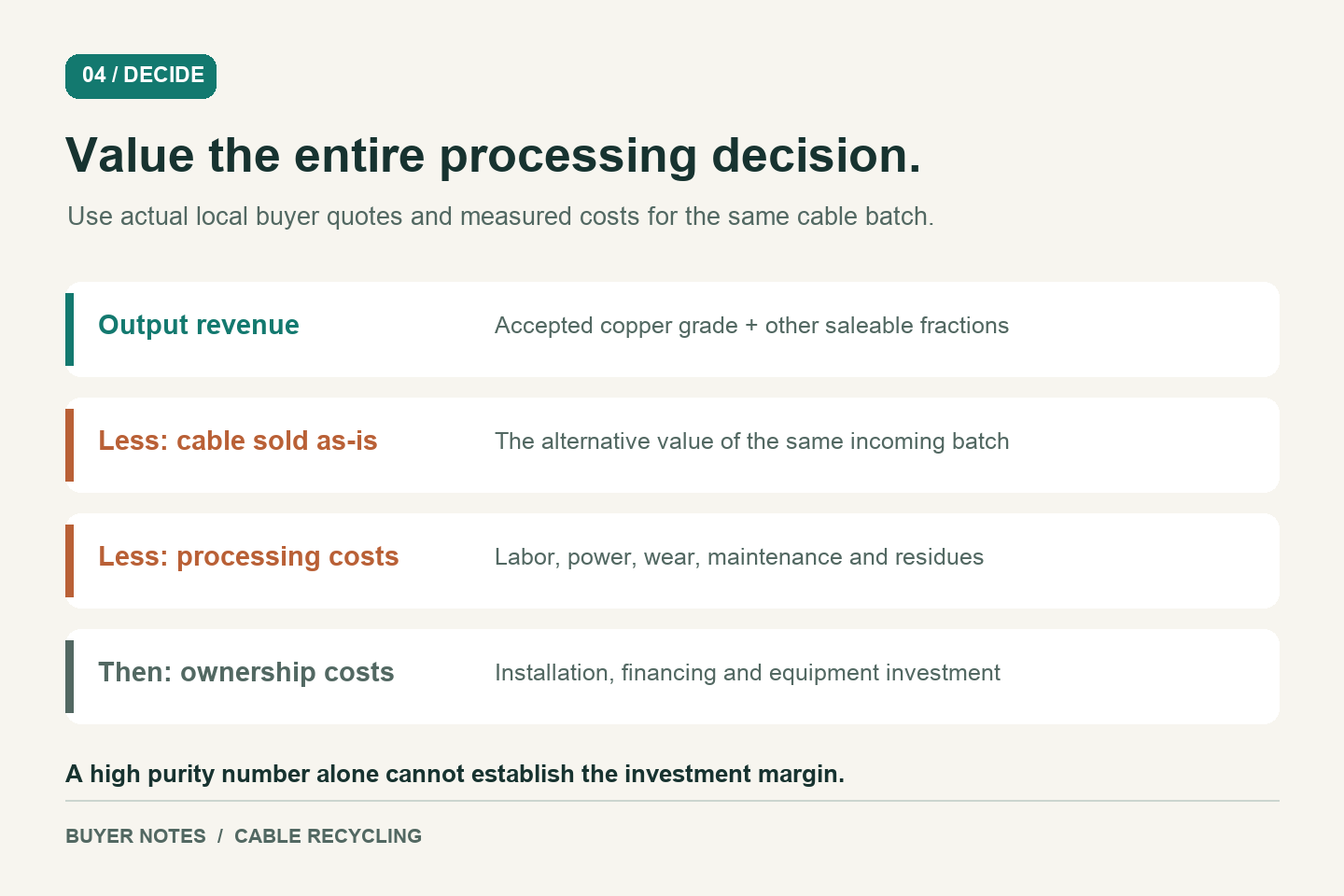
Price the accepted outputs, not an attractive percentage
Return to the hypothetical trials. If both products are accepted, compare 190 × the buyer's price per kg for A's product with 195 × the price per kg for B's product. With equal processing costs and no other revenue differences, B matches A's product revenue when its price is 190 ÷ 195, or about 97.44%, of A's price. A discount greater than about 2.56% would erase B's product-revenue advantage in this example.
This uses a price for each kilogram of the actual product. Do not also multiply that price by purity unless the buyer's pricing formula explicitly requires it; doing both can count the same quality adjustment twice. If the buyer pays for contained copper instead, use that contract's deductions and payable-metal basis consistently.
Now compare processing with selling the original cable. Start from output revenue actually available to your business, subtract the as-is value of the same feed, then subtract labor, electricity, wear parts, maintenance, residue handling and any extra processing. Do not assign a positive value to insulation without a buyer and an accepted specification. Ownership and installation costs belong in the wider investment calculation.
I would also check usable production time. A test that needs repeated passes may recover more copper but consume capacity needed for the next batch. Report the total batch time and remaining intermediate inventory alongside the recovery figure. A good decision balances accepted grade, copper captured and completed work.
For a specific equipment discussion, review MECUVO's copper wire granulator options and send your cable details. Ask about a representative-material trial, the proposed configuration and a quotation with included stages listed separately. Trial scope, availability, charges and sample shipping arrangements need to be agreed before sending material.
Conclusion
Compare the same feed, all outputs, and total processing time. Accept a granulator against a defined product grade and measured recovery, then check the economics.
— YOUR RECYCLING PROJECT
Find the right machine for your material.
Tell us your material and required capacity.
Or email sales@mecuvo.com