Table of Content
Machinery manufacturers routinely pitch ‘99.9% copper recovery with zero metal loss’, but scrap yard owners often discover significant copper pellets discarded into their plastic regrind dumpsters. A true engineering audit debunks zero-loss claims by accounting for dust abrasion, hair-wire aerodynamic lift, and screen fines; on complex wire, achieving a verifiable 99.8% recovery rate requires a mass-balance reconciliation audit and secondary electrostatic separation. This technical guide explains how to calculate true mass balances, conduct accredited laboratory assays on plastic tailings, and protect your commercial profits with verifiable recovery guarantees.
Why are ‘100% zero copper loss’ claims physically impossible?
I examine the physics of mechanical size reduction, micron copper dust generation, and aerodynamic air table dynamics. Mechanical blade shearing inevitably pulverizes 0.2% to 0.4% of copper into microscopic dust captured in pulse-jet filters, while hair-thin strands (<0.2 mm) float across standard air tables unless captured by electrostatic sorters.
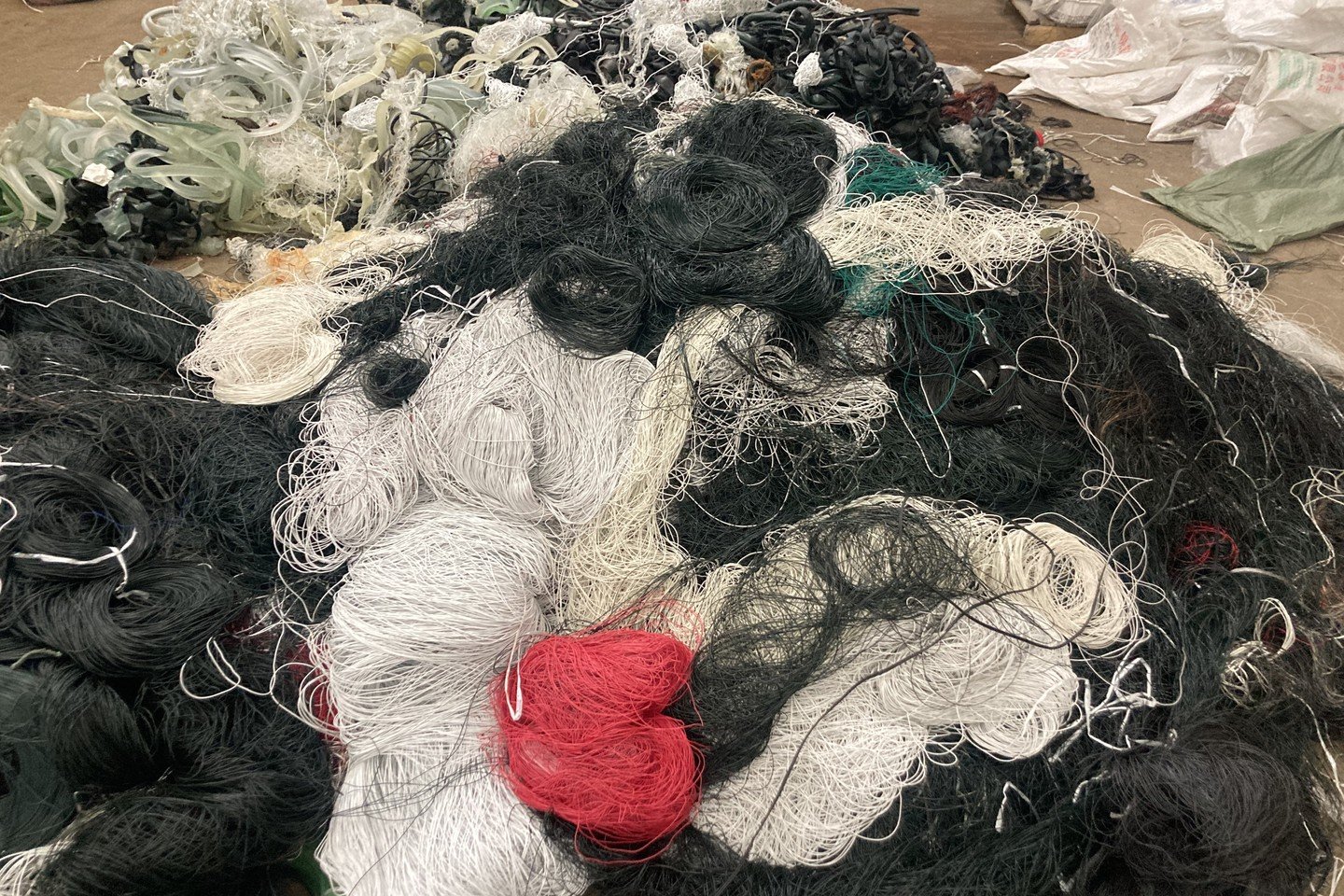
Mechanical attrition fines, cyclone aspiration losses, and aerodynamic terminal velocity
Sales brochures claiming ‘zero copper loss’ violate basic physics:
- Mechanical Attrition & Micron Dust: When high-speed rotating knives shear copper wire against bed blades at 550 RPM, micro-abrasion can generate fine copper dust smaller than 50 microns. In commercial operations processing fine wire, pneumatic suction conveys a portion of these metallic fines into the cyclone and pulse-jet dust baghouse, typically accounting for an estimated 0.2% to 0.4% of metallic throughput depending on wire gauge and screen aperture.
- Aerodynamic Hair-Wire Float: In complex cables like Category 6 network wire or automotive harness assemblies, copper conductors consist of hair-thin strands measuring 0.10 mm to 0.18 mm. When chopped, their high aerodynamic drag can cause an estimated 1.5% to 3.5% of micro-strands to ride fluidizing air over the plastic discharge lip on standard air tables.
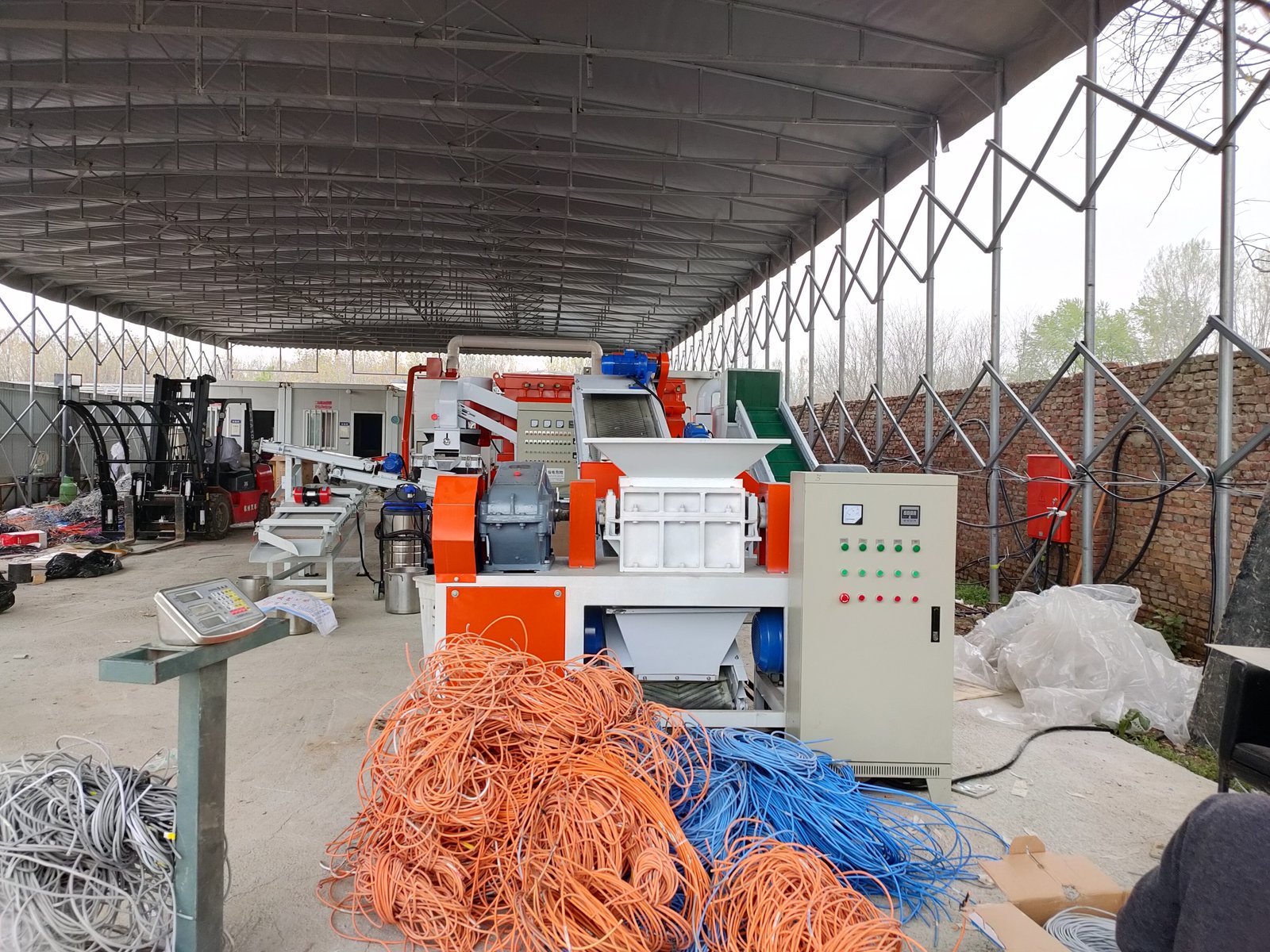
- The Honest Commercial Benchmark: A standard gravity air table alone typically achieves 96.5% to 98.0% recovery on mixed wire. Achieving a true 99.5% to 99.8% recovery on fine-wire feeds requires adding a secondary high-voltage electrostatic separator to extract sub-millimeter copper from the plastic regrind stream.
How do you conduct a rigorous mass-balance reconciliation audit?
I provide the exact engineering mass-balance formula used to audit recycling plant recovery efficiency. Execute a mass-balance test by hand-stripping a 5 kg baseline sample to find theoretical copper content, processing 500 kg of cable, and weighing heavy nodules, electrostatic fines, and cyclone dust against initial inputs.
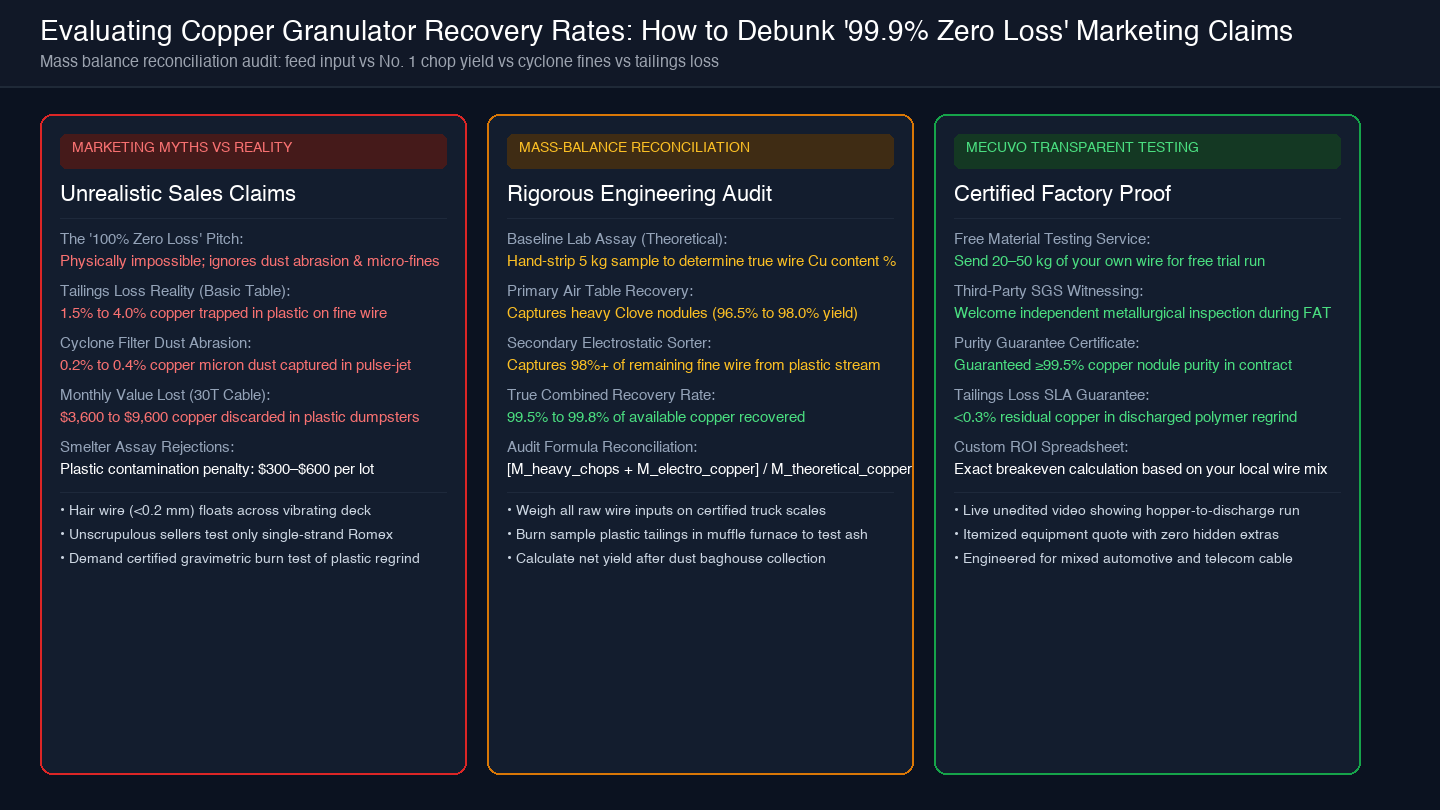
Mass-balance audit formula, sample hand-stripping baseline, and certified truck scale weighing
To audit any granulator’s true performance, follow this rigorous protocol:
- Theoretical Copper Baseline ($Y_{theo}$): Take a representative 5.00 kg sample of incoming scrap cable. Carefully hand-strip the jackets using manual wire strippers and weigh the bare copper on a precision digital scale:
- The 500 kg Processing Run: Run a certified 500 kg batch of the identical wire lot through the granulator under steady-state operating temperatures.
- Reconciliation Mass Weighing: Weigh the three recovery streams:
- The True Recovery Rate Equation:
How do you test plastic tailings for hidden copper contamination?
I describe the accredited laboratory assay approach that accurately reveals copper entrained in plastic tailings. Representative regrind samples must be tested by an accredited analytical laboratory using professional loss-on-ignition in scrubber-equipped furnaces or acid digestion with optical/spectrometric analysis, verifying residual copper in tailings remains strictly below agreed thresholds.
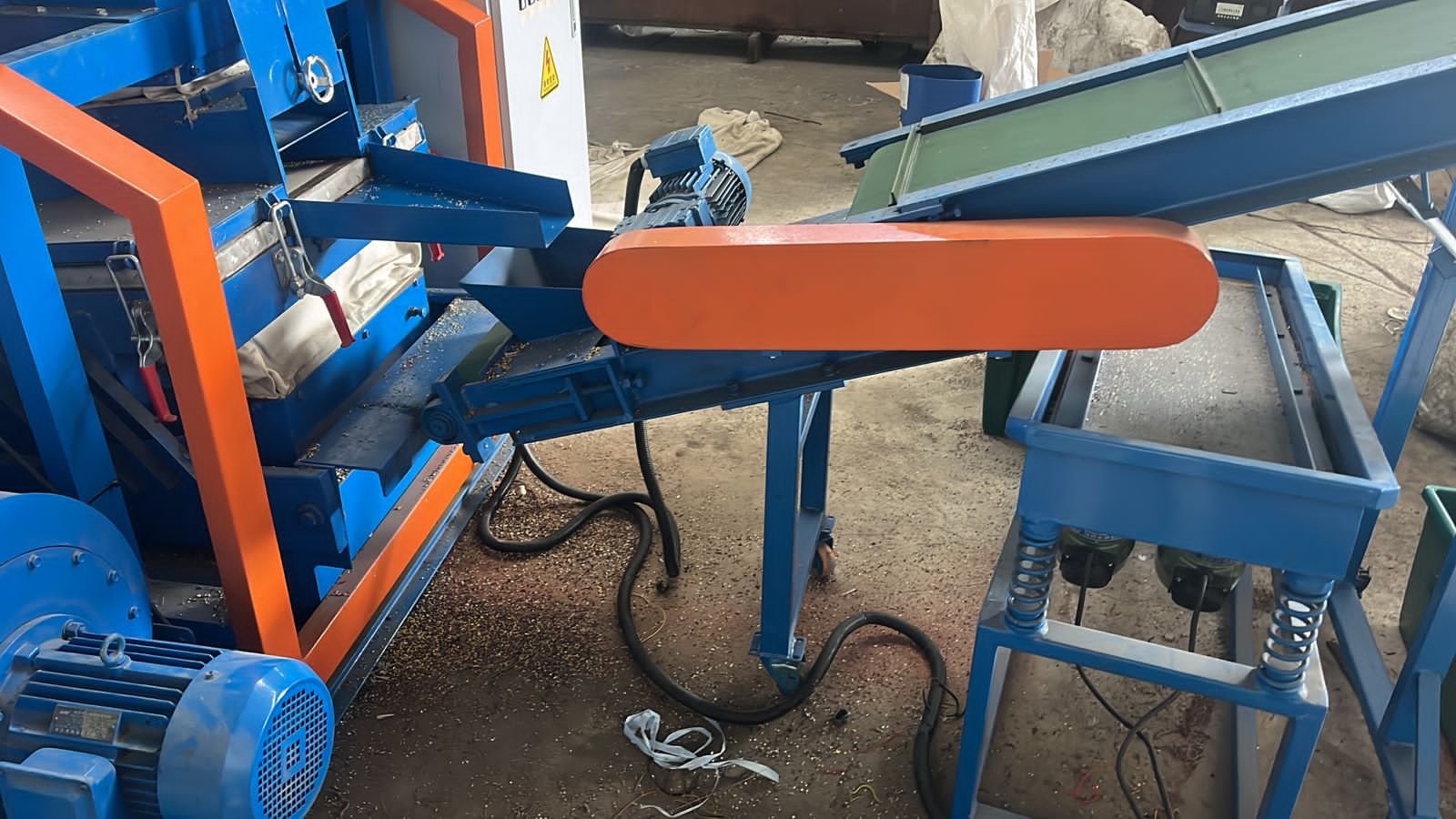
Accredited laboratory assay, controlled loss-on-ignition, and residual metal verification
Visual inspection of plastic tailings is deceptive; fine copper is often enveloped inside melted polymer crumbs:
- Accredited Analytical Laboratory Protocol: Do not attempt uncontrolled burning in yard workshops. Heating PVC, rubber, and cross-linked polyolefin insulation releases hazardous hydrogen chloride (HCl) gas, toxic chlorinated fumes, and volatile decomposition products (see HSE Guidance PPIS13 on controlling plastics processing fumes). Furthermore, standard ash methods such as ASTM D5630 explicitly exclude halogenated polymers and measure non-combustible mineral fillers (calcium carbonate, silica) rather than identifying pure metallic copper. Submit representative 1 kg composite tailings samples to an accredited testing laboratory equipped with fume-scrubbed furnaces, acid digestion, and analytical balances.
- Interpreting Tailings Residual Copper: The testing laboratory quantifies metallic copper residue through selective digestion or standardized optical and density separation. If residual copper in the plastic tailings exceeds 0.25% by sample weight (0.25 g copper per 100 g plastic regrind), the granulator separation system requires screen realignment, air volume rebalancing, or secondary electrostatic finishing.
How can buyers demand contractual performance guarantees?
I explain how to bind manufacturers to enforceable recovery rate SLAs in purchase orders. Incorporate a written Performance Guarantee Appendix into your purchase contract stipulating minimum 99.5% recovery on agreed scrap categories, backed by a 10% payment holdback until FAT verification.
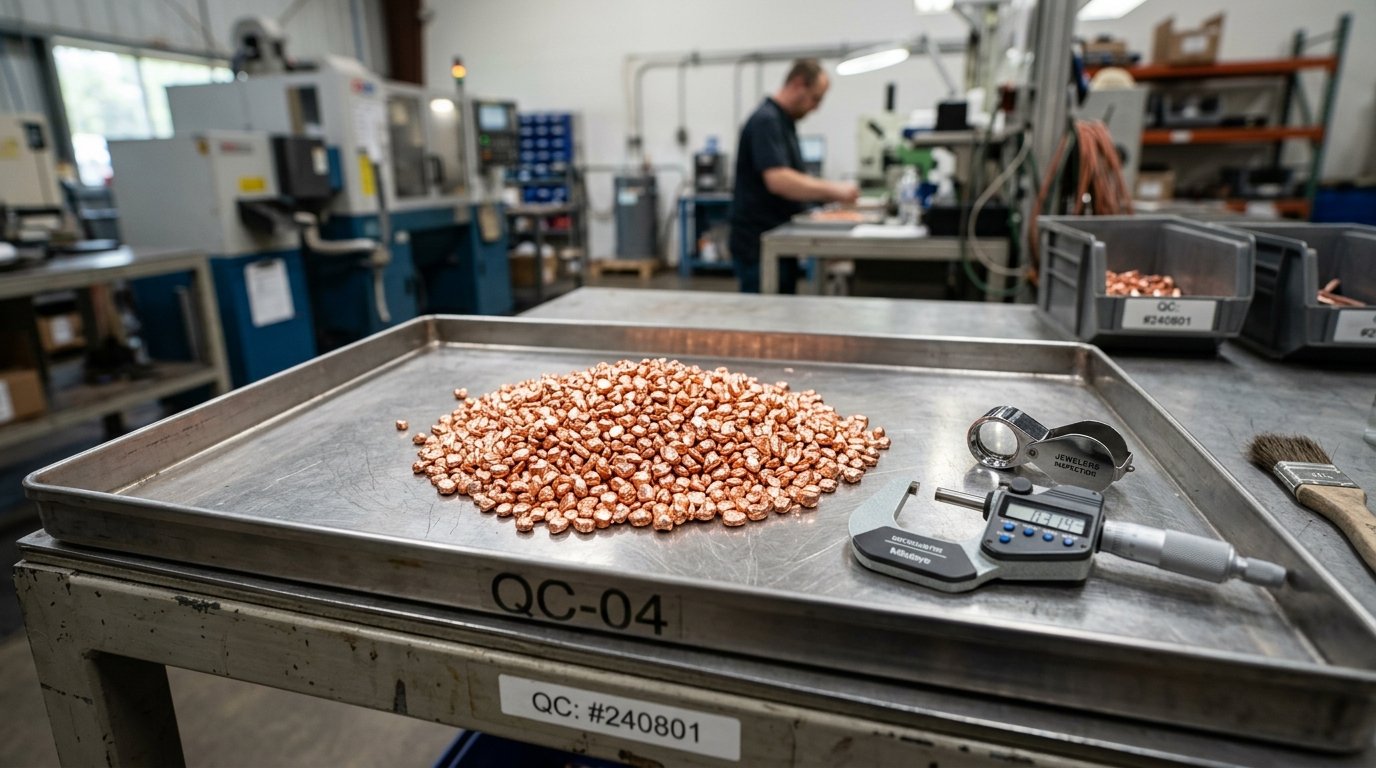
Performance Service Level Agreements (SLAs), commissioning milestone payments, and sample testing
Do not rely on verbal assurances or glossy sales brochures:
- The Contractual Recovery SLA: Require this clause in your commercial purchase agreement: ‘Manufacturer guarantees that the equipment will achieve a minimum copper recovery rate of 99.5% by weight of available metal, and clean copper nodule purity of ≥99.8% (exceeding the standard ReMA/ISRI Clove specification minimum of 99.0% copper content), when processing target cables defined in Exhibit A.’
- Enforceable Pre-Shipment & Commissioning Testing: Tie final commercial acceptance to verified performance: a pre-shipment Factory Acceptance Test (FAT) on your representative cable material, followed by release of the remaining milestone payment (typically 10%) upon on-site commissioning verification.
Verify Your Copper Recovery with MECUVO
- Free Factory Sample Testing: Send 20–50 kg of your scrap wire to MECUVO. We will perform a complete mass-balance test on video, provide an accredited laboratory assay of the plastic tailings, and prove recovery yields before you buy.
- Custom ROI & Payback Spreadsheet: Contact MECUVO engineering to calculate your exact financial returns from eliminating fine copper losses in plastic.
- Direct Factory Price & Spec Sheet: Review turnkey systems featuring closed-loop density tables and secondary electrostatic sorters on the MECUVO copper granulator machines overview page.
Key Takeaways
Disregard ‘100% zero loss’ marketing hype; audit granulators using rigorous mass-balance formulas and accredited laboratory tailings assays, and demand contractual 99.5%+ recovery SLAs backed by electrostatic separation.
— YOUR RECYCLING PROJECT
Find the right machine for your material.
Tell us your material and required capacity.
Or email sales@mecuvo.com