Table of Content
I see many scrap yard owners hesitate between selling insulated copper wire as-is to brokers or investing tens of thousands of dollars into an on-site granulator line.
A copper wire granulator can be economically viable when a scrap yard processes sufficient recurring wire volume (modeled at four to six tons monthly in our baseline $28,000 scenario, indicating an estimated capital recovery in 6.3 to 9.5 months). However, actual breakeven depends on facility fixed costs, local electrical rates, financing terms, and market scrap spreads; this represents an illustrative sensitivity model rather than an earnings guarantee.
Below, I break down the commercial margin spread, worked breakeven arithmetic, operating expense realities, and wire category selection rules.
What determines the profitability of a copper wire granulator?
I advise recyclers never to evaluate equipment profitability based purely on daily copper commodity prices on financial tickers.
Granulator profitability depends on the margin spread between the discounted purchase price of raw insulated wire and the realized selling price of clean No. 1 copper chops, minus direct operating costs per ton.
Understanding the raw wire discount spread
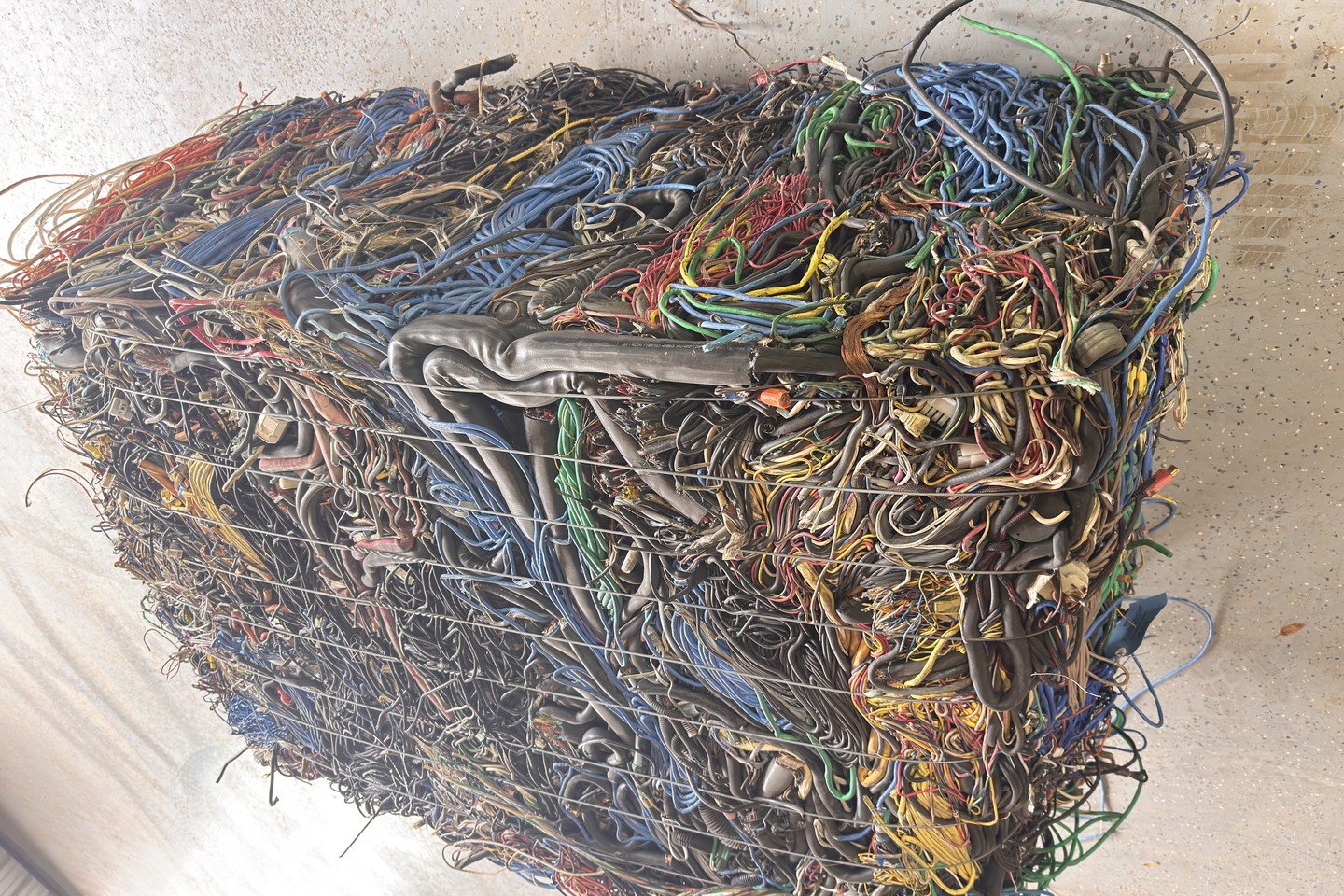
When a scrap yard sells raw insulated copper wire (ICW) to downstream exporters or industrial processing hubs, it surrenders a significant portion of the intrinsic metal value. According to commercial grading benchmarks defined in the ISRI Scrap Specifications Circular, scrap cables classified under categories such as "Druid" (insulated copper wire) are traded at substantial discounts relative to clean copper nodules classified as "Clove" (No. 1 copper chops with a minimum 99% copper content).
Middleman buyers discount raw cable for two unavoidable reasons: freight costs on heavy, bulky plastic insulation and the commercial tolling margin required to process the material. For typical #2 insulated wire yielding approximately 50% copper by weight, a broker discount frequently deducts 20% to 30% from the contained metal value. If refined copper trades at $4.00 per pound, a ton of 50% wire contains $4,000 worth of copper, yet middleman offers often cap out around $2,800 to $3,000 per ton. The remaining $1,000 to $1,200 represents the gross processing spread.
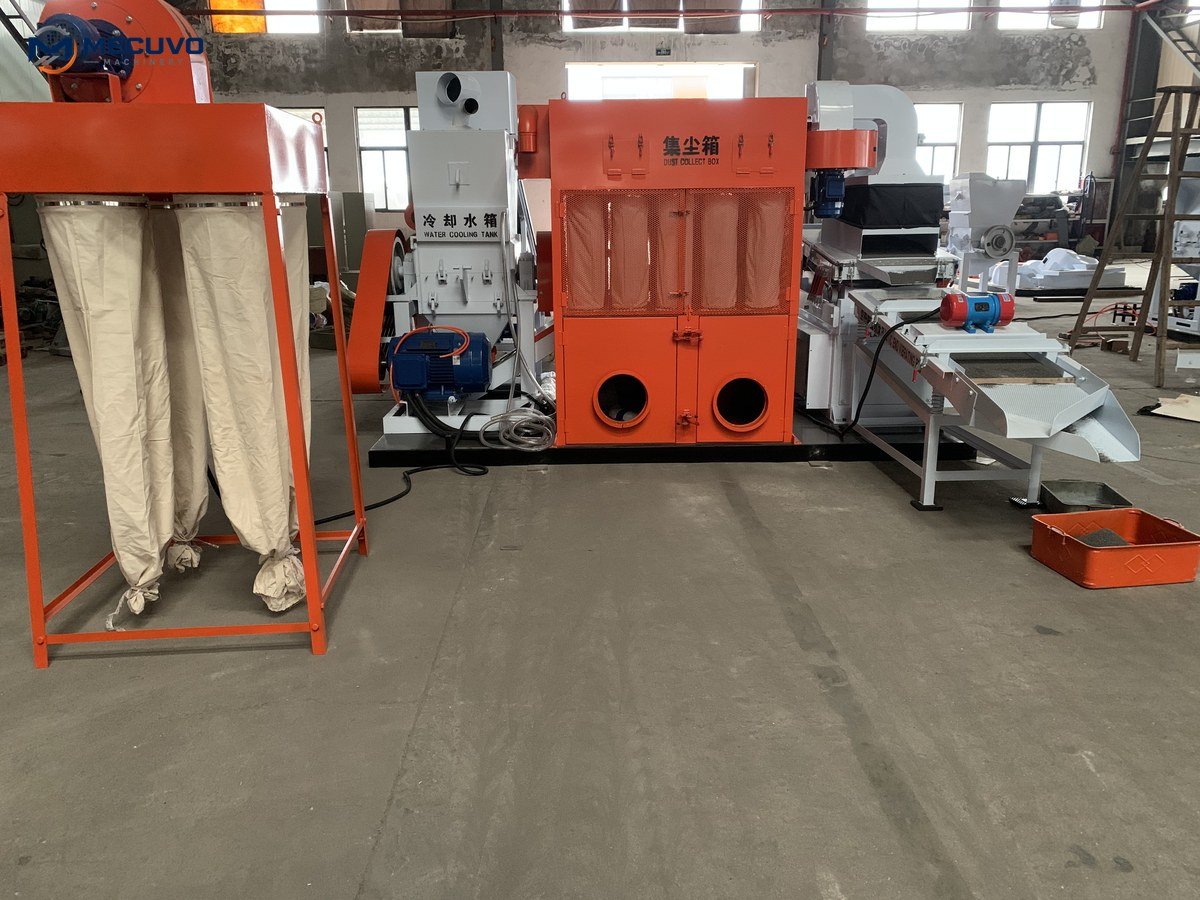
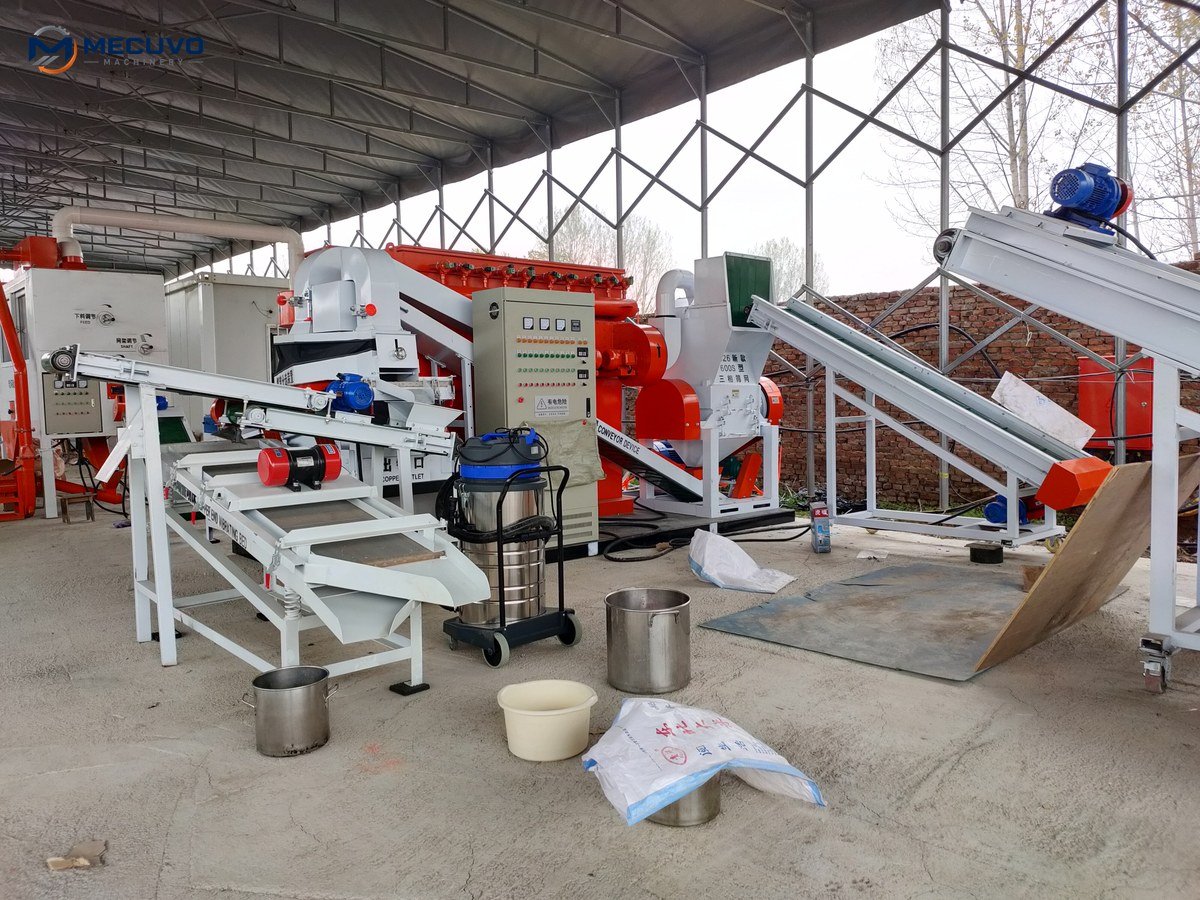
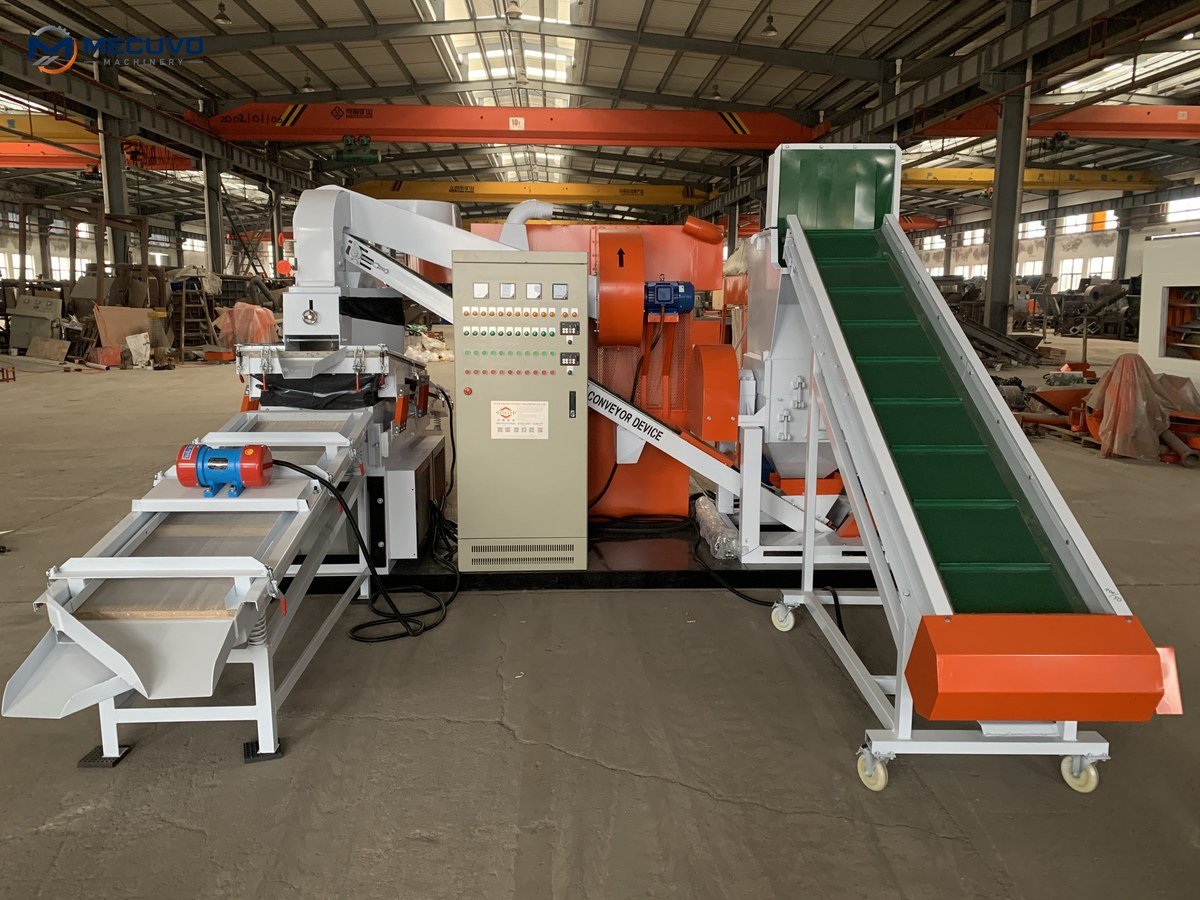
By installing an on-site processing line such as MECUVO copper granulator machines, a recycling yard captures that processing spread directly. Instead of acting as an aggregation middleman, the yard sells certified #1 bright copper chops directly to local brass mills, foundries, or secondary ingot manufacturers at near-spot pricing. However, gross spread is not net profit; machine power, operator time, blade sharpening, and waste disposal must be subtracted.
| Commercial Pathway | Infeed Material | Downstream Buyer | Realized Value per Ton of Cu Content | Operational Overhead |
|---|---|---|---|---|
| Raw Wire Sale | Unstripped #2 ICW | Regional scrap broker | 70%–75% of spot metal value | Forklift loading only |
| Toll Processing | Batched mixed wire | Third-party processor | 82%–86% of spot (net of tolling fees) | Logistics, weighing, and cash delay |
| On-Site Granulation | In-house cable feed | Mill or ingot caster | 96%–98% of spot metal value | On-site labor, power, and blade maintenance |
How much scrap wire volume does a scrap yard need to break even?
I calculate machine payback using a transparent monthly mass balance rather than optimistic sales claims.
Processing four to six tons monthly breaks even in approximately 6.3 to 9.5 months under a $28,000 capital model. This worked calculation is an illustrative scenario estimate rather than a profit guarantee, because local wire purchase discounts, utility tariffs, and actual metal yields fluctuate.
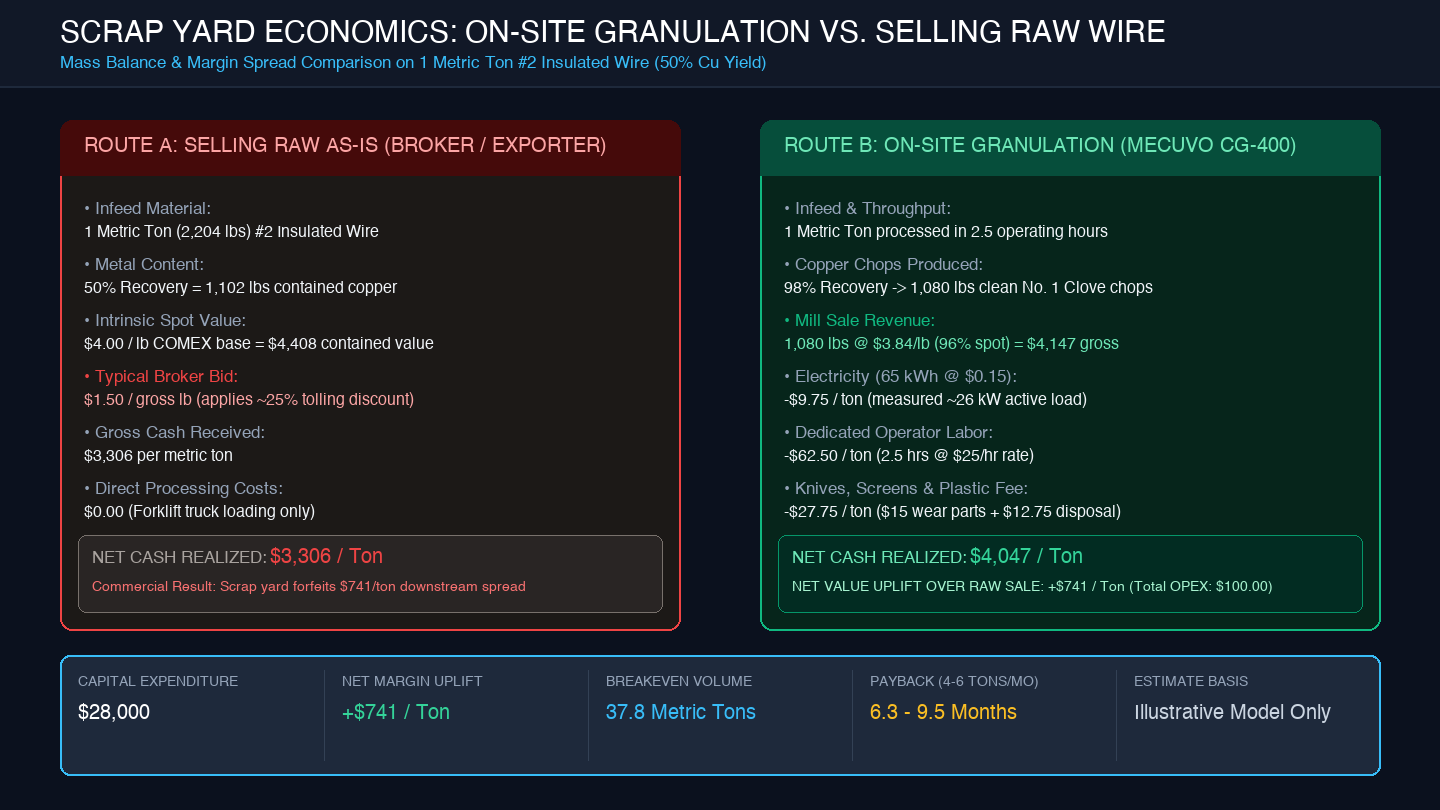
Worked breakeven calculation and monthly volume thresholds
To see where the economic boundary lies, consider a representative hypothetical scenario based on prevailing secondary metals dynamics outlined by the Copper Development Association. Suppose an independent yard acquires a compact 300 to 400 kg/h copper granulator line with an installed capital expenditure (CAPEX) of $28,000, and assumes a COMEX copper base price of $4.00 per pound ($8,800 per metric ton).
If the yard processes one metric ton (2,204 lbs) of common #2 electrical cable with an average 50% recovery rate, the cable contains 1,102 lbs of copper. Selling this ton as raw wire to a broker at $1.50 per gross pound yields $3,306 in cash revenue. Alternatively, running that ton through a granulator recovering 98% of the metal produces 1,080 lbs of No. 1 copper chops. Selling these chops to a consumer at 96% of spot ($3.84/lb) generates $4,147 in gross output revenue.
Now subtract direct operating costs (OPEX): $9.75 in electricity (~65 kWh @ $0.15/kWh across a 2.5-hour operating cycle at 26 kW average active load), $62.50 in dedicated operator labor ($25/hr over 2.5 hours), $15.00 in prorated knife sharpening and screen wear, and $12.75 in plastic tailings disposal fees, totaling exactly $100.00 per ton. Net revenue from on-site processing is $4,047 per ton—a net value uplift of $741 per ton compared to selling raw wire. At $741 net uplift per ton, the breakeven cumulative volume to recover the $28,000 machine investment is 37.8 metric tons. Processing 4 tons monthly achieves full payback in 9.5 months, while 6 tons monthly shortens capital recovery to 6.3 months. Operators should treat these figures as an illustrative engineering model rather than an earnings warranty or commercial promise, as regional scrap broker discounts, localized power rates, and incoming cable recovery percentages vary widely across recycling facilities.
| Monthly Wire Intake | Monthly Net Uplift ($741/t) | Annualized Net Value Gain | Estimated Payback Period | Financial Assessment |
|---|---|---|---|---|
| 2 Metric Tons | $1,482 / month | $17,784 / year | 18.9 Months | Low ROI; machine remains idle most shifts |
| 4 Metric Tons | $2,964 / month | $35,568 / year | 9.5 Months | Minimum viable baseline; covers fixed depreciation |
| 6 Metric Tons | $4,446 / month | $53,352 / year | 6.3 Months | Economically viable; healthy capital recovery window |
| 10 Metric Tons | $7,410 / month | $88,920 / year | 3.8 Months | Highly lucrative; strong capital justification |
| 25 Metric Tons | $18,525 / month | $222,300 / year | 1.5 Months | Urgent need; selling raw forfeits massive profit |
Operational Sensitivity: Fixed Overhead, Financing, and Market Spread Factors
While the simplified engineering model above illustrates a direct variable-cost breakeven of 37.8 cumulative metric tons, real-world scrap yard economics must account for four operational sensitivity factors:
- Facility Fixed Overhead & Financing Debt: If equipment is financed via commercial equipment loans or leases, monthly debt service interest (typically 7% to 12% APR) and capital depreciation must be amortized against monthly throughput. Facilities with dedicated warehouse rental overhead and insurance must allocate these fixed costs into the monthly ledger.
- Equipment Availability and Maintenance Downtime: The model assumes 100% operational availability during planned runs. In practice, knife sharpening, screen changes, and preventative lubrication require 10% to 15% planned maintenance downtime. Operators should budget for operational utilization rates between 75% and 85%.
- Local Utility & Disposal Volatility: Industrial electrical rates vary from $0.08/kWh in some regions to over $0.28/kWh in others. Similarly, tipping fees for non-metallic automotive shredder residue (ASR) or plastic fluff range from $40 to over $120 per ton depending on municipal solid waste regulations.
- Bilateral Scrap Spread Fluctuations: If local competition among scrap aggregators tightens the purchase spread between raw wire and spot copper, the gross value uplift narrows. Conversely, establishing direct smelter or foundry sales accounts at 97% of spot widens the spread significantly.
What are the hidden operating costs and maintenance expenses?
I warn buyers that operating a granulator requires factoring in blade sharpening cycles, electrical load, and plastic waste handling into the monthly budget.
Key variable expenses include cutting blade sharpening every 80 to 120 operating hours, bed screen replacement, power consumption of roughly 55 to 75 kWh per processed ton, and tipping fees for unrecyclable plastic tailings.
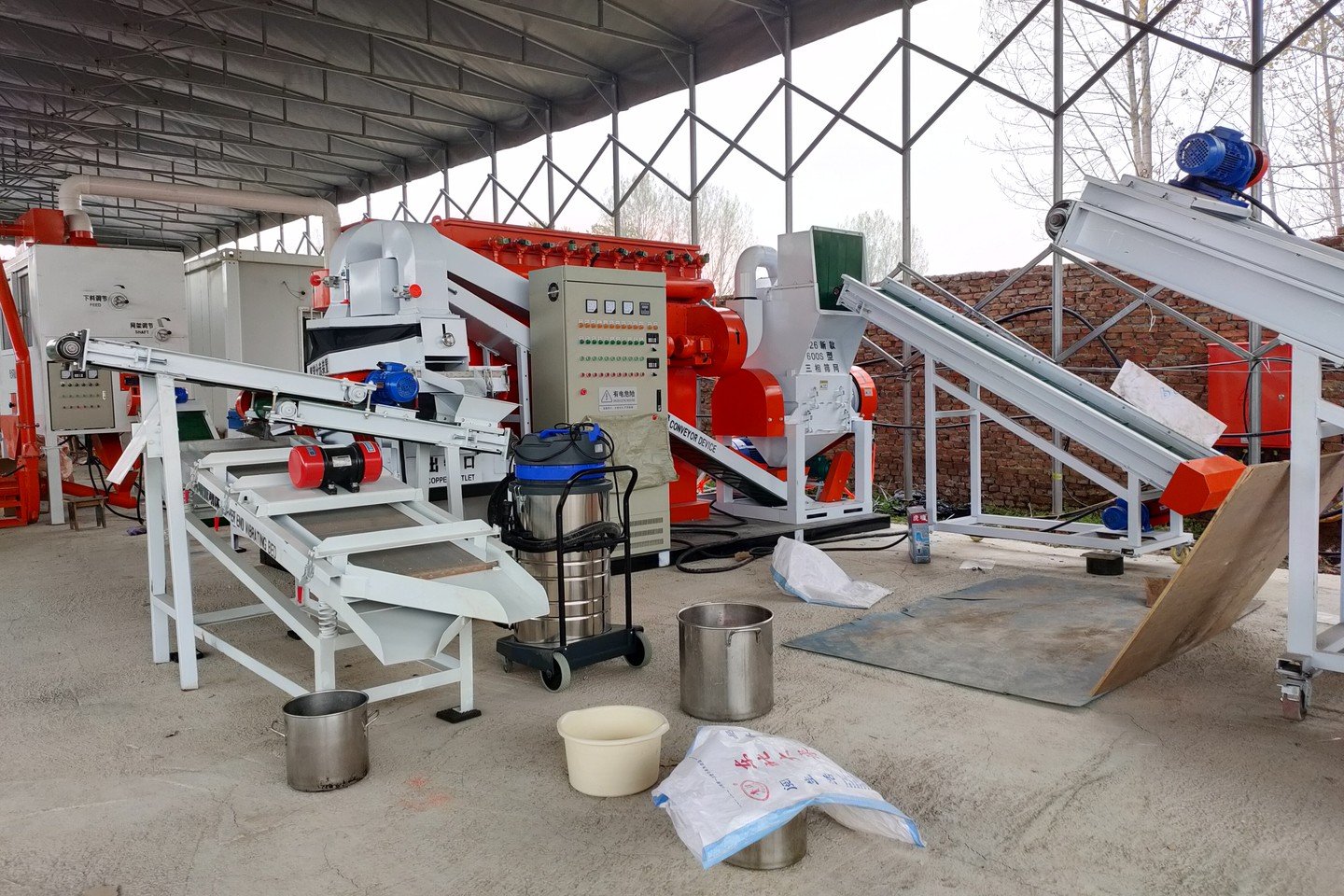
Operational expenses, wear parts, and residue management
Many first-time equipment buyers budget for machine purchase price but overlook routine operating costs. In the comprehensive Waste Treatment Best Available Techniques reference, regulatory authorities highlight that mechanical size-reduction and pneumatic separation installations generate ongoing operational demands in electrical energy, acoustic control, wear-part maintenance, and non-metallic residue handling.
The single largest maintenance consumable in a cable granulator is the knife set. A standard compact granulator utilizes rotating knives and fixed bed blades fabricated from high-wear alloy steel such as D2 or SKD-11. When processing clean copper wire, blades maintain their keen cutting edge for roughly 80 to 120 operating hours before requiring precision regrinding. Running dull blades doubles electrical motor load, increases chamber heat, and ruins separation efficiency. After three to four sharpenings, the blade dimension reaches its minimum adjustment tolerance and must be replaced entirely, representing an ongoing cost of $250 to $600 per set.
Electrical consumption is another continuous factor. A compact line with main milling motor, air-density table blower, discharge conveyors, and dust cyclone pulls between 22 kW and 35 kW of connected load, translating to 55 to 75 kWh per metric ton processed across typical 2.5-hour operational cycles. Furthermore, operators must account for plastic tailings. A ton of 50% recovery cable leaves approximately 1,000 lbs of shredded PVC, rubber, and cross-linked polyethylene fluff. If your local municipality or waste transfer facility charges tipping fees for non-metallic automotive or construction shredder waste, this disposal cost must be incorporated into your per-ton spreadsheet.
When should a recycling yard granulate wire instead of selling as-is or stripping?
I recommend choosing your processing pathway based on scrap wire construction rather than attempting to force all cable through a single machine.
Granulation is ideal for thin, tangled, multi-strand, and automotive harness cables under 10 mm. Heavy, single-conductor building cables are cheaper to strip mechanically, while volumes under two tons monthly should be sold as-is.
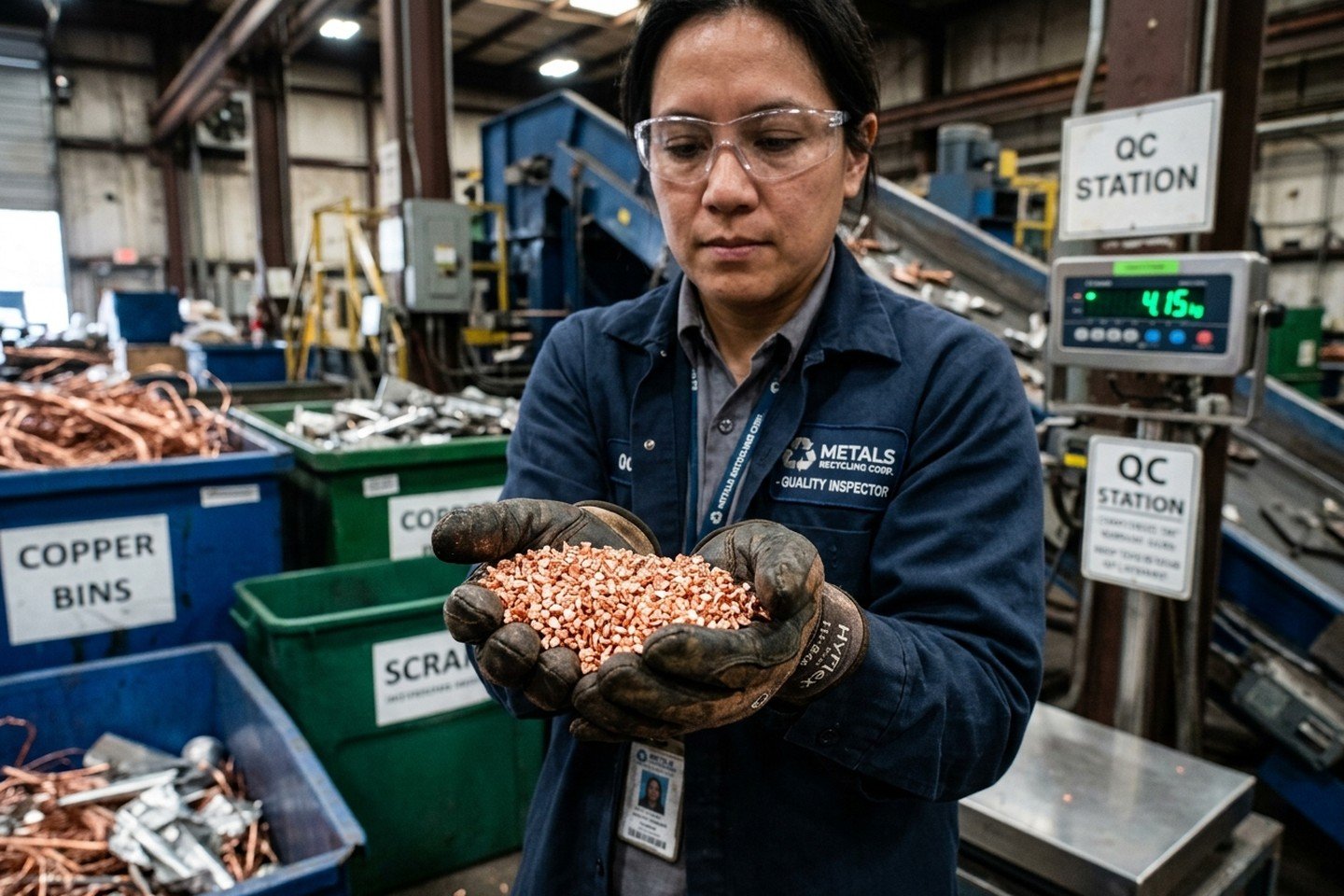
Establishing a feedstock triage framework
A profitable scrap facility does not granulate every wire that enters the yard. High-capacity mechanical rotary strippers process heavy single-conductor cables (such as 250 to 750 MCM power distribution lines or heavy Romex) at speeds up to 100 feet per minute with minimal electricity and zero blade wear on insulation chop. Stripping preserves the copper as high-value Bare Bright (ISRI Berry), avoiding granulator screen resistance entirely.
Conversely, a copper wire granulator is indispensable for material that mechanical strippers cannot physically handle. This includes tangled communication cables, Cat5 and Cat6 Ethernet wiring, automotive harness assemblies with varied connectors, appliance cords, and fine stranded multi-core flexible wires. Stripping these cables by hand or feeding them into tabletop strippers is physically impossible or financially ruinous due to labor overhead. Granulators shear this complex, tangled inventory into uniform pellets, fluidizing the insulation away in a single pass.
To balance capital allocation, compare your numbers against our copper wire granulator purity and recovery framework. If your facility collects at least five tons of mixed fine cable each month and currently absorbs middleman discounts, on-site granulation directly increases your business's monthly retained earnings.
To review machine throughput ratings or discuss trial material testing for your specific scrap mix, reach out to MECUVO Machinery with your cable samples and processing targets.
Conclusion
A copper wire granulator is profitable when consistent monthly volume exceeds five tons. Audit your infeed grades, calculate direct operating costs, and match machine capacity to your scrap supply.
— YOUR RECYCLING PROJECT
Find the right machine for your material.
Tell us your material and required capacity.
Or email sales@mecuvo.com