Table of Content
I often see recycling plant operators discard valuable copper granules because uncalibrated density tables blow fine copper chops directly into the plastic discharge chute. Stopping copper loss requires tuning fluidizing airflow velocity just below the terminal velocity of copper chops, matching screen hole diameter to cable strand gauge, keeping knives sharp, and routing tailings to an electrostatic separator. Below, I explain root causes of copper carryover, airflow damper calibration, screen sizing protocols, and downstream dust recovery economics.
What causes clean copper granules to carry over into the plastic tailings?
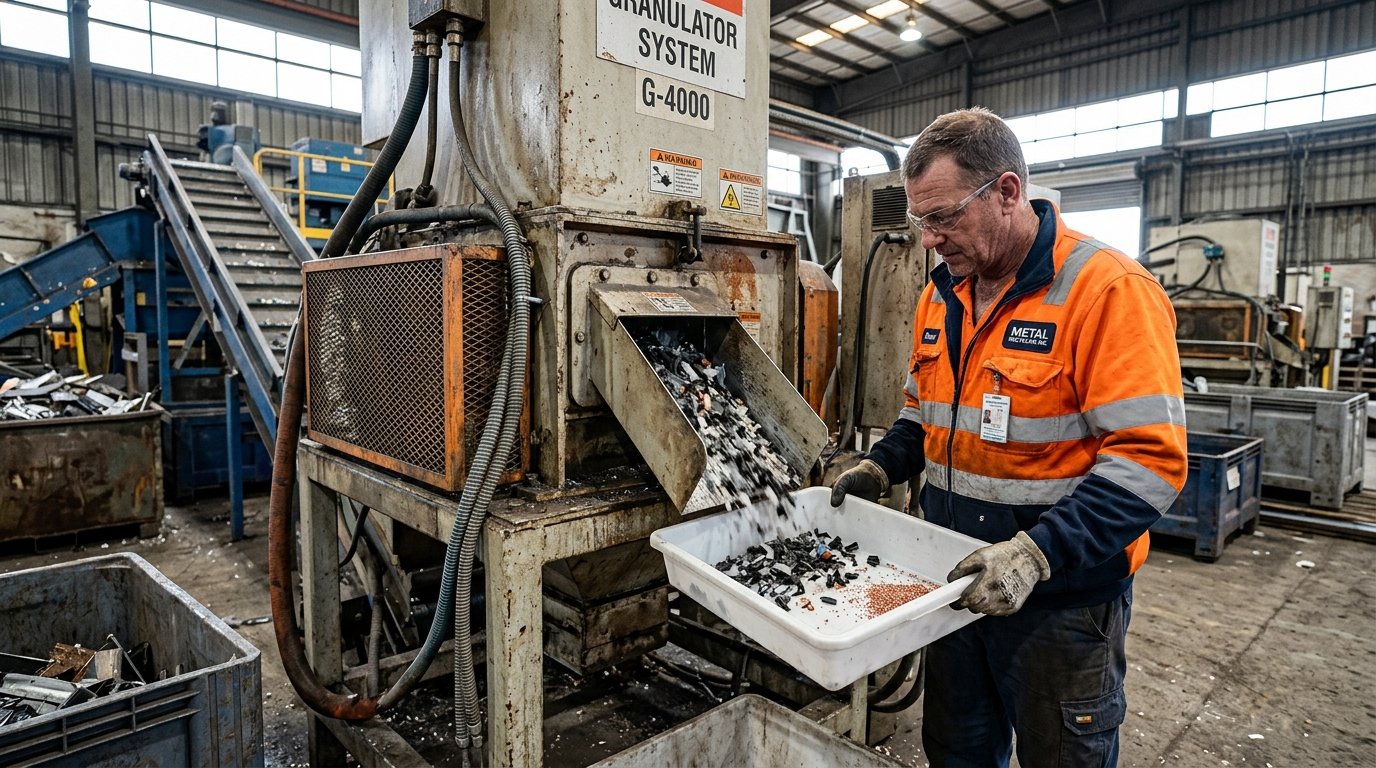
I diagnose copper carryover by inspecting the plastic discharge chute for specific aerodynamic, mechanical, and material feed imbalances. Copper granules escape into plastic tailings due to excessive fluidizing fan velocity, dull granulator blades creating flattened tails, overloaded vibration tables, or tangled fine wires that remain bonded to plastic insulation.
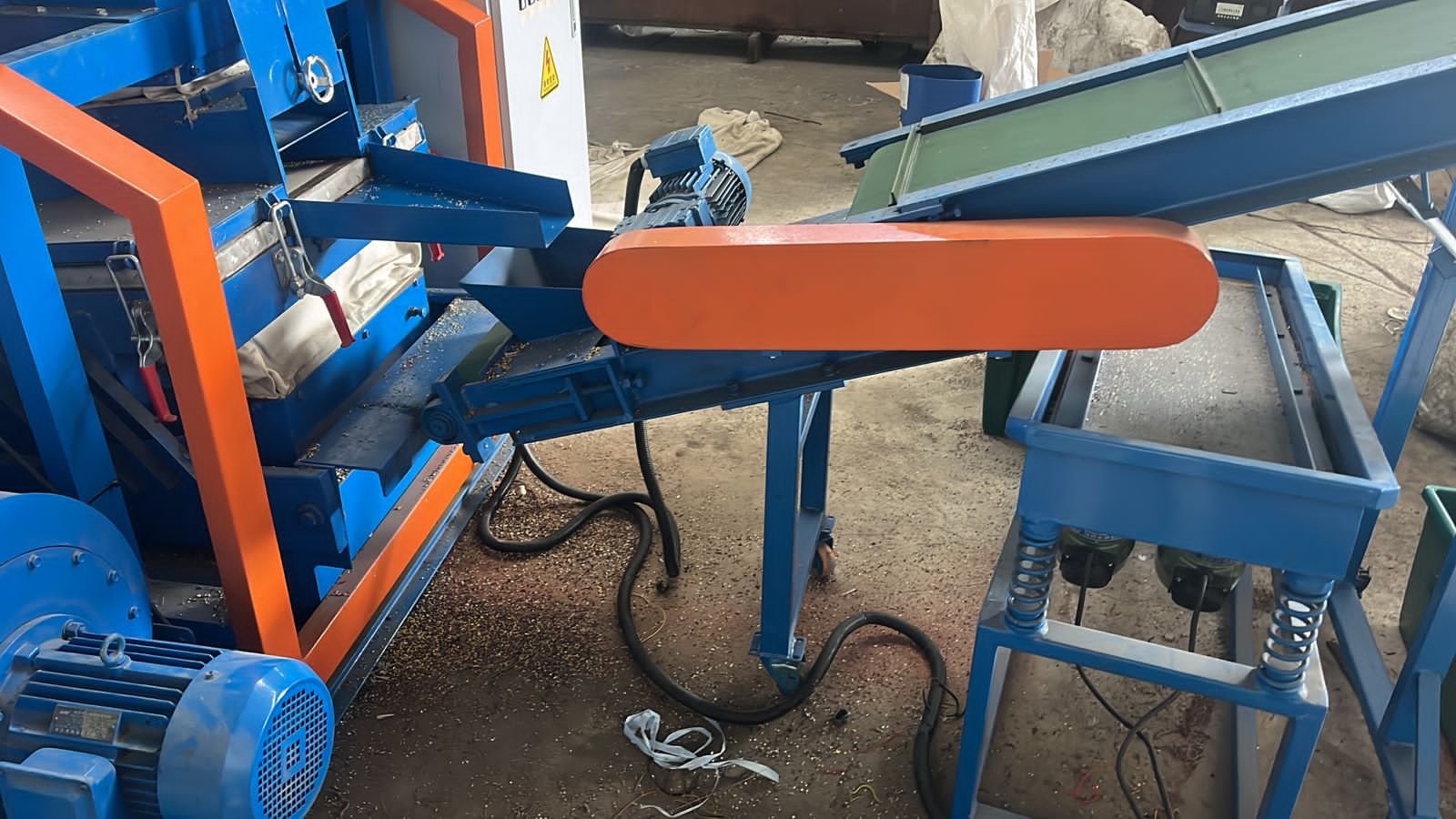
Aerodynamic, mechanical, and material carryover mechanisms
When clean copper chops appear in the plastic discharge bin, the separation line is losing pure profit. In dry copper granulation systems, density separation relies on the substantial specific gravity differential between metallic copper (8.96 g/cm³) and common thermoplastic insulation materials such as PVC (1.35–1.45 g/cm³) or polyethylene (0.92–0.96 g/cm³). However, as documented in grading specifications published by the ISRI Scrap Specifications Circular, pneumatic gravity separation functions on apparent density rather than absolute density alone.
Three primary failure mechanisms cause copper granules to bypass the heavy discharge and ride out with plastic tailings:
- Aerodynamic Blow-Out (Excessive Superficial Velocity): The bottom fluidization blower forces air upward through the angled mesh bed. If the blower speed or damper is set too high, the upward drag force exceeds the terminal settling velocity of small copper particles. Instead of sinking onto the woven wire screen and contacting the uphill vibration deck, fine copper granules are buoyed into the fluidized suspension and swept downhill by cascading plastic flakes.
- Blade Smear and Unliberated Copper Tails: When rotary and bed knives lose their razor edge, or when the knife gap expands beyond 0.3 mm, the cutting chamber stops shearing wires crisply. Instead of clean cylindrical copper chops, dull blades pinch and smear fine strands into elongated shapes or leave copper wire segments mechanically entrapped within torn insulation jackets. These composite chunks behave like plastic in the airstream, dragging copper directly into the tailings chute.
- Deck Overloading and Bed Choking: Forcing infeed beyond rated capacity creates an excessively thick material bed on the separator deck. Fine copper granules trapped at the top of the bed cannot penetrate downward through the dense layer of plastic shreds to reach the screen before the entire mass discharges out the lower plastic gate.
| Carryover Failure Mode | Root Physical Mechanism | Visual Indicator on Deck | Immediate Corrective Action |
|---|---|---|---|
| High-Velocity Blow-Out | Upward air drag > copper terminal velocity | Fine copper boiling at plastic weir | Reduce blower VFD frequency by 5–10% |
| Blade Smear / Pinched Tails | Dull knife edges or gap > 0.3 mm | Flatted copper flakes with plastic tags | Resharpen blades and reset gap to 0.15–0.20 mm |
| Deck Overloading | Bed depth > 20 mm choking stratification | Copper chops riding top of plastic wave | Throttle infeed conveyor rate by 15–20% |
| Screen Blindness | Plugged bed mesh holes restricting airflow | Uneven channeling and stagnant dead zones | Clean screen holes with brass brush or vacuum |
How do you calibrate the airflow velocity and fluidization damper?
I tune air-density tables by measuring bed behavior across the stratification deck rather than guessing fan motor frequencies. Calibrate airflow by adjusting the variable frequency drive until plastic flakes lift into suspension while copper chops sink into the deck mesh grooves, advancing uphill via eccentric vibration toward the copper outlet.
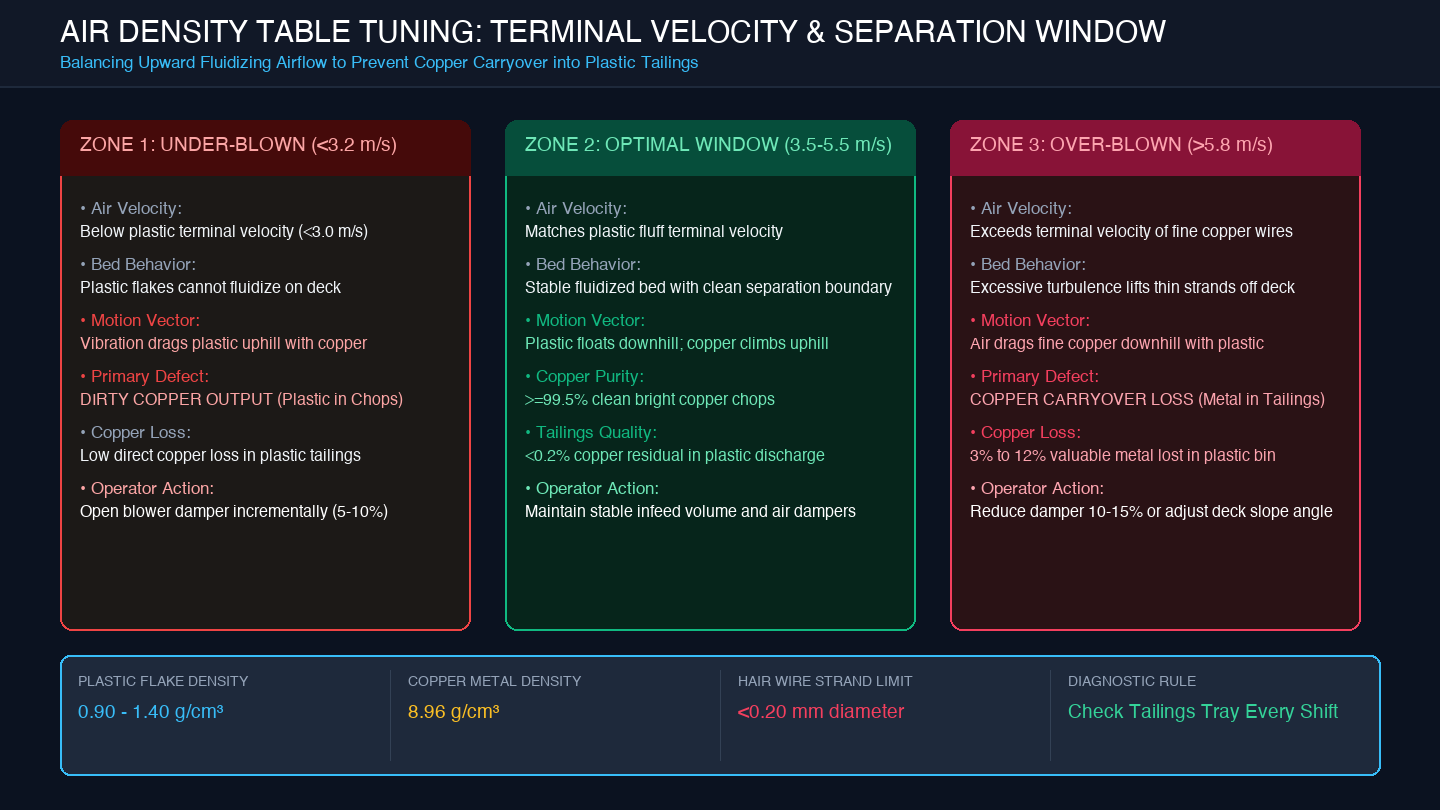
Precision fluidization calibration and deck balancing protocol
Properly calibrating an air-density separator requires harmonizing three interdependent mechanical parameters: upward fluidizing airflow, longitudinal deck vibration frequency, and deck inclination angle. As outlined in the Waste Treatment Best Available Techniques reference, pneumatic stratification achieves optimal efficiency only within a narrow, stable aerodynamic boundary.
Follow this step-by-step tuning procedure when commissioning or recalibrating MECUVO copper granulator machines:
- Establish the Zero-Load Baseline: Clear all residual granules from the deck screen. Inspect the woven wire bed to confirm 100% of apertures are free from lodged wire bits or dust build-up. Power on the eccentric vibration motor at 380–420 RPM and set the bed incline between 5° and 7°.
- Throttle the Airflow Damper Low: Start the bottom fluidization blower via its Variable Frequency Drive (VFD) at approximately 30 Hz (roughly 60% rated flow). Begin feeding wire granulated material at a moderate, steady rate. At this low air setting, plastic flakes will pack heavily onto the screen, impeding the forward uphill movement of copper.
- Incrementally Elevate Air Velocity: Gradually increase blower VFD frequency in 1.5 Hz increments while observing material behavior across the central transition zone. Watch for the fluidization threshold: the point where plastic shreds begin to “simmer” and dance lightly on a cushion of air without flying violently into the upper hood.
- Confirm Copper Pinning: In the optimal operating window, heavy copper granules settle directly into the woven wire grooves and march steadily uphill toward the top discharge. Plastic flakes remain buoyant, flowing downhill like a liquid over the lower discharge weir. If copper granules begin tumbling backward into the plastic stream, reduce airflow by 1–2 Hz immediately.
- Balance the Top Suction Hood: Adjust the negative-pressure exhaust hood damper so that airborne PVC dust and light paper fuzz are evacuated to the cyclone without pulling granulated plastic flakes or copper chops into the dust duct.
Why do hair-thin communication and automotive wires escape into the plastic fraction?
I find that processing capillary harness wires on standard building-cable screens creates severe metal loss due to matching terminal velocities. Hair-thin wires under 0.2 mm have low mass relative to surface area, causing aerodynamic drag to lift copper together with lightweight PVC flakes unless milled through smaller 1.5 to 2 mm screens.
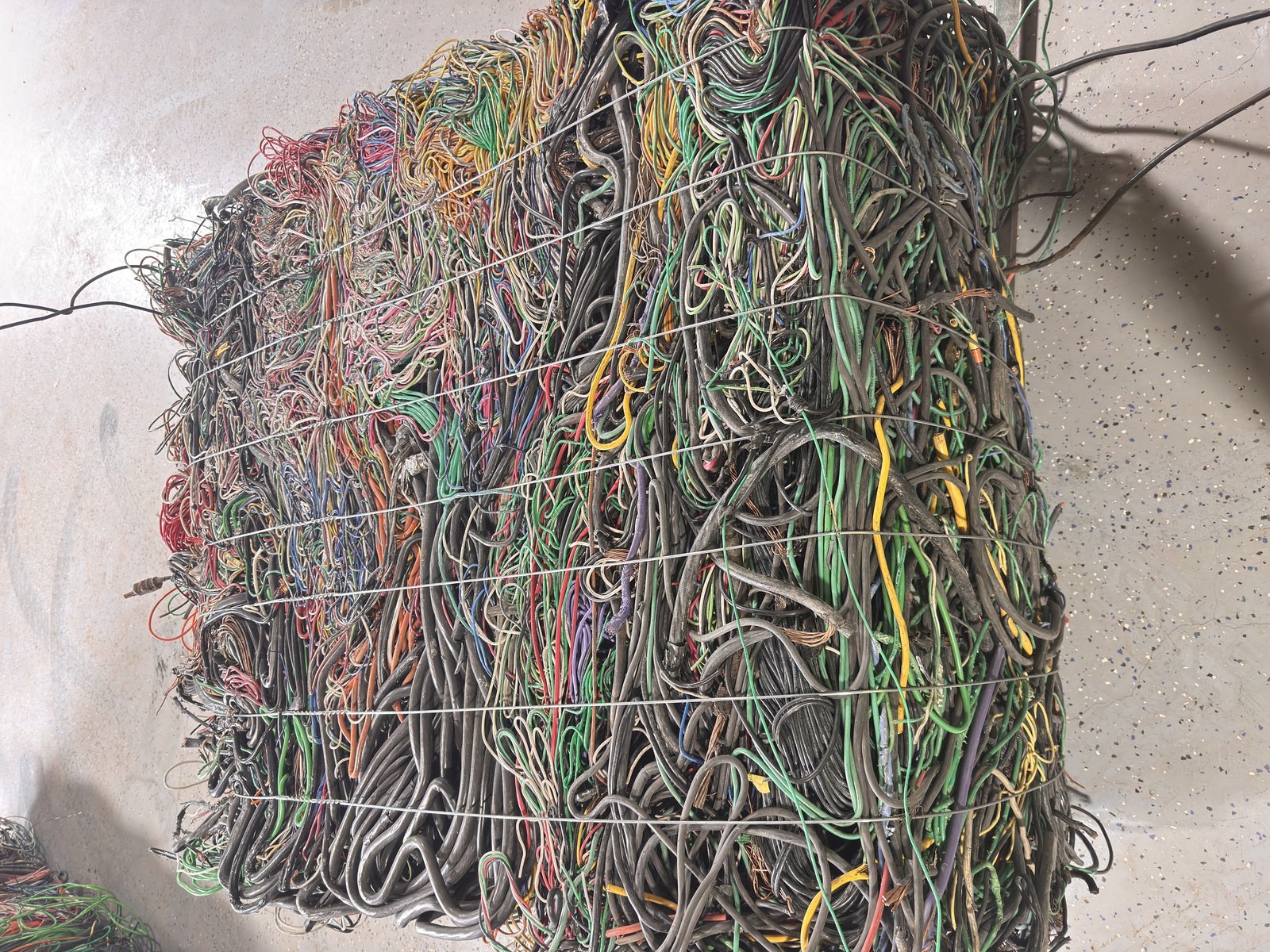
Aerodynamic similarity in micro-gauge conductors
When granulating automotive wiring harnesses, computer ribbon cables, telecommunication twisted pairs, and aircraft avionics wiring, operators encounter a fundamental physics dilemma: the aerodynamic behavior of microscopic copper wires closely mimics shredded plastic. While solid single-conductor building wire yields heavy, bullet-shaped copper nuggets upon granulation, multi-strand wires composed of individual 0.10 mm to 0.25 mm filaments shear into ultra-light copper curls and needle-like whiskers.
According to terminal velocity calculations published by the Copper Development Association, aerodynamic drag is proportional to particle surface area, whereas gravitational settling force is proportional to volume and mass. Because a 0.15 mm copper hair exhibits an enormous surface-area-to-weight ratio, its aerodynamic terminal velocity drops from 12–15 m/s (typical for a solid 2 mm copper pellet) down to less than 2.5 m/s. This terminal velocity overlaps directly with the terminal velocity of thin PVC insulation flakes and woven nylon harness sleeving.
To prevent hair-thin conductors from floating across the plastic weir, three processing modifications are essential:
- Install a Smaller Granulator Bottom Screen: Standard building cable operates efficiently through a 3.0 mm or 4.0 mm granulator screen. For fine automotive harnesses, switch to a 2.0 mm or 1.5 mm aperture screen. A smaller screen ensures that multi-core cables are sheared thoroughly into microscopic lengths rather than long, tangled whiskers that bridge across plastic flakes.
- Maintain Razor-Sharp Knife Clearances: Rotary-to-bed blade clearance must be gauged with feeler gauges to exactly 0.15 mm to 0.20 mm. Any wider gap results in pulling and tearing rather than cutting, leaving fine copper strands anchored inside plastic sleeves.
- Lower Deck Tilt Angle and Air Volume: Flatten the air-table incline to 4° and reduce fluidization fan velocity, allowing micro-granules adequate dwell time to separate before reaching the discharge boundary. For a comprehensive overview of separation mechanics, see our technical guide on how copper wire granulators separate copper from plastic.
When does adding an electrostatic separator pay off for copper dust recovery?
I calculate electrostatic separator ROI based on daily tons of plastic tailings and the percentage of trapped microscopic copper. An electrostatic separator pays off when processing over 500 kg/h of fine automotive or communication wire containing 1% to 3% residual copper dust, recovering up to 99.9% metal and generating $15,000 to $40,000 in recovered copper annually.
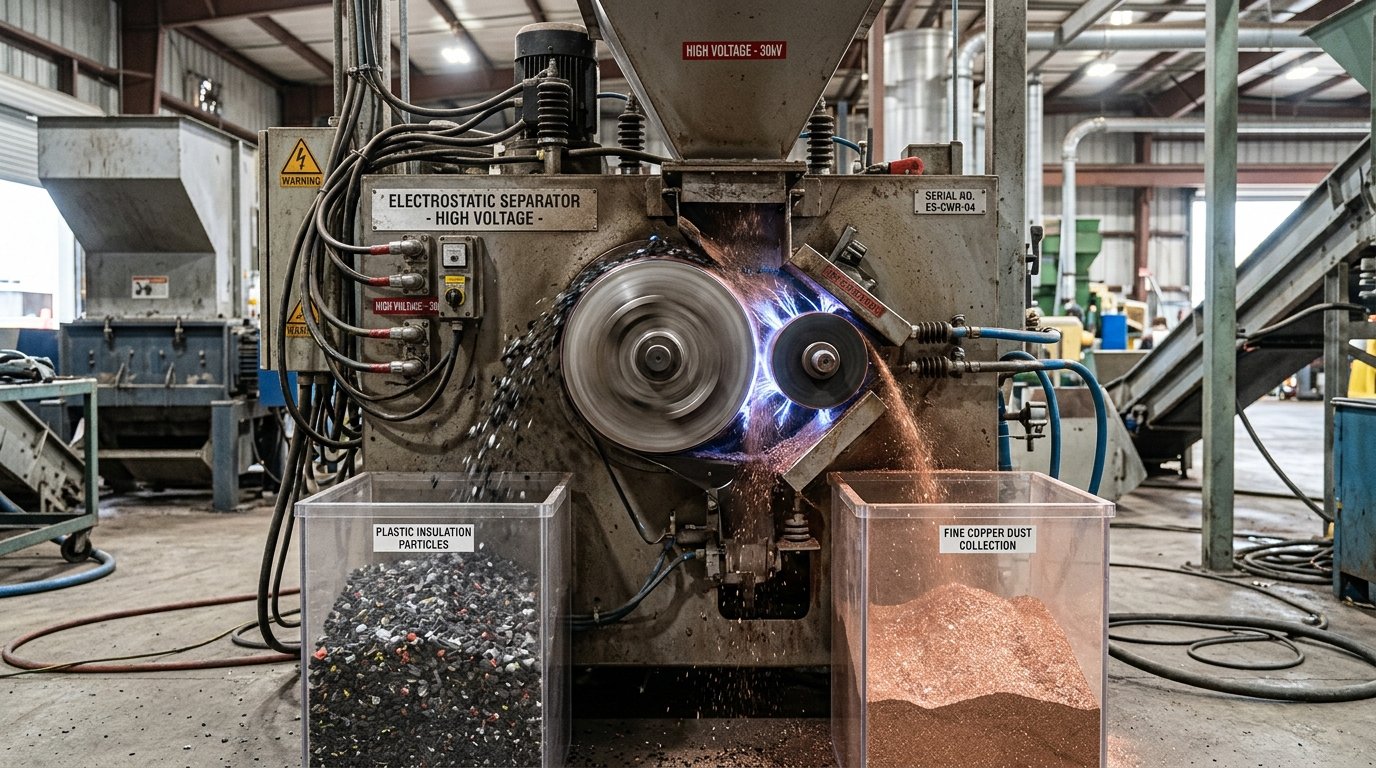
Electrostatic scavenging physics and commercial breakeven
Even with an impeccably calibrated air-density table and fresh knives, mechanical dry separation of fine capillary wire encounters physical limits. Up to 1.5% to 3.5% of total copper content—primarily microscopic copper dust, sheared foil shields, and hair strands under 0.15 mm—invariably escapes with the plastic tailings. An inline high-voltage electrostatic separator solves this problem by bypassing aerodynamic density principles entirely.
Electrostatic separation operates on electrical conductivity differentials rather than mass or specific gravity. Plastic tailings discharged from the granulator line feed into a vibratory feeder that distributes a single-particle layer across a grounded, rotating metallic drum. An adjacent high-voltage corona ionizing electrode (operating at 25,000 to 45,000 volts DC) bombards the falling mixture with a dense curtain of electrical ions:
- Dielectric Plastic Retention: Non-conductive plastic flakes (PVC, PE, rubber) absorb the electrical charge and hold it across their dielectric surface. By image-force attraction, the plastic particles cling tightly to the grounded steel drum surface and rotate underneath, where an adjustable scraper blade drops them into the clean plastic bin.
- Conductive Copper Deflection: Metallic copper granules possess high electrical conductivity. The moment they contact the grounded rotating drum, their acquired charge dissipates instantaneously back into ground. Free from pinning forces, the copper particles follow a natural gravitational parabolic arc, bouncing forward over a precision splitter blade into the copper salvage hopper.
| Facility Operating Profile | Monthly Infeed (50% Cu) | Tailings Cu Loss (2.5% of metal) | Electrostatic Rec. (98% capture) | Net Annual Cashflow (after OPEX) | Payback on Electrostatic Unit |
|---|---|---|---|---|---|
| Small Yard (Batch Runs) | 10 Metric Tons / mo | 125 kg Cu / mo | 122.5 kg / mo (1.47 t/yr) | $12,040 / yr net | 12.0 Months ($12,000 unit) |
| Mid-Size Recycling Center | 25 Metric Tons / mo | 312.5 kg Cu / mo | 306.3 kg / mo (3.68 t/yr) | $30,200 / yr net | 5.9 Months ($15,000 unit) |
| Industrial Wire Processor | 60 Metric Tons / mo | 750.0 kg Cu / mo | 735.0 kg / mo (8.82 t/yr) | $72,650 / yr net | 2.9 Months ($18,000 unit) |
Calculation Basis & Sensitivity Note: Assumptions reflect typical automotive/mixed wire containing 50% elemental copper by mass, where primary air tables achieve a 97.5% recovery rate leaving 2.5% of contained copper in plastic tailings. Secondary electrostatic recovery captures 98% of tailings fines at an illustrative realized price of $8,450/t ($3.83/lb, 96% of $8,800/t spot), net of electrical power ($0.15/kWh) and scheduled wiper maintenance. Actual payback varies with scrap copper percentage, local utility rates, and equipment model specifications.
Adding an electrostatic unit boosts overall metal recovery from approximately 97.5% up to 99.8%+, turning an unrecoverable waste stream into premium revenue. To compare overall recovery and purity trade-offs across your entire plant, explore our analysis of copper wire granulator purity vs recovery or contact the MECUVO engineering team for an equipment layout review tailored to your wire feed.
Key Takeaways
Eliminating copper loss requires balancing airflow velocity, maintaining sharp 0.2 mm blade clearances, selecting proper bed screens, and adding electrostatic scavenging for ultra-fine capillary wires.
— YOUR RECYCLING PROJECT
Find the right machine for your material.
Tell us your material and required capacity.
Or email sales@mecuvo.com