Table of Content
When evaluating a copper wire granulator, available electrical infrastructure is a key planning factor. Single-phase and three-phase supplies can serve different granulator configurations, but phase alone does not set a universal motor-power, cable-diameter or throughput limit. Select a machine using its confirmed voltage, phase, frequency, full-load current, starting requirements and accepted feed specification. Have a qualified electrician verify the available service, conductors, protection and auxiliary loads before installation.
What are the physical and electrical limits of 220V single-phase copper granulators?
Available electrical service influences machine sizing, drive selection, and installation costs. Single-phase connections often face utility service ampacity limits, requiring careful evaluation of motor full-load amperes, starting currents, and upstream transformer capacity before selecting equipment.
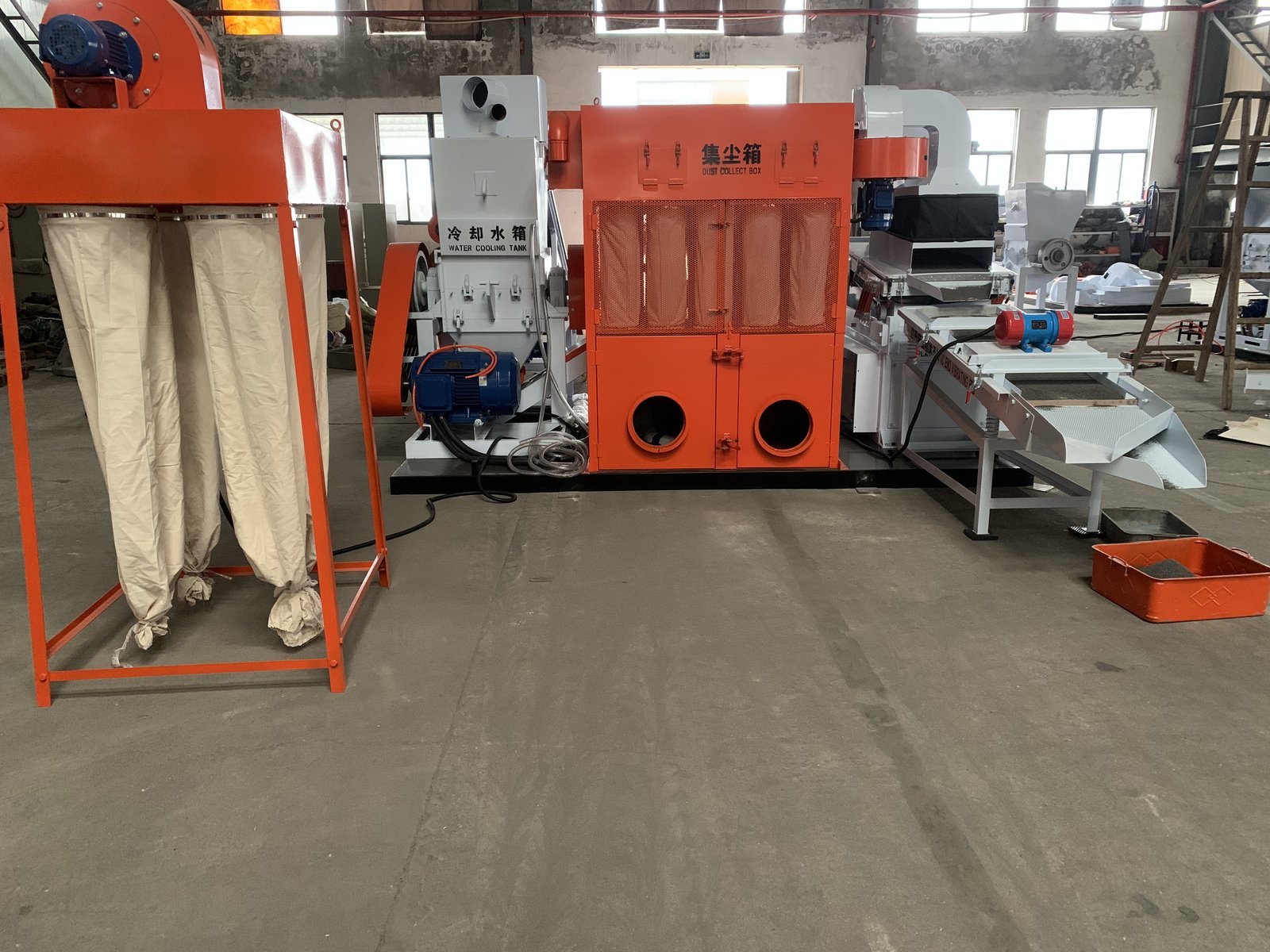
Electrical power physics, wire gauge limitations, and single-phase motor torque
To understand why granulator capacity is fundamentally tied to electrical phase configuration, one must examine the mechanical shearing resistance of copper. Slicing through bundles of flexible multi-conductor automotive wiring or tough multi-layer building cable requires immense kinetic energy and rotational torque. According to machinery engineering benchmarks in the European IPPC Bureau Waste Treatment Reference Document, processing capacity scales directly with shaft power:
- Electrical Service Considerations: Single-phase branch circuits are subject to utility supply ampacity, conductor sizing, and breaker ratings. Motor current calculation involves shaft power, motor efficiency, and operating power factor rather than a simplified kW-to-voltage division. Upstream service must account for total connected electrical load, including the granulator, air blower, vibration motors, and extraction fans.
- Cable Feeding Considerations: Wire processing capability depends on cutter chamber dimensions, knife geometry, motor torque, and screen aperture rather than electrical phase alone. Heavier multi-strand building wires or tough jacketed cables require sufficient instantaneous shear torque to avoid motor stalling. Always consult the manufacturer’s approved feed specification for maximum acceptable wire outer diameter and conductor types.
| Engineering Specification | Single-Phase Granulator (220V/240V) | Three-Phase Granulator (380V/480V) |
|---|---|---|
| Total Connected Power | 5.5 kW – 7.5 kW (7.5 – 10 HP) (Illustrative) | 18 kW – 45 kW (25 – 60 HP) (Illustrative) |
| Processing Throughput | 50 – 100 kg/h (110 – 220 lbs/h) | 300 – 800 kg/h (660 – 1,760 lbs/h) |
| Max Cable Outer Diameter | 10 mm – 15 mm (Light cords / cables) | 25 mm – 35 mm (Mixed harnesses, multi-strand) |
| Flywheel Mass (Illustrative) | Lightweight assembly (15 – 25 kg) | Heavy solid flywheel (80 – 160 kg) |
| Nominal Shift Output (8-Hr Continuous) | 400 – 800 kg scrap wire | 2,400 – 6,400 kg scrap wire |
| Electrical Service Benchmark | 50A – 60A @ 220V (Nameplate dependent) | 40A – 80A @ 480V 3-Phase (Nameplate dependent) |
Why is three-phase industrial power essential for high-throughput commercial recycling?
Three-phase industrial electrical power (such as 380V or 480V) is standard for industrial machinery, delivering continuous torque, balanced conductor loading, and favorable motor efficiency. For commercial facilities processing diverse cable streams, three-phase power supports the higher drive ratings required for heavier cutting rotors and multi-motor separation systems.
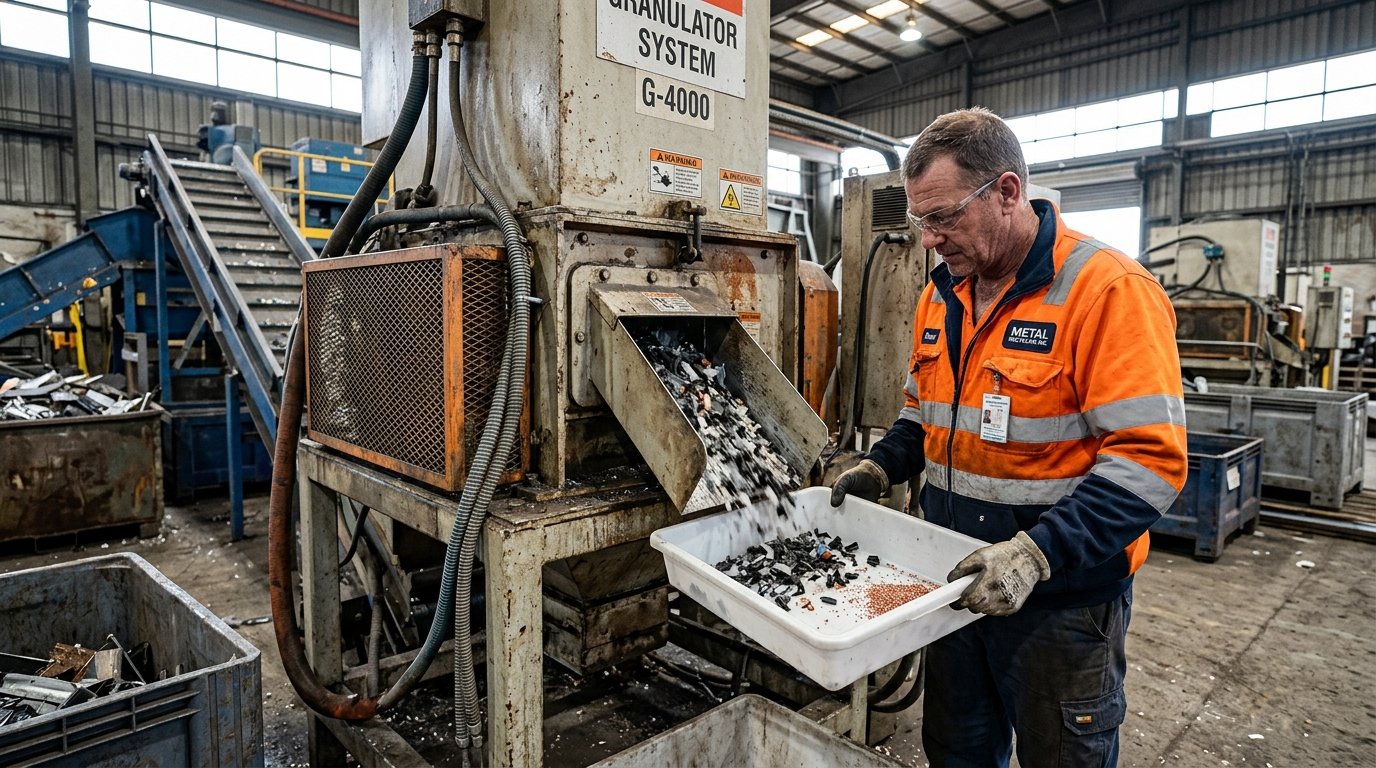
Rotational dynamics, starting inrush management, and continuous heavy-duty duty cycles
In commercial scrap yards where wire inventory accumulates by the truckload, processing speed determines operating profitability. Three-phase alternating current provides three distinct operational advantages that single-phase machines cannot match:
- Smooth, Continuous Torque Under Heavy Shock Loads: In a three-phase motor, three overlapping sinusoidal waveforms produce a rotating magnetic field with continuous torque delivery. When dense wire bundles enter the cutting chamber, three-phase drives maintain operational momentum with reduced risk of sudden rotor stall compared to single-phase equivalents of identical power.
- Controlled Motor Starting & Inrush Management: While across-the-line starting can induce substantial inrush currents, three-phase systems allow the integration of soft starters or variable frequency drives (VFDs) to ramp motor speed progressively. Soft starters manage current peaks during acceleration, protecting electrical switchgear and reducing mechanical wear on drive belts.
- Continuous Industrial Duty Cycle: Commercial granulation demands multi-hour continuous duty. Three-phase industrial motors feature robust thermal dissipation and higher full-load efficiency, enabling sustained operation across commercial shifts without thermal tripping.
Can you run a commercial three-phase copper granulator on a generator or rotary phase converter?
A generator or phase converter may be suitable only after the complete machine load and control system have been reviewed. Generator selection must consider starting kVA, acceleration, simultaneous loads, drive characteristics and acceptable voltage and frequency variation. A phase converter does not necessarily change voltage or frequency; any transformer, motor reconnection or control-supply arrangement must be approved for the specific installation. Use the motor, drive and converter manufacturers’ requirements rather than a universal sizing multiplier.
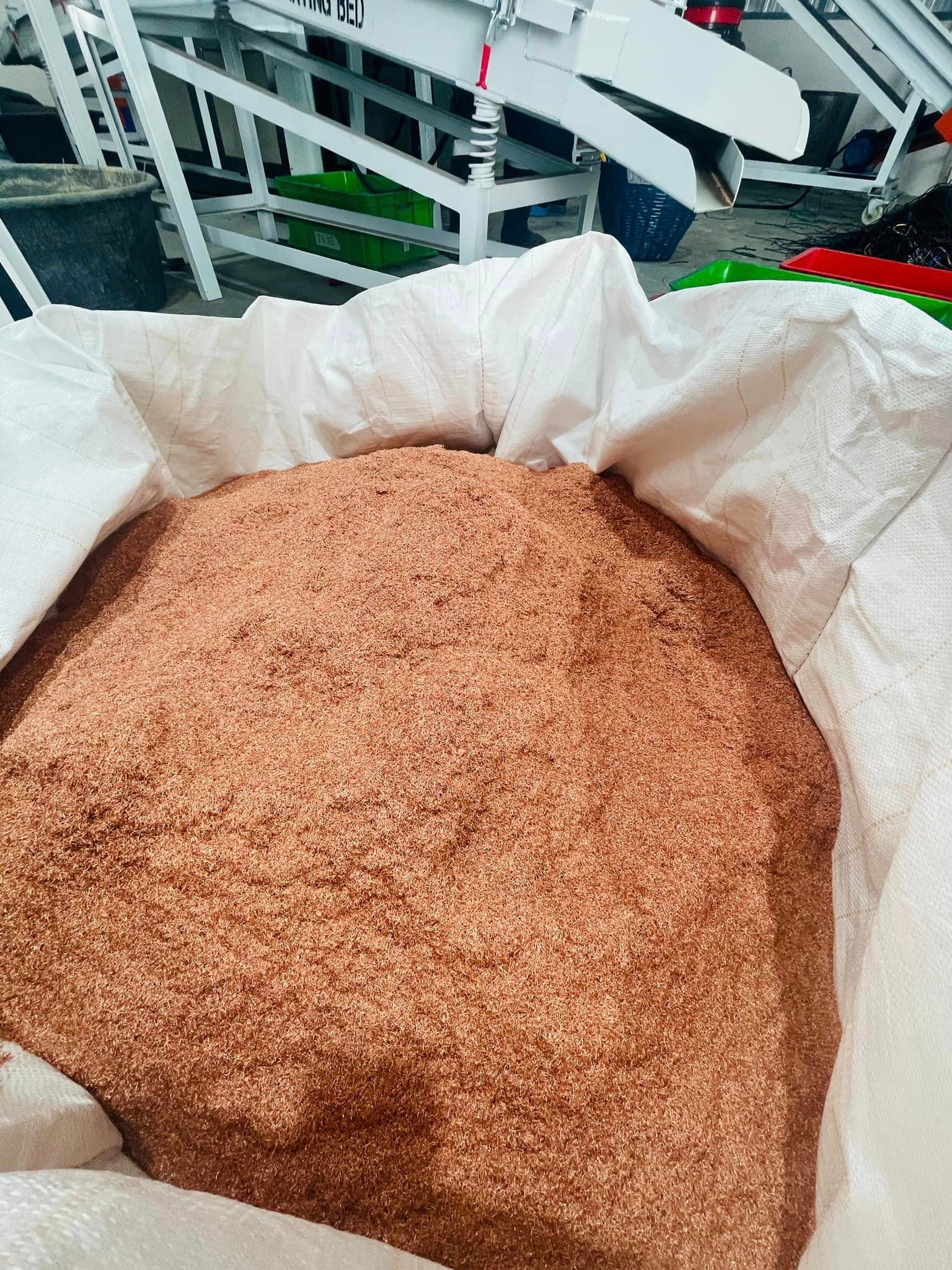
Off-grid power solutions, generator sizing formulas, and utility interconnection costs
For many scrap yards located in rural industrial parks or remote salvage properties, bringing utility three-phase power to the facility requires installing new utility poles, high-voltage transformers, and commercial metering. Local electric utilities routinely quote $20,000 to $60,000+ for three-phase extensions, presenting a massive barrier to entry.
Recyclers have two proven engineering workarounds to operate commercial three-phase equipment:
- Diesel Generator Sizing: Operating off-grid requires sizing a diesel generator to accommodate total connected motor load, starting kVA inrush, and auxiliary blower systems. Motor starting demand (especially across-the-line starts) requires generator capacity well above continuous running kW. Sizing should be verified using manufacturer application guidelines (e.g., Cummins or Caterpillar generator sizing criteria) to ensure acceptable frequency and voltage regulation during load steps.
- Phase Converters & Transformers: Rotary phase converters can generate a third leg for three-phase motors from single-phase utility service. However, converters do not alter line voltage (e.g., a 240V converter does not produce 480V without a dedicated step-up transformer). Furthermore, voltage balance across manufactured phases must be verified to prevent motor overheating, and compatibility with sensitive PLC controls and variable frequency drives must be confirmed with the equipment manufacturer.
What is the financial payback timeline: single-phase vs three-phase granulators?
When comparing equipment configurations, recyclers must evaluate capital expenditure alongside processing throughput and labor efficiency. While single-phase machines offer lower initial acquisition costs for small volumes, three-phase industrial lines provide substantially higher hourly capacity, enabling commercial yards to process incoming scrap faster with lower labor hours per ton of recovered metal.
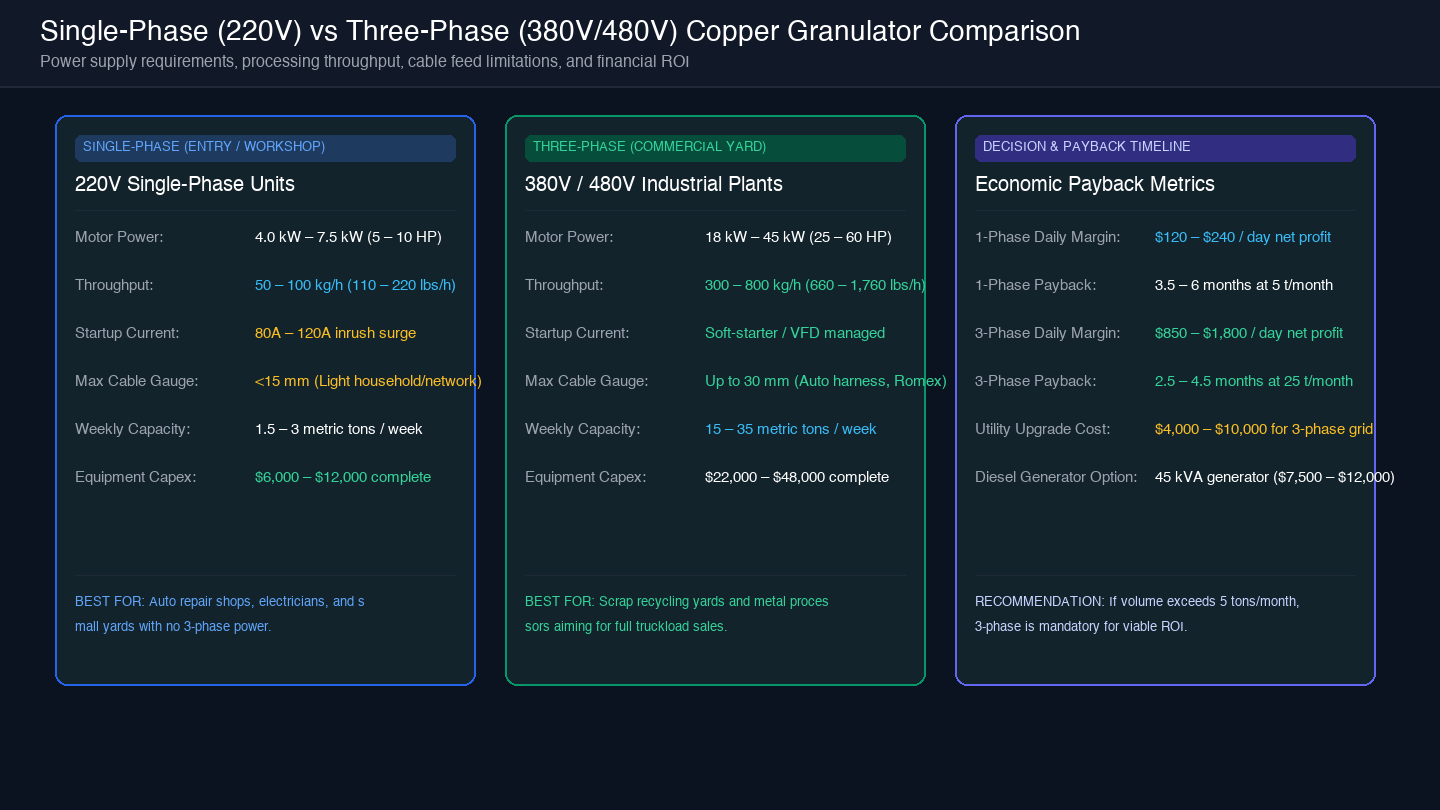
Capex comparison, daily margin generation, and truckload economies of scale
The ultimate decision between single-phase and three-phase equipment comes down to business volume and commercial sales strategy. As outlined in our comprehensive financial guide on whether a copper wire granulator is worth it for a scrap yard, the profit spread on scrap cable expands dramatically when you achieve wholesale volume.
Consider the operational comparison between both configurations (provided as a hypothetical illustrative model):
- The Single-Phase Operational Model (Small Workshop – Hypothetical Illustration): Designed for low-volume specialty scrap, communication wiring, or small workshops accumulating limited monthly tonnage (e.g., 2 to 4 tons/month). Lower initial capital expenditure allows lower financial exposure, but smaller hourly throughput (e.g., 50–100 kg/h) requires longer operating hours to process equal tonnage. Operating economics are suited to yards with low cable accumulation rates and limited electrical service.
- The Three-Phase Commercial Model (Scrap Yard / Recycler – Hypothetical Illustration): Suited for commercial salvage yards, electrical demolition contractors, and recyclers processing consistent container-load volumes (e.g., 15 to 40+ tons/month). Higher hourly processing throughput (e.g., 300–800 kg/h) processes raw cable rapidly, minimizing labor hours per processed ton and allowing direct accumulation of bulk truckload volumes for competitive smelter settlement. Payback depends on scrap purchasing spreads, local labor costs, power tariffs, and equipment utilization.
To view complete machine specifications across single-phase compact units and heavy three-phase commercial lines, explore our copper granulator machine catalog, or request a power sizing consultation with MECUVO engineers.
Key Takeaways
Electrical infrastructure is a primary consideration when selecting wire granulation equipment. While compact single-phase units serve low-volume workshops with limited power availability, three-phase industrial equipment delivers the continuous torque, higher throughput, and operational efficiency required for commercial scrap operations. Equipment selection should always be verified against confirmed nameplate electrical ratings and facility power capacity.
— YOUR RECYCLING PROJECT
Find the right machine for your material.
Tell us your material and required capacity.
Or email sales@mecuvo.com