Table of Content
In wire granulation facilities processing fine multi-strand cables, density separation tables can experience fine copper carryover into plastic tailings. When aerodynamic differences between tiny copper hair strands and light polymer flakes diminish, recyclers evaluate secondary recovery technologies. Adding an electrostatic roll separator to treat air table tailings utilizes electrical conductivity differentials to recover fine conductive metal, improving overall facility recovery when processing fine-gauge wire feeds.
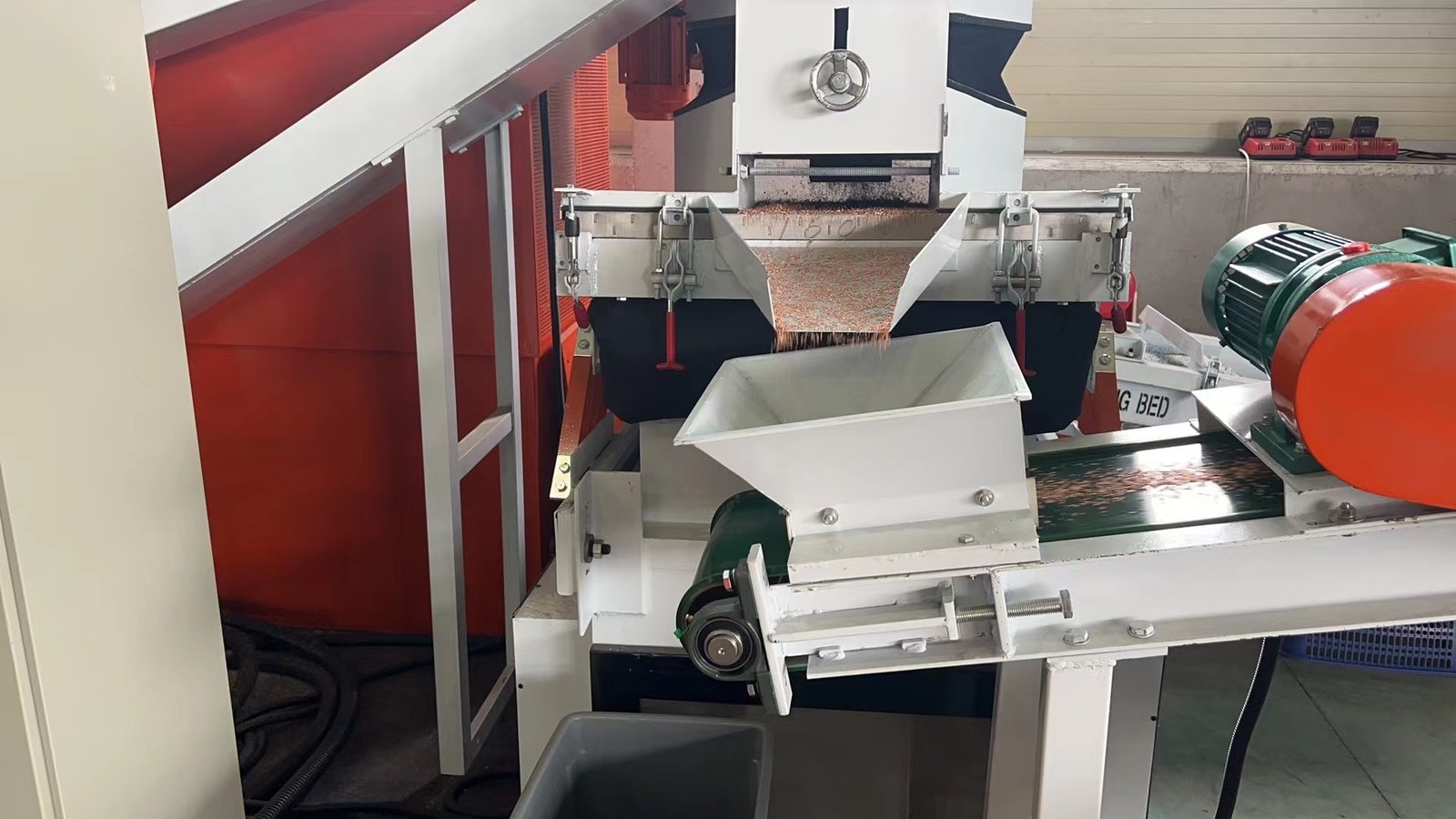
Why do dry air separation tables inherently lose fine copper hair strands?
Fluidized density separation operates by balancing aerodynamic drag against gravitational settling. While highly effective for coarser wire chops, aerodynamic drag challenges arise as conductor diameters drop below 0.20 mm, where high surface-area-to-mass ratios can cause fine metal particles to become entrained in the light polymer fraction.
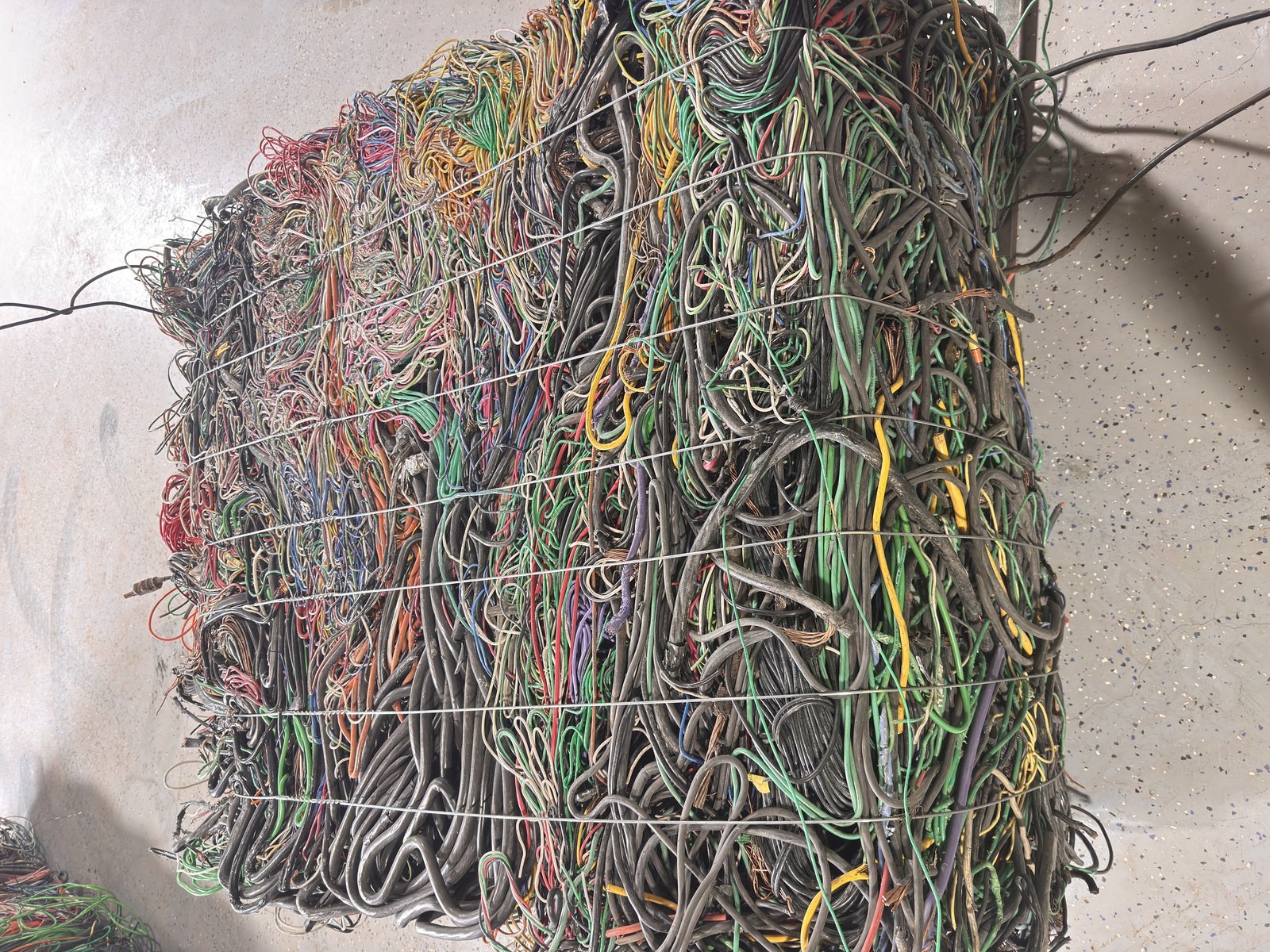
Fluidizing aerodynamics, aerodynamic drag, and the fine-wire physical limit
A dry air density separation table is an exceptional machine for classifying coarse particles. When separating 1.5 mm solid copper pellets ($8.96\text{ g/cm}^3$) from 2 mm PVC granules ($1.35\text{ g/cm}^3$), gravity and vibration easily drive copper uphill while fluidizing air sweeps plastic downhill. As established in equipment research by the European IPPC Bureau Waste Treatment Reference Document, aerodynamic separation efficiency deteriorates dramatically when particle size drops below a critical threshold:
- The Surface-Area-to-Mass Problem: A 2 mm copper chop has a mass of approximately 37 milligrams with a surface area of 12.5 mm² (a surface-to-mass ratio of 0.34). In contrast, a 0.15 mm diameter capillary copper wire strand (found in automotive data cords and headphone wires) cut to 2 mm length has a mass of just 0.31 milligrams with a surface area of 0.96 mm²—a surface-to-mass ratio of 3.10 (nearly 10x higher!).
- Aerodynamic Drag Overcomes Gravity: In any upward airstream, aerodynamic drag force ($F_d = \frac{1}{2}\rho v^2 C_d A$) scales with projected surface area ($A$), while gravitational downward force ($F_g = mg$) scales with mass ($m$). For hair-thin copper wire, the upward aerodynamic lift force exerted by the air table blower easily overcomes its microscopic weight. The fine copper strand floats buoyantly alongside the plastic fluff, discharging out the waste chute.
- The Operational Catch-22: If the operator reduces blower air velocity to prevent blowing fine copper away, the heavy PVC plastic pellets stop fluidizing. Dense plastic stays grounded on the deck, crawling uphill and contaminating the clean copper discharge! Therefore, on automotive wiring harness feeds, air table recovery inevitably caps at 96.0% to 97.5%, leaving a permanent 2.5% to 4.0% copper loss in the plastic tails.
How does a 35,000-volt electrostatic separator achieve 99.8% metal recovery?
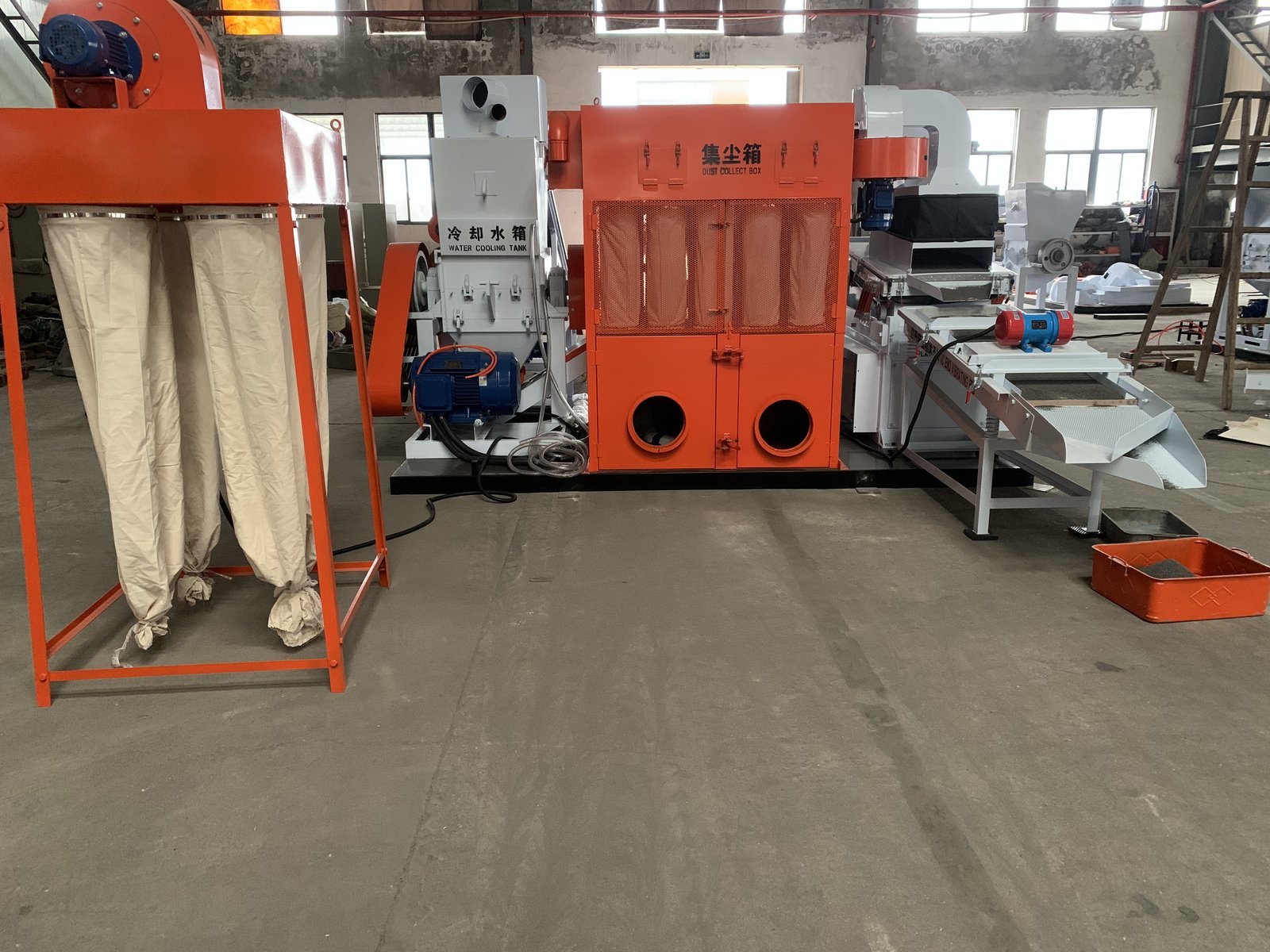
I walk facility managers through the electrical conductivity physics of corona discharge roll separation. The electrostatic separator charges all falling particles with a 35,000-volt corona field; conductive copper particles instantly discharge into the grounded drum and fly free, while non-conductive plastic particles retain their charge, pinning to the drum until scraped away by a rear brush.
Corona ionization, charge relaxation time, and electrostatic pinning forces
Electrostatic separation uses differences in electrical behavior, but performance still depends on particle size, liberation, moisture, dust and operating conditions. Test representative tailings on the proposed separator and measure the copper content of every output before quoting capture efficiency or overall plant recovery.
- High-Voltage Corona Ionization: Material discharged from the air table tailings is fed evenly onto a grounded rotating metal drum. An ionizing corona electrode operating at high direct-current voltage creates an electrical field that imparts a surface charge to both conductive metal particles and non-conductive polymer flakes.
- Charge Dissipation Differential: Conductive copper particles rapidly dissipate their electrical charge to the grounded roll and are thrown clear by centrifugal force and gravity into a clean metal discharge chute. Insulating polymer particles hold their surface charge, adhering electrostatically to the drum surface until removed by a stationary wiper blade into a tailings bin.
- Separation Influences: Separation efficiency requires dry, free-flowing feed. High ambient humidity, surface moisture, or unliberated composite particles impede electrical charge dissipation and reduce separation sharpness.
What is the detailed financial payback model for adding an electrostatic unit?
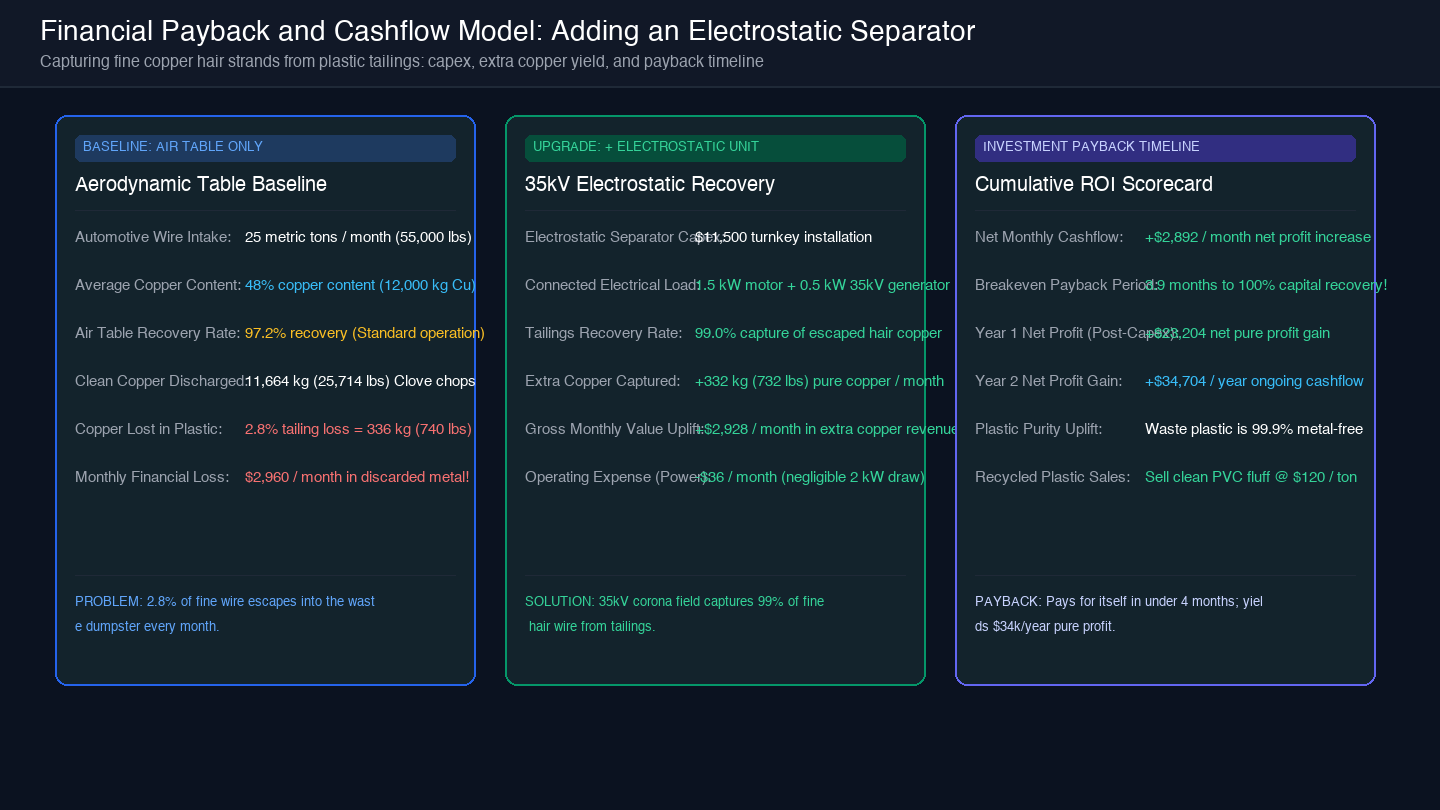
I provide scrap yards with a comprehensive financial model showing that the machine pays for itself in less than 4 months. For a scrap yard processing 25 tons of automotive wire per month, an electrostatic unit recovers an extra 330 kg of clean copper monthly ($2,900+ extra cashflow), paying off its $11,500 purchase price in 3.9 months.
Quantitative monthly cashflow, capital amortization, and multi-year ROI
Evaluating the capital return of secondary electrostatic separation requires analyzing scrap feed composition, tailing copper content, and total operating expenses. Consider the following hypothetical illustrative model:
- Baseline Feed Assumptions (Hypothetical Illustration):
• Monthly Scrap Cable Intake: 25 metric tons (55,115 lbs)
• Estimated Copper Content: 48% (12,000 kg / 26,455 lbs contained copper)
• Primary Air Table Recovery: 97.2% (recovering 11,664 kg clean copper)
• Unrecovered Copper in Tailings: 2.8% of metal burden = 336 kg (740 lbs) copper in polymer tailings per month - Secondary Electrostatic Recovery (Hypothetical Illustration):
• Assumed Electrostatic Capture Rate on Tailings: 99.0%
• Additional Copper Recovered: 336 kg × 99% = 332.6 kg (733.2 lbs) copper per month (~13.3 kg per ton of scrap cable input)
• Illustrative Net Copper Value Realization: .00/lb basis = approximately +,933 gross monthly revenue uplift - Ownership & Operating Cost Considerations:
• Incremental Electrical Power: High-voltage power supply and drive motor (~2.0 kW total draw)
• Maintenance & Cleaning: Periodic electrode dusting, drum surface cleaning, and ionization wire replacement
• Capital Amortization: Equipment acquisition, installation, electrical hookup, and space allocation - Financial Payback Dynamics: In operations processing high ratios of fine capillary wire (such as automotive harnesses or telecommunication cables), recovering unliberated fines can generate positive cashflow. Actual payback duration depends on machine capital cost, feed composition, running hours, and prevailing metal pricing.
What secondary benefits does an electrostatic separator provide for plastic tailings?
Beyond immediate metal recovery, extracting residual copper from polymer tailings influences secondary byproduct handling, residue disposal classifications, and potential recycling outlets.
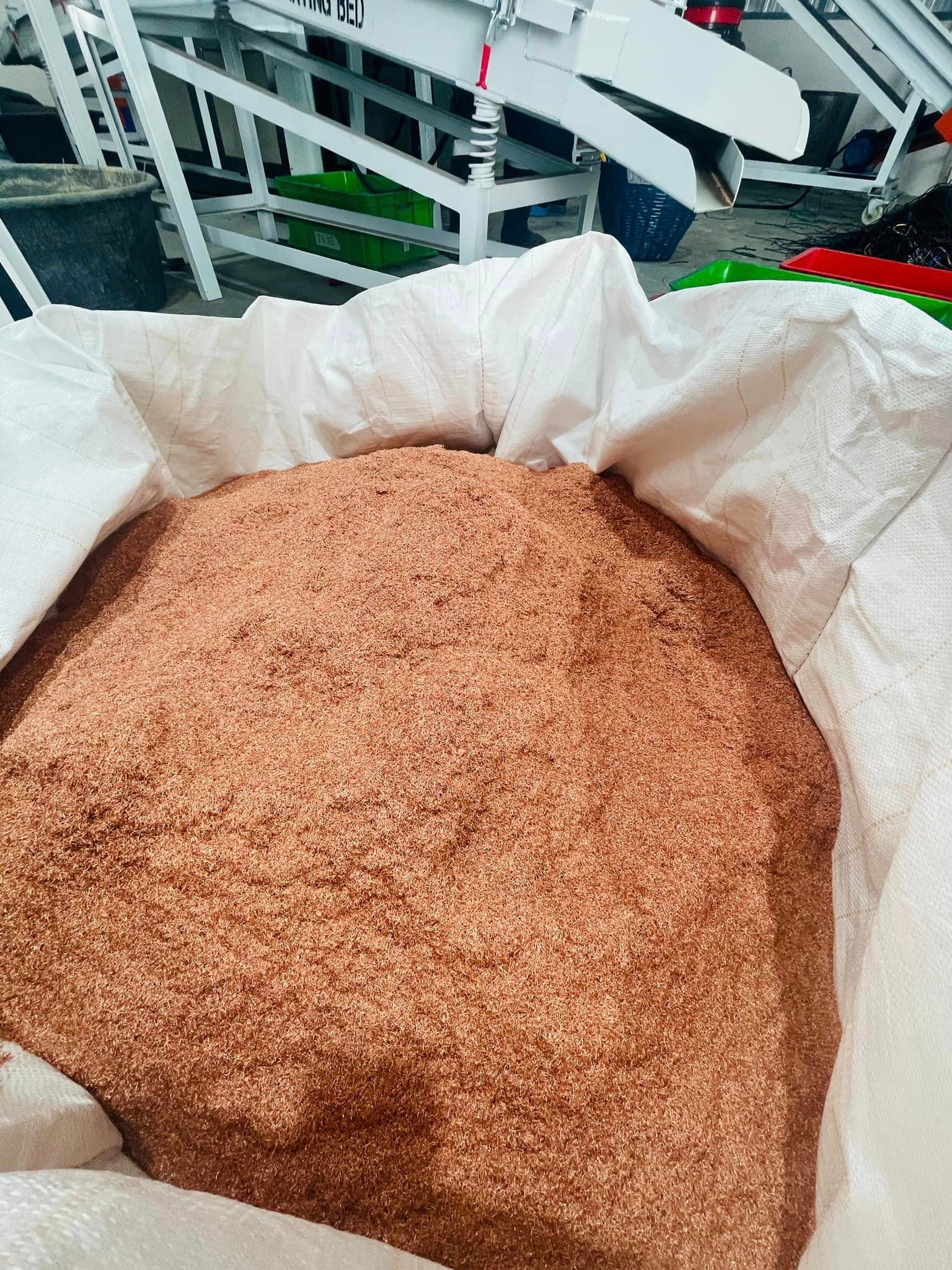
Plastic circularity, landfill tipping fee elimination, and secondary polymer sales
While secondary metal recovery provides the direct financial justification for electrostatic equipment, minimizing residual metal in polymer fractions offers operational advantages:
- Residue Classification & Disposal Costs: Polymer tailings containing elevated copper percentages may be subject to specialized waste disposal fees or environmental landfill restrictions in certain jurisdictions. Reducing residual copper content facilitates compliance with local non-hazardous waste thresholds, though local regulations govern actual classification.
- Polymer Reclamation Potential: Removing metallic fines improves the technical feasibility of downcycled polymer blending or extrusion into non-critical products (such as construction pads or conduit). However, mixed plastic streams (containing co-mingled PVC, PE, and cross-linked resins) require dedicated downstream sorting, cleaning, and buyer qualification before material revenue can be realized.
To review technical specifications for standalone and integrated electrostatic roll separators, explore our copper granulator machine catalog, or request a tailor-made payback calculation from MECUVO engineers.
Key Takeaways
Adding a secondary electrostatic separator provides a proven engineering solution for capturing fine copper strands that escape dry air tables. Conducting representative feed trials, verifying mass balances across all output fractions, and evaluating complete capital and operating costs enables scrap yards to optimize overall metal recovery.
— YOUR RECYCLING PROJECT
Find the right machine for your material.
Tell us your material and required capacity.
Or email sales@mecuvo.com