Table of Content
Operating a copper wire granulator with dull knives is the fastest way to bleed money in a scrap yard. Rotor blades made of D2 or SKD-11 tool steel must be sharpened every 80 to 120 operating hours and replaced after 4 to 6 grindings, maintaining a precise cutting clearance of 0.20 mm to 0.30 mm against stationary bed knives. When cutting edges round past 0.40 mm, the machine stops shearing clean cylindrical chops and begins tearing wire, causing fine copper hair strands to smear into plastic tailings and triggering sudden motor amperage spikes.
What are the primary operational signs that your granulator blades need sharpening?
I train maintenance crews to track machine amperage and granule morphology daily rather than relying strictly on calendar hours. Key indicators of dull blades include a 15% to 25% increase in main motor operating current, flattened or smeared copper granules, visible wire strands trapped in the plastic discharge, and rising cutting chamber temperatures exceeding 70°C.
Blade wear physics, thermal friction, and copper tailing losses
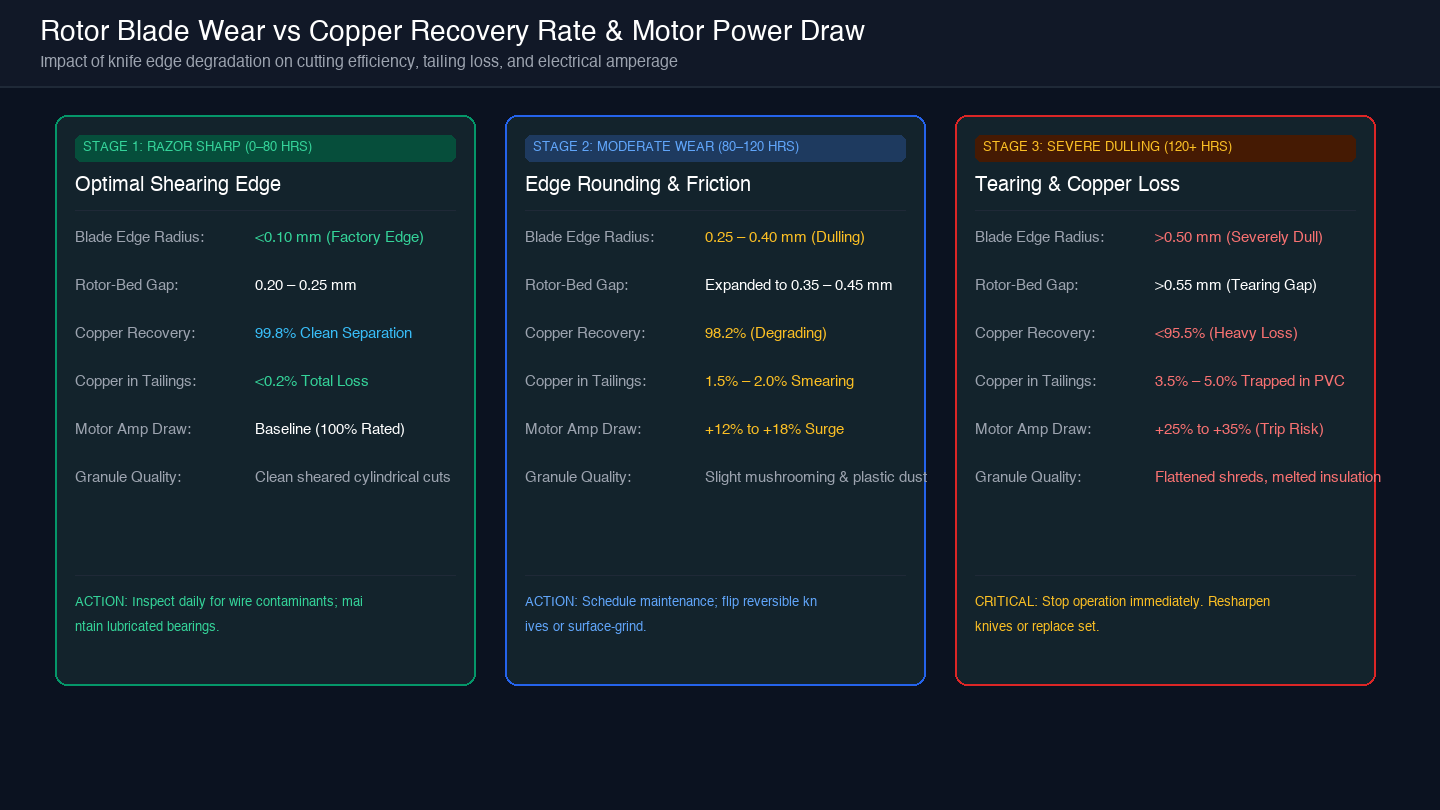
In a high-speed copper wire granulator, the cutting chamber functions on pure scissor shearing mechanics. Sharp knives slice multi-conductor PVC and copper wires into clean, distinct granules. According to industrial operational standards in the European IPPC Bureau Waste Treatment Reference Document, cutting edge degradation follows three predictable phases that directly dictate recovery yield:
- Edge Rounding and Increased Amperage: Sharp D2 tool steel blades possess a factory cutting edge radius under 0.08 mm. As abrasive copper wire and plastic filler pass through the rotor, friction gradually rounds this radius past 0.30 mm. Rather than cleanly severing the conductor, the dull edge drags and crushes the wire against the rotary screen. On an electrical ammeter, this extra shearing resistance manifests as a steady 15% to 25% current surge (e.g., from a baseline 48A running load with sharp knives up to 56A–60A continuous under identical steady-state cable infeed, representing a 15% to 25% operational load surge).
- Thermal Smearing and Plastic Gumming: As mechanical friction replaces clean shearing, cutting chamber temperature escalates rapidly from a normal 45°C–55°C up to 75°C–90°C. PVC and rubber insulation soften near their glass transition points, becoming gummy. This molten plastic encapsulates fine copper hair strands, creating composite agglomerates that cannot be separated on the downstream dry airflow table.
- Plastic Tailings Contamination: When knives are sharp, copper losses in plastic tailings stay strictly below 0.2%. Once blade edges exceed 0.50 mm radius, copper loss surges to 3.5%–5.0%, sending hundreds of dollars of clean metal into the waste dumpster every shift. For an in-depth diagnosis of tailing contamination, see our troubleshooting guide on stopping copper loss in granulator plastic tailings.
| Operating Metric | Sharp Factory Knives (0–80 Hrs) | Moderate Wear (80–120 Hrs) | Severely Dull (>120 Hrs) |
|---|---|---|---|
| Blade Edge Radius | <0.10 mm | 0.25–0.40 mm | >0.55 mm |
| Chamber Operating Temp | 42°C – 52°C | 58°C – 68°C | 78°C – 95°C (Overheating) |
| Motor Load Amps | 100% baseline | 115% – 120% | 130% – 145% (Thermal trip risk) |
| Copper in Tailings | <0.2% | 1.2% – 1.8% | 3.5% – 5.2% |
| Copper Chop Shape | Crisp cylindrical pellets | Slight edge burrs | Flattened flakes & wire nests |
How does blade clearance gap directly affect copper recovery and machine power draw?
I emphasize that setting the gap between rotary knives and bed knives with a calibrated feeler gauge is the most critical 30 minutes of machine maintenance. The optimal clearance gap is 0.20 mm to 0.30 mm (0.008 to 0.012 inches); setting it wider than 0.40 mm allows thin wires to slip through unsheared, while setting it narrower than 0.15 mm risks catastrophic thermal knife clash during continuous running.
Mandatory Safety Prerequisite: Lockout/Tagout (LOTO) and Mechanical Rotor Immobilization
CRITICAL SAFETY WARNING (OSHA 1910.147 Compliant): Never open the granulator cutting chamber, loosen knife mounting bolts, or insert feeler gauges without completing full hazardous energy isolation:
- Zero Energy Electrical Isolation: Disconnect and physically padlock the primary electrical disconnect switch at the main distribution panel; attach authorized employee Lockout/Tagout (LOTO) safety tags.
- Zero Motion & Electrical Verification: Depress the local start pushbutton to test and verify that incoming power is completely de-energized, and ensure all auxiliary blowers and conveyors have come to a complete standstill.
- Mechanical Rotor Locking Pin: Manually engage the manufacturer-certified mechanical locking pin into the rotor flywheel or shaft indexing hole. This physically immobilizes the cutting cylinder, preventing gravitational rotation or spring-back while hands are inside the knife path.
- Mandatory Cut-Resistant PPE: Always wear ANSI Cut Level A5 (or EN388 Level 5) Kevlar gloves and heavy eye protection when handling knife seats or adjusting feeler gauges.
- Model-Specific Manufacturer Precedence: All knife clearance values (0.20–0.30 mm), bolt torque ratings (180–220 Nm), and sharpening intervals (80–120 hours) discussed below represent baseline guidelines for D2/SKD-11 tool steel on standard mixed cable. Always verify against your specific granulator model manual and manufacturer-certified maintenance schedules.
Calibrating knife clearance tolerances across the rotor width
The gap between the rotating rotor knives and the stationary bed knives determines whether the granulator performs clean precision shearing or inefficient grinding. As documented in technical research by the Copper Development Association, copper has high ductility, meaning dull knives or wide clearances simply stretch copper filaments instead of parting them.
To achieve maximum recovery yield, operators must follow rigorous clearance setting protocols:
- The Multi-Point Feeler Gauge Check: Never measure knife clearance at a single central point. Because rotors experience thermal expansion and shaft deflection under load, operators must slide a brass or stainless feeler gauge (0.25 mm) across five equidistant points along the length of each bed knife: far left, mid-left, center, mid-right, and far right. Clearance must remain uniform within ±0.03 mm across the entire rotor span.
- Thermal Growth Allowance: During steady-state granulator operation, friction heats the rotor body by 25°C to 40°C. Due to thermal expansion of steel, the rotor expands radially by approximately 0.05 mm to 0.08 mm. If an operator sets the cold knife clearance too tightly (e.g., 0.10 mm), the rotating knives will expand and collide with the bed knives as soon as the machine reaches operational temperature, causing cracked knife edges or bent rotor shafts.
- Consequences of Excessive Gap (>0.40 mm): When the gap widens past 0.40 mm, thin multi-strand automotive cables and communication wires (0.15 mm–0.30 mm diameter) do not shear. Instead, they fold over the bed knife edge, jamming the sizing screen apertures and causing immediate motor stalling. To understand how fine wires behave under mechanical shearing, review our guide on granulating automotive wire harnesses without copper loss.
- Bed Knife Inversion Protocol: Most industrial granulators feature reversible bed knives with two to four usable cutting edges. When the active cutting face rounds, the operator can unbolt the knife, clean the seat thoroughly with an industrial degreaser, and flip it to an unused edge, cutting maintenance downtime by 50%.
What is the correct procedure for sharpening and balancing granulator blades?
I advise recyclers never to use a handheld angle grinder on granulator blades; high-precision wet surface grinding is mandatory to preserve steel temper. Blades must be ground on a specialized magnetic-chuck wet surface grinder at a 45-degree bevel, applying abundant coolant to prevent surface overheating past 150°C, and knife sets must be balanced in matching pairs within 5 grams of each other.
Wet grinding parameters, hardness retention, and rotor dynamic balancing
Sharpening granulator knives is not merely about restoring a sharp edge; it is about preserving the metallurgical integrity of high-alloy tool steel. Industrial granulators utilize high-carbon, high-chromium tool steels such as AISI D2, DIN 1.2379, or Japanese SKD-11 heat-treated to 58–60 HRC. Improper grinding destroys this hardness in seconds.
Key rules for professional blade reconditioning include:
- Flood Coolant Surface Grinding: Hand-grinding with an abrasive wheel generates localized friction temperatures exceeding 600°C, causing micro-structural annealing (softening the steel to below 45 HRC) and microscopic surface stress fractures. Knives must be secured on a reciprocating magnetic chuck grinder equipped with water-soluble synthetic flood coolant. Material removal must be restricted to 0.02 mm to 0.03 mm per grinding pass.
- Preserving Factory Bevel Angles: Granulator rotor blades typically feature a primary bevel angle of 45° with a 2° relief land. Altering this angle alters the shearing force: an angle steeper than 50° increases motor torque demand and crushes copper, whereas an angle shallower than 40° creates a fragile cutting edge prone to chipping when encountering tramp steel staples.
- Precision Rotor Pair Weighing: High-speed rotors spin at 450 to 650 RPM. If opposing knives on a five-row rotor differ in weight by more than 5 to 10 grams after grinding, centrifugal imbalance induces heavy harmonic vibration. This vibration destroys the spherical roller pillow-block bearings within 200 operating hours. Always weigh sharpened knives on a digital gram scale and arrange them in diametrically opposed balanced pairs around the rotor shaft.
- Removing Grinding Burrs: After grinding, use a fine Arkansas stone or hard felt honing wheel lubricated with light oil to de-burr the cutting edge back-face. Leaving an abrasive grinding burr will cause the knife edge to micro-chip during the first 15 minutes of wire feeding.
When must granulator blades be permanently retired and replaced?
I teach operators that every knife has a minimum width limit stamped by the manufacturer; grinding beyond this safety margin invites catastrophic blade failure. Blades must be replaced when total material ground away exceeds 15 mm to 20 mm from the original width, when bolt slot clearances become compromised, or when deep impact chipping exceeds 2.5 mm into the cutting shoulder.
Safe dimensional limits, bolt torque specs, and operational cost analysis
Every granulator blade has a finite mechanical service life. Standard D2 rotor knives measure 80 mm to 100 mm in original width. Each professional re-grind typically removes 0.8 mm to 1.5 mm of worn steel, providing 4 to 6 resharpenings over the life of a knife set before retirement.
To ensure plant safety and equipment integrity, adhere to these retirement and replacement criteria:
- Minimum Safe Width Threshold: Once grinding approaches within 5 mm of the knife mounting bolt holes, the cross-sectional clamping force diminishes. Continuing to operate with undersized knives risks bolt shearing under shock load, which allows the knife to detach into the spinning rotor at 500 RPM, completely destroying the cutting chamber, screen, and rotor shaft.
- Bolt Torque and Thread Integrity: When reinstalling sharpened knives, always inspect the Grade 12.9 high-tensile mounting bolts. Clean female rotor threads with compressed air and replace bolts every two knife changes. Torque bolts with a calibrated torque wrench in a cross-pattern to 180–220 Nm (depending on M16 vs M20 bolt specification). Never use air impact wrenches without torque verification.
- The Economics of Knife Maintenance: A complete set of replacement D2 knives for a 400 kg/h granulator costs approximately $650 to $900. Operating dull knives costs a commercial scrap yard roughly $160 per shift in lost copper tailings (3% loss on 3 metric tons of cable = 90 kg copper @ $4.00/lb = $792 per week) plus $18/day in excess electricity. Re-sharpening costs roughly $60 at a local machine shop, generating a 10x return on investment on the first day of resumed operation.
To explore heavy-duty machinery built with quick-change knife clamps and reversible bed knives, explore our full line of MECUVO copper granulator machines, or consult our engineering team for spare blade sets and maintenance advice.
Key Takeaways
Sharpening D2 rotor blades every 80 to 120 operating hours and setting a precise 0.25 mm clearance gap prevents copper tailing losses, lowers motor electricity by 18%, and preserves 99.8% recovery yields.
— YOUR RECYCLING PROJECT
Find the right machine for your material.
Tell us your material and required capacity.
Or email sales@mecuvo.com