Table of Content
Scrap yard owners frequently hesitate to purchase a copper granulator because they fear their existing warehouse space is too constricted to fit an industrial recycling plant. A compact commercial copper granulator line requires only 20 to 25 square meters (215 to 270 sq ft) of floor space organized into three streamlined zones: a raw wire sorting buffer (8 m²), the core processing cell (10 m²), and a finished packaging station (7 m²). Examining spatial zoning, pallet jack turning radii, vertical cyclone clearances, and exterior dust ducting proves that even small urban scrap shops can operate an in-house granulation plant.
How much floor space does a complete compact granulator cell require?
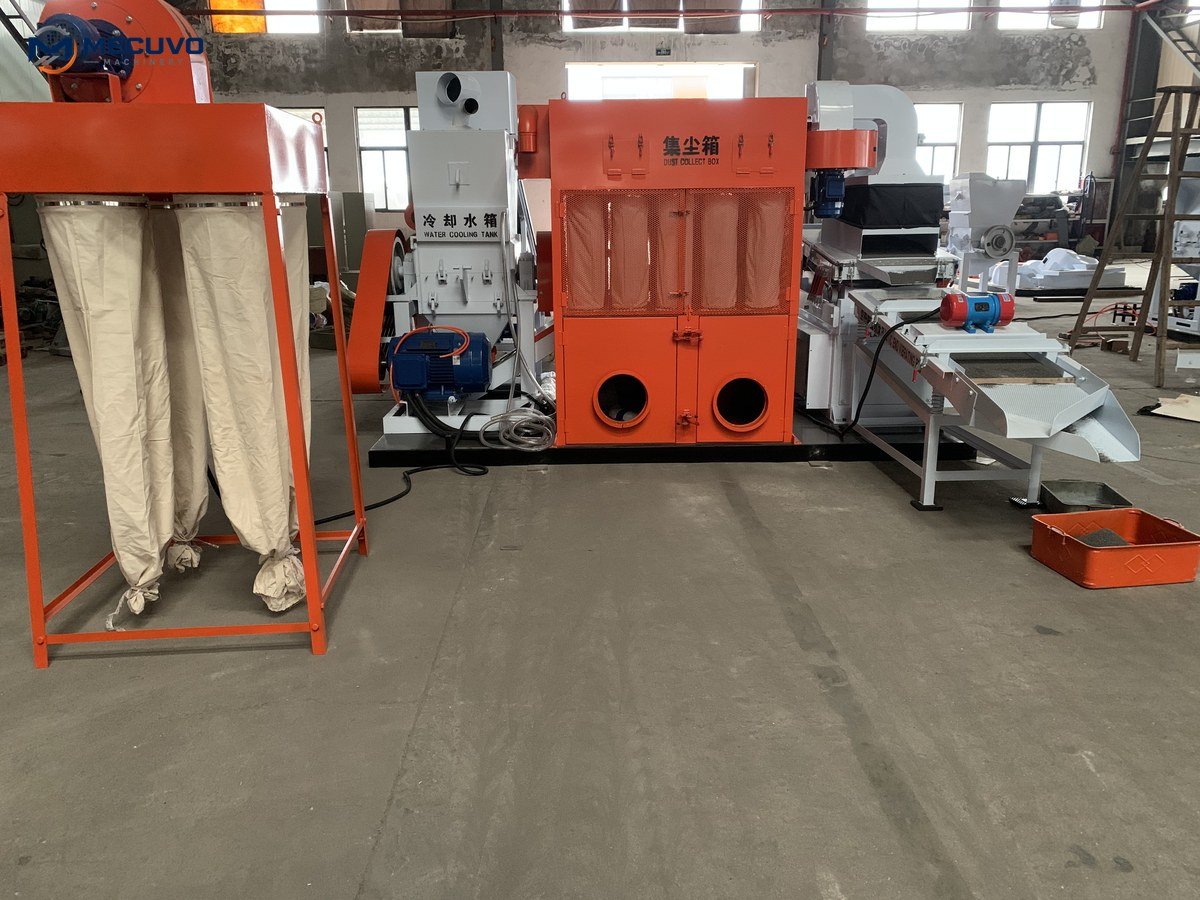
I provide the physical dimensions and structural clearances for a compact processing plant. The core machine occupies just 3.2 m x 2.2 m of floor space, requiring a total operating envelope of 10 to 12 m² with 3.2 meters of overhead vertical clearance for cyclone ducting.
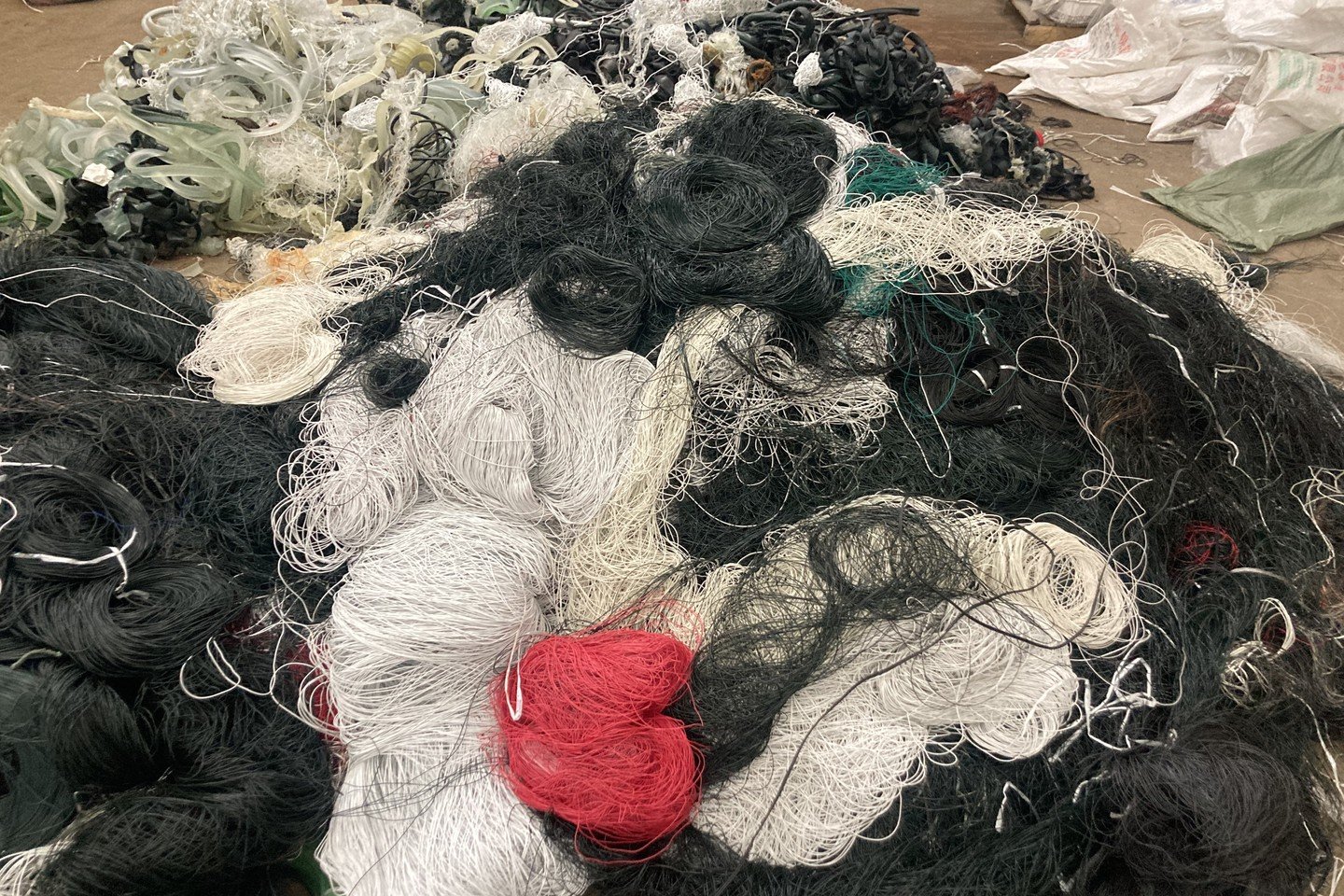
Machine footprint specifications, cyclone overhead clearance, and concrete slab thickness
Modern engineering concentrates commercial processing capacity into minimal floor space:
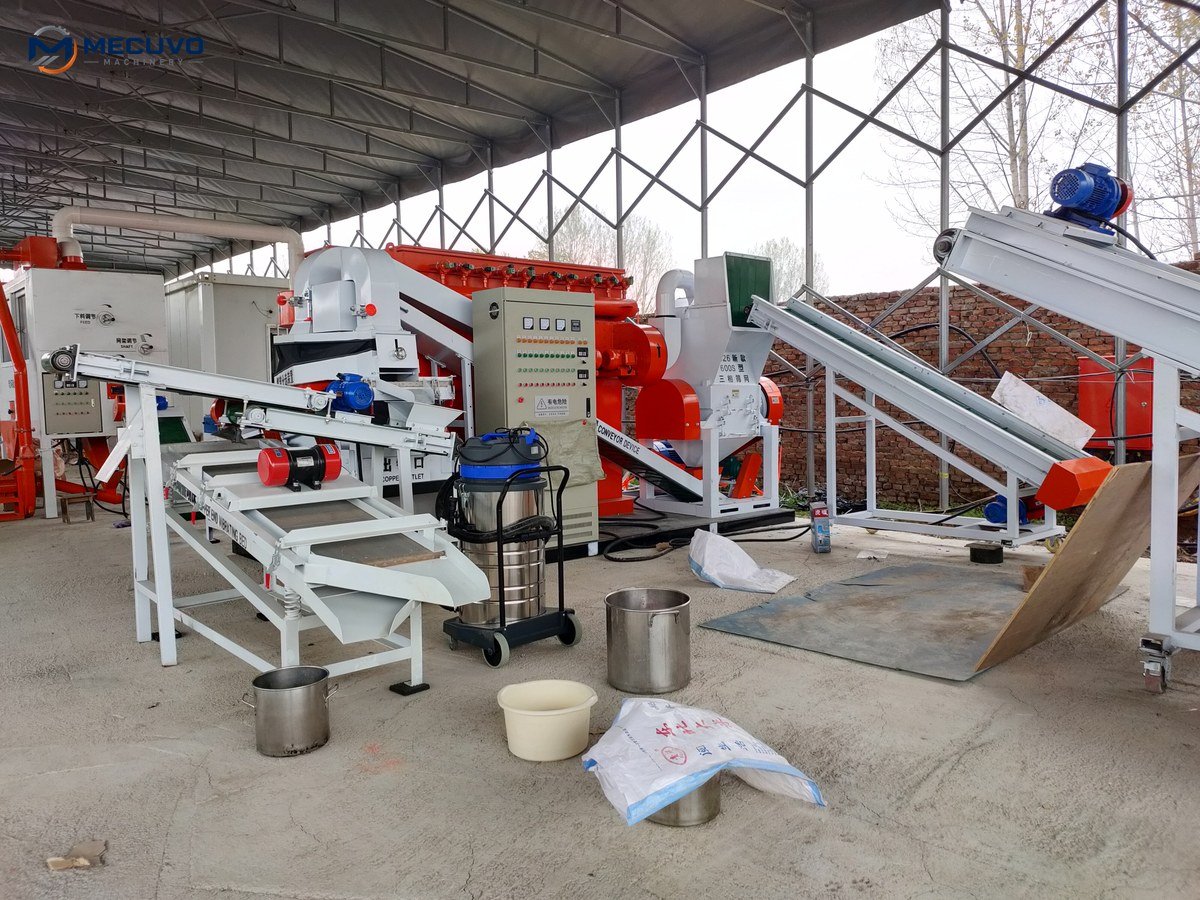
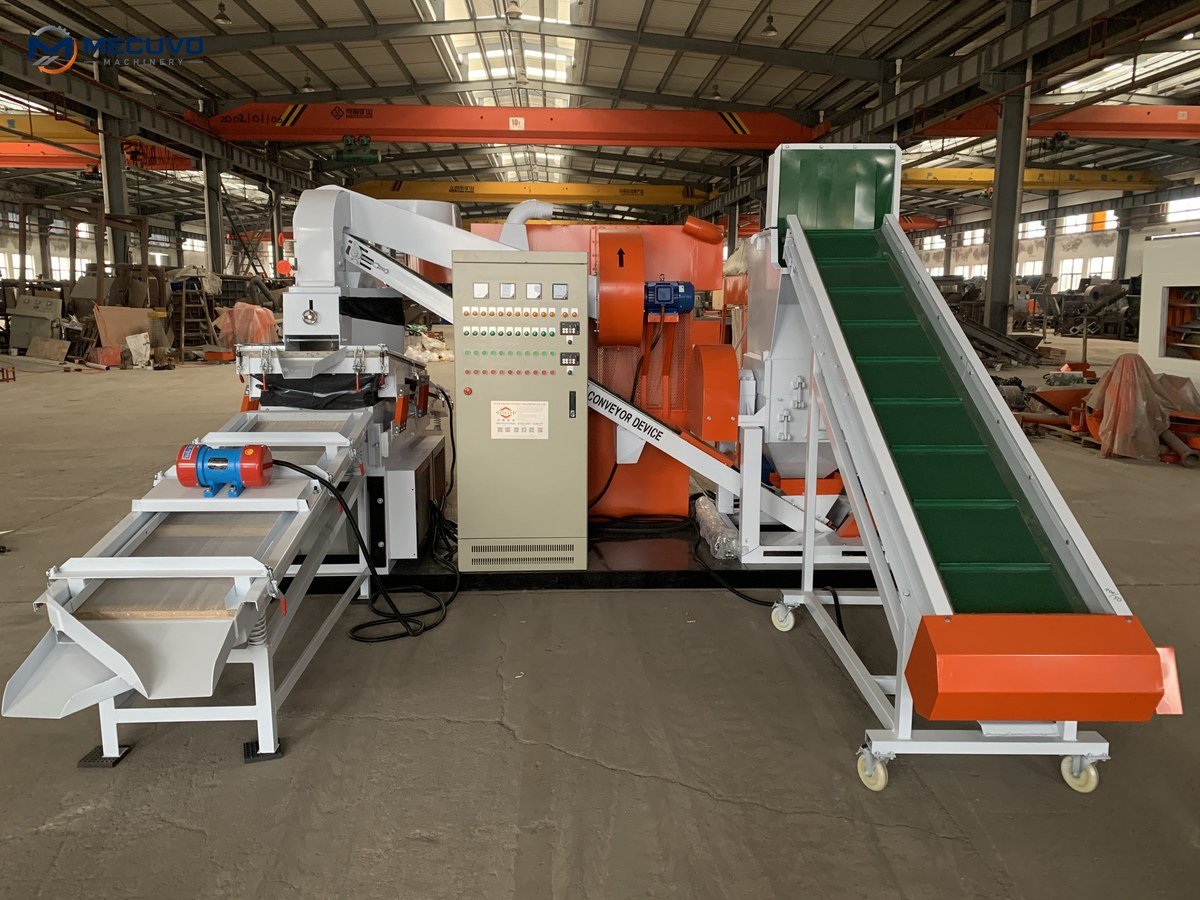
- The Integrated Monoblock Design: Unlike sprawling modular plants of the past, compact systems like the MECUVO Model 300 integrate the infeed conveyor, magnetic separator, cutting mill, primary cyclone, and vibrating air density table onto a single rigid steel chassis. The physical machine footprint measures just 3.2 meters long by 2.2 meters wide.
- Vertical Ceiling Clearance: The highest component is the primary pneumatic aspiration cyclone discharge, which requires a minimum ceiling height of 3.2 meters (10.5 feet) to accommodate vertical gravity airlocks.
- Concrete Foundation Requirements: The unit sits on standard 150 mm (6-inch) reinforced concrete industrial slab. Heavy-duty elastomeric vibration isolation pads absorb harmonic vibration, preventing floor cracking.
How should a small scrap yard divide its 25 m² floor plan into functional zones?
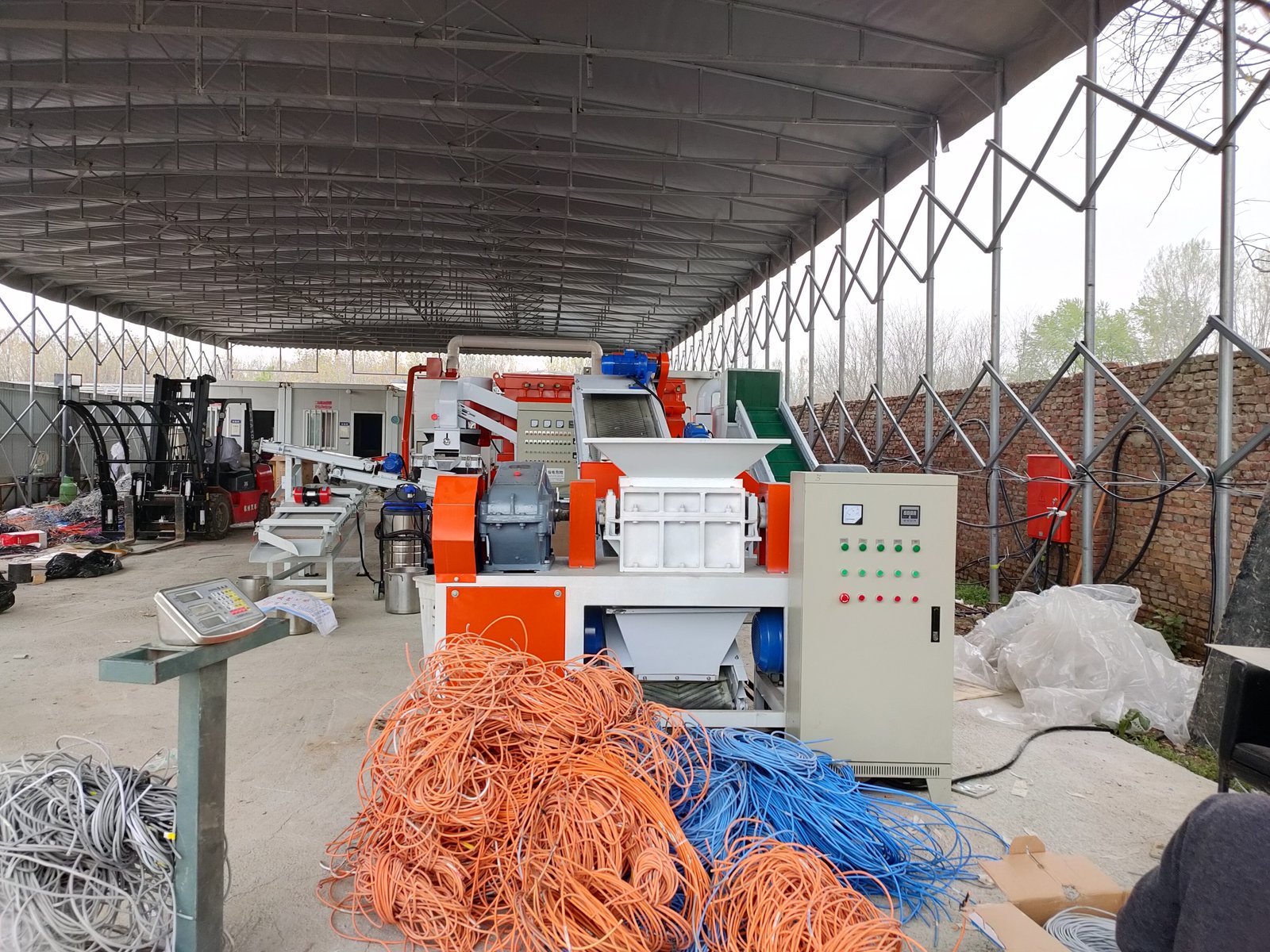
I walk through the 3-zone layout that guarantees clean material flow and prevents cross-contamination. Divide the 25 m² area into: Zone 1 for raw wire staging and plug snipping (8 m²), Zone 2 for the granulator cell (10 m²), and Zone 3 for finished copper super-sacks and exterior dust exhaust (7 m²).
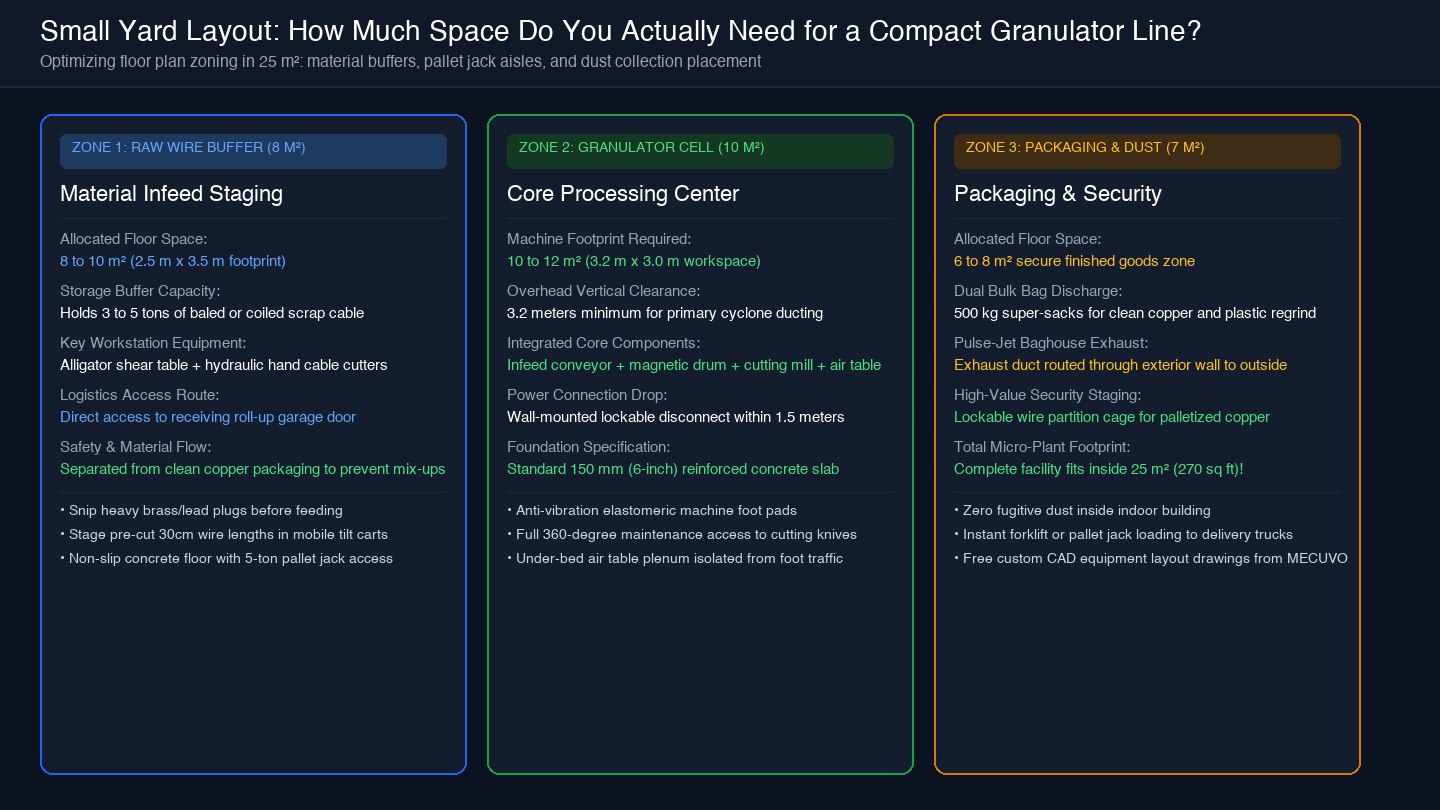
3-zone layout architecture: material flow buffers, pallet jack turning aisles, and security
A disciplined floor plan prevents clutter and maximizes operator efficiency:
- Zone 1: Raw Material Staging & Pre-Sort (8 m²): Positioned directly adjacent to your warehouse loading door. Houses 3 to 5 tons of incoming wire bales on heavy wood pallets, an alligator shear bench for snipping heavy brass and lead fittings, and rolling tilt carts for staging pre-cut 30cm wire lengths.
- Zone 2: Core Granulator Cell (10 m²): Positioned along an interior wall. Provides 1.0-meter walking clearance around the machine for knife maintenance and screen access. The main electrical disconnect is mounted on the wall directly opposite the control panel, meeting NEC Article 110.26 working clearance rules.
- Zone 3: Packaging & Exterior Dust Extraction (7 m²): The dual discharge chutes deposit finished No. 1 Clove pellets and clean PVC regrind directly into 500 kg FIBC super-sacks. A lockable wire security partition encloses finished copper sacks to prevent overnight theft.
How do you manage dust collection and noise in tight indoor spaces?
I explain how exterior wall penetrations eliminate indoor dust and keep ambient shop air clean. Penetrate the exterior warehouse wall with smooth spiral ducting to mount the pulse-jet dust collector outdoors, completely eliminating indoor fugitive dust and fan noise.
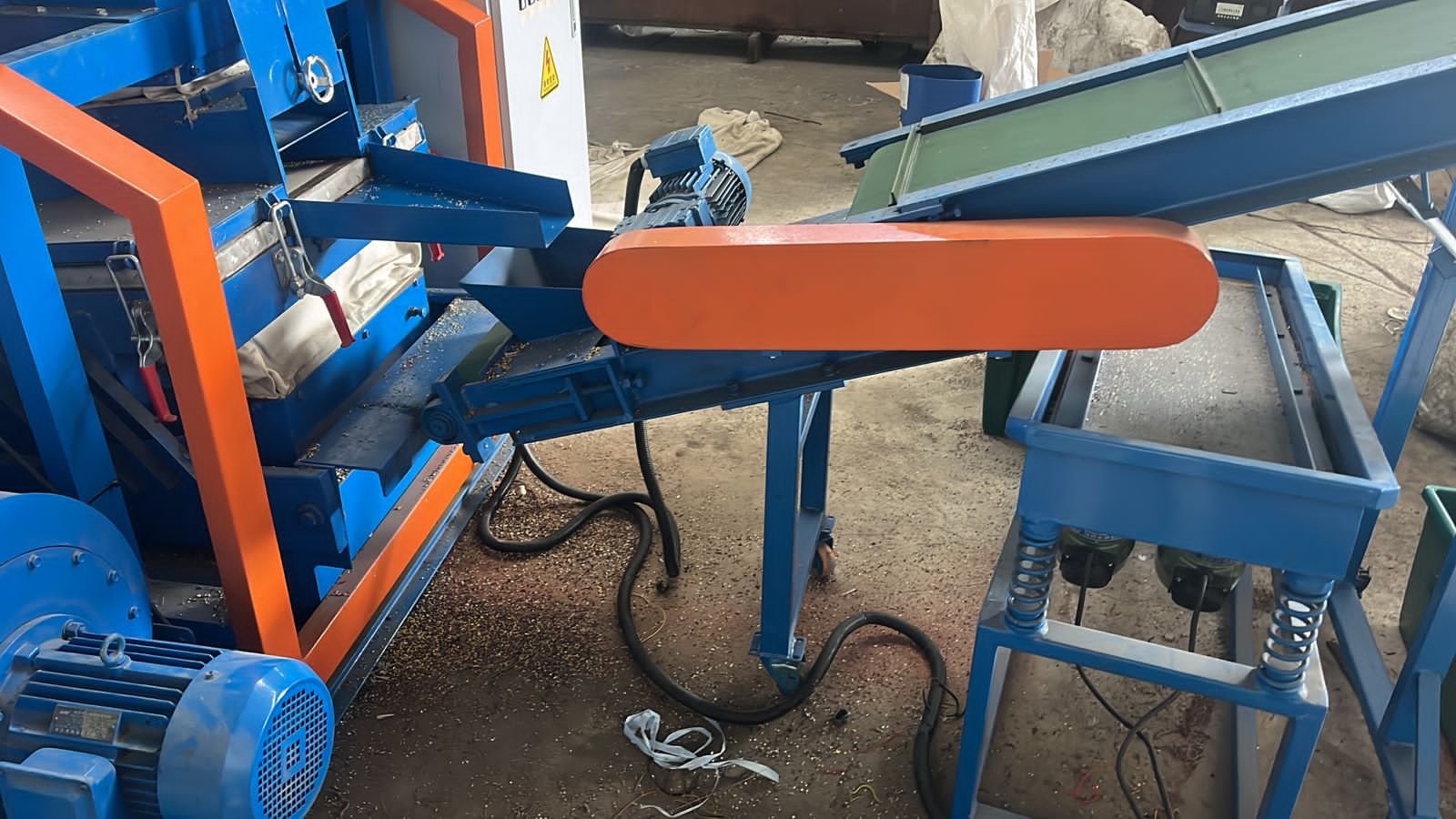
Negative-pressure pneumatic ducting, exterior pulse-jet baghouse mounting, and OSHA noise standards
Maintaining clean indoor air quality in a compact space is simple with proper duct routing:
- Exterior Baghouse Mounting: Mount the pulse-jet dust collector outside the warehouse on a poured concrete pad or heavy wall-bracket shelf. Route a 200 mm (8-inch) galvanized spiral duct through the building wall. This removes fan motor noise from the shop and isolates combustible polymer dust compliant with NFPA 652 standards.
- Negative Pressure Dust Hoods: Enclosed acrylic view hoods over the cutting chamber infeed and vibrating density table maintain continuous negative air draft, ensuring zero plastic fluff or copper micron dust escapes into the shop air.
How does MECUVO assist with facility CAD layout blueprints?
I describe MECUVO’s engineering layout service tailored to your exact building dimensions. MECUVO provides complimentary custom 2D/3D CAD equipment placement drawings, electrical conduit routing schematics, and material flow plans tailored to your specific building dimensions.
Complimentary 2D/3D CAD layout planning, electrical drop schematics, and factory engineering support
Never guess whether equipment will fit:
- Send Your Room Dimensions: Provide our design team with a simple hand sketch or architectural blueprint showing your room length, width, ceiling height, door locations, and existing electrical panels.
- Receive Turnkey CAD Drawings: Within 48 hours, MECUVO delivers a full CAD equipment placement drawing showing exact machine positioning, forklift turning lanes, foundation anchor bolts, and conduit drops.
Request Your Free Custom Shop Layout Blueprint
- Free CAD Layout Consultation: Contact MECUVO engineering with your building dimensions to receive a tailored 25 m² installation blueprint.
- Free Factory Sample Testing: Ship 20–50 kg of your scrap wire to MECUVO to test throughput and recovery on our compact machines.
- Direct Factory Price & Spec Sheet: Review our compact commercial systems on the MECUVO copper granulator machines overview page.
Key Takeaways
You do not need a massive plant to profit from wire granulation; a compact MECUVO machine fits in 25 m², runs cleanly with exterior dust venting, and transforms small scrap yards into high-margin copper processing hubs.
— YOUR RECYCLING PROJECT
Find the right machine for your material.
Tell us your material and required capacity.
Or email sales@mecuvo.com