Table of Content
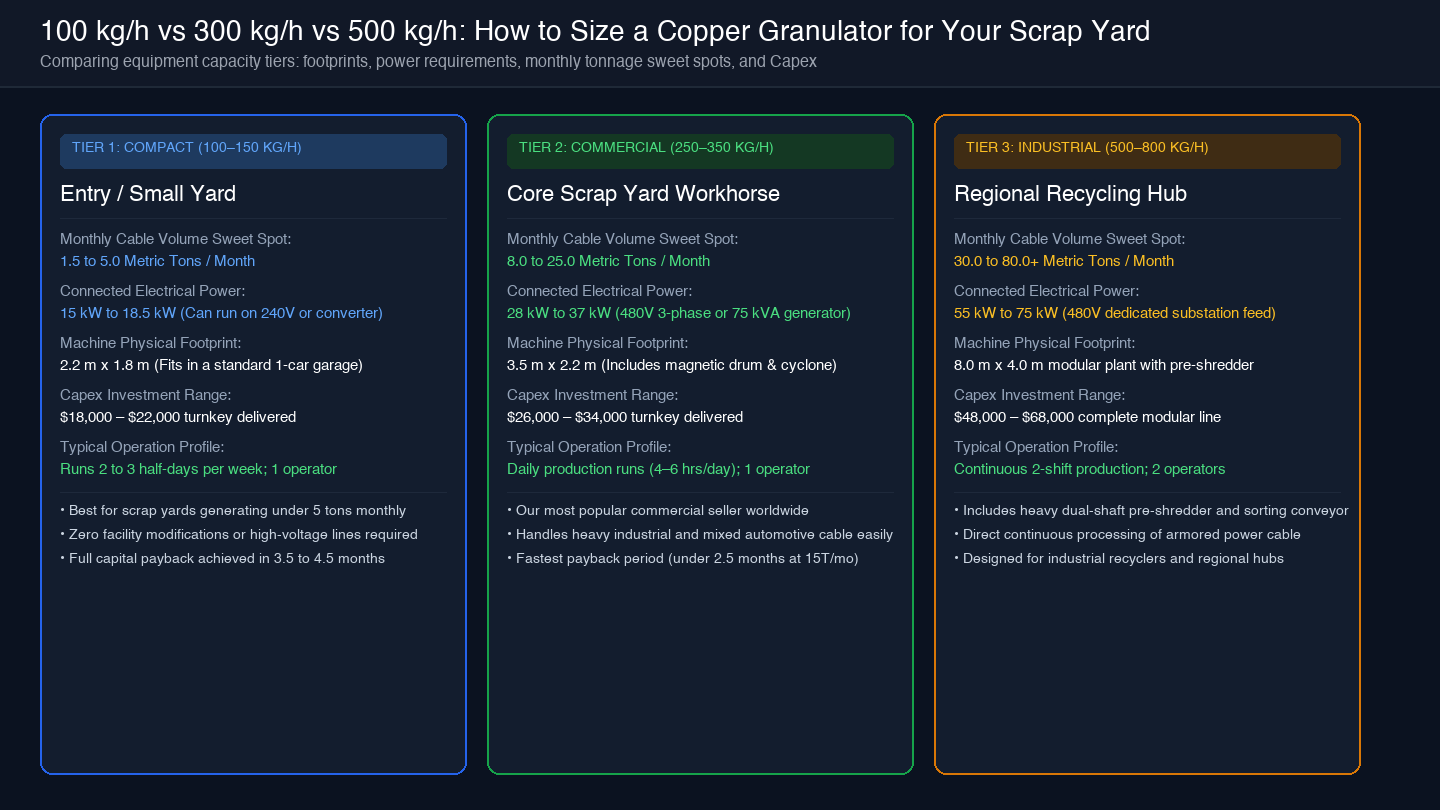
Selecting the wrong granulator capacity creates costly operational problems: buy too small and your yard suffers severe material bottlenecks; buy too large and you waste tens of thousands of dollars on oversized idle machinery. Selecting the optimal machine capacity depends on monthly wire tonnage: operations under 5 tons monthly thrive with compact 100–150 kg/h units; core commercial yards processing 8 to 25 tons require 250–350 kg/h workhorses; and regional hubs processing 30+ tons require 500–800 kg/h pre-shredder lines. Examining hourly throughput ratings, motor horsepower, physical machine footprints, and electrical service demands helps recyclers select the exact capacity tier that maximizes profitability.
How does the compact 100–150 kg/h tier perform for small operations?
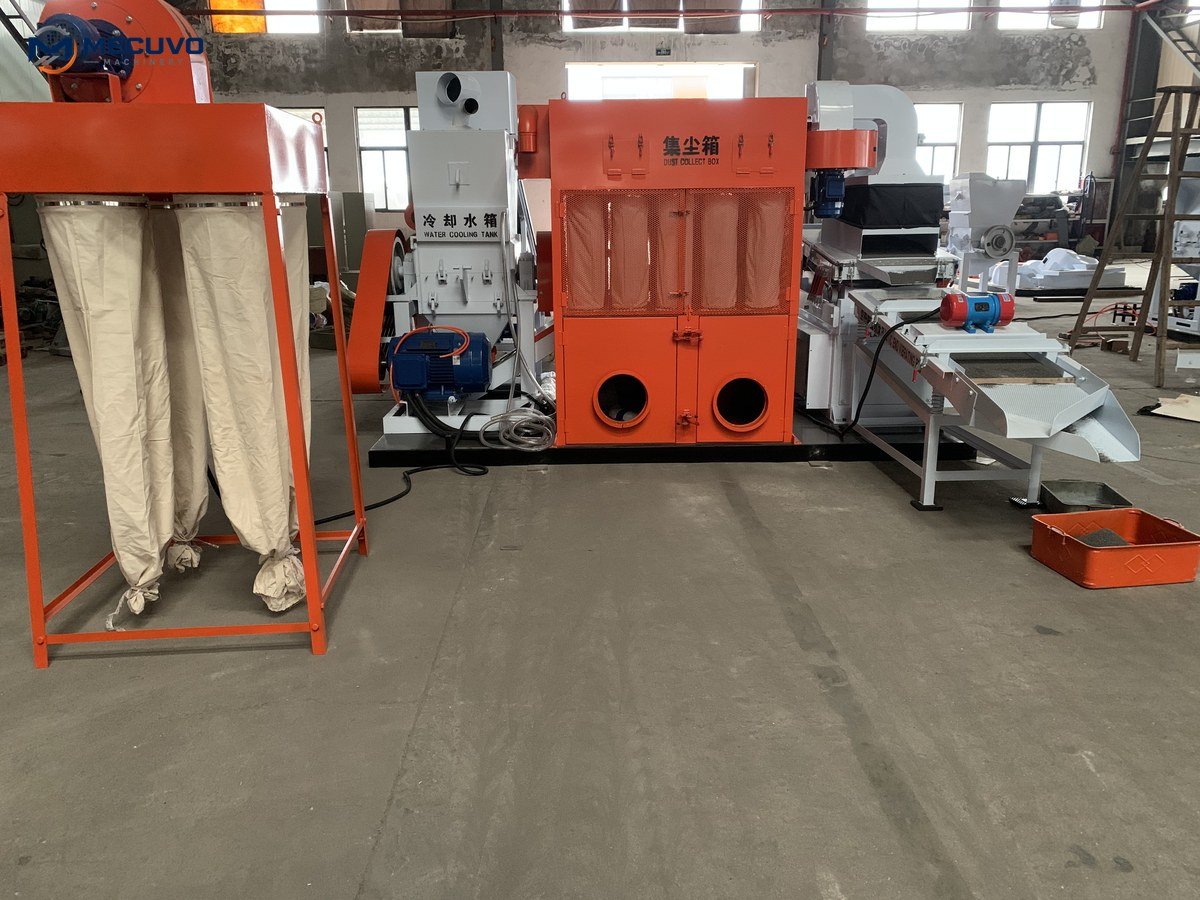
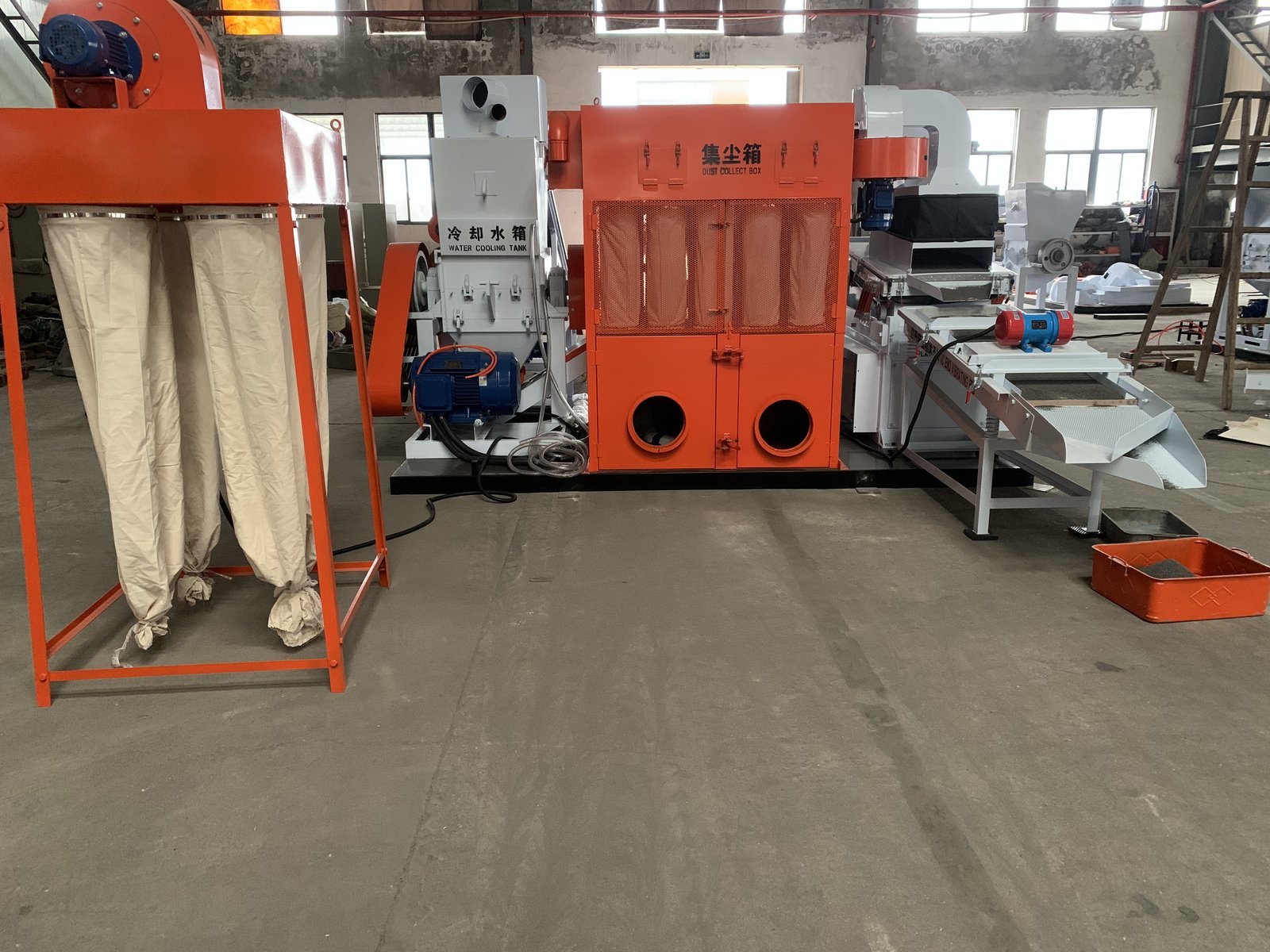
I analyze the footprint, power draw, and production throughput of compact entry-level granulators. Compact 100–150 kg/h systems feature a 15–18.5 kW power draw, fit in a standard garage (2.2m x 1.8m), process 1.5 to 5.0 tons monthly, and require an investment of $18,000 to $22,000.
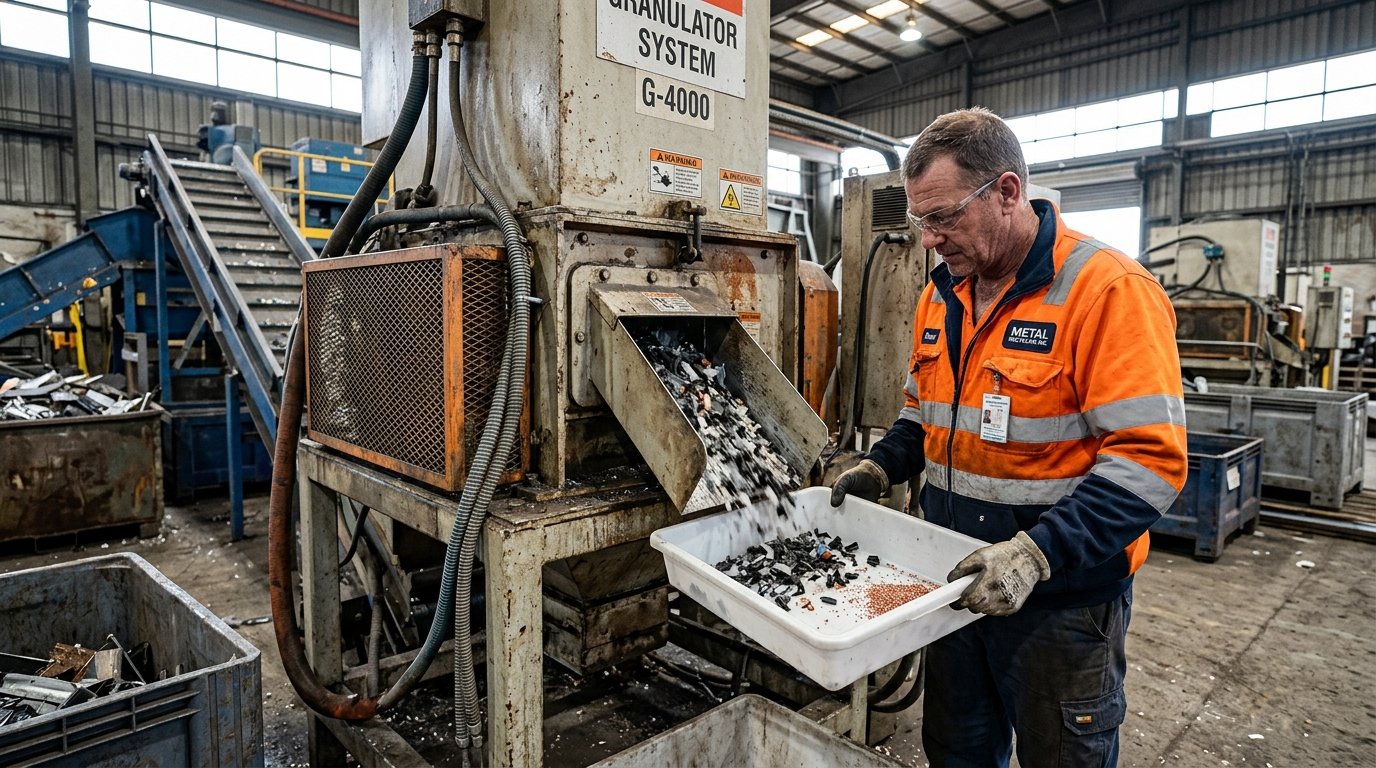
Entry-level capacity metrics, light-commercial power constraints, and garage setups
The compact tier is the ideal entry point for growing scrap yards:
- Target Monthly Volume: Best suited for operations processing 1.5 to 5.0 metric tons of cable per month (approx. 70 to 230 kg per day). Running 3 half-days per week clears all inventory.
- Power & Footprint: Draws only 15 kW to 18.5 kW total power, making it easy to run on 240V split-phase power via a rotary phase converter or a modest 45 kVA generator. Footprint is just 2.2 m x 1.8 m, fitting inside any standard workshop bay.
- Capex & Payback: Pricing ranges from $18,000 to $22,000 turnkey delivered, achieving complete payback in 3.5 to 4.5 months.
Why is the 250–350 kg/h tier the universal scrap yard workhorse?
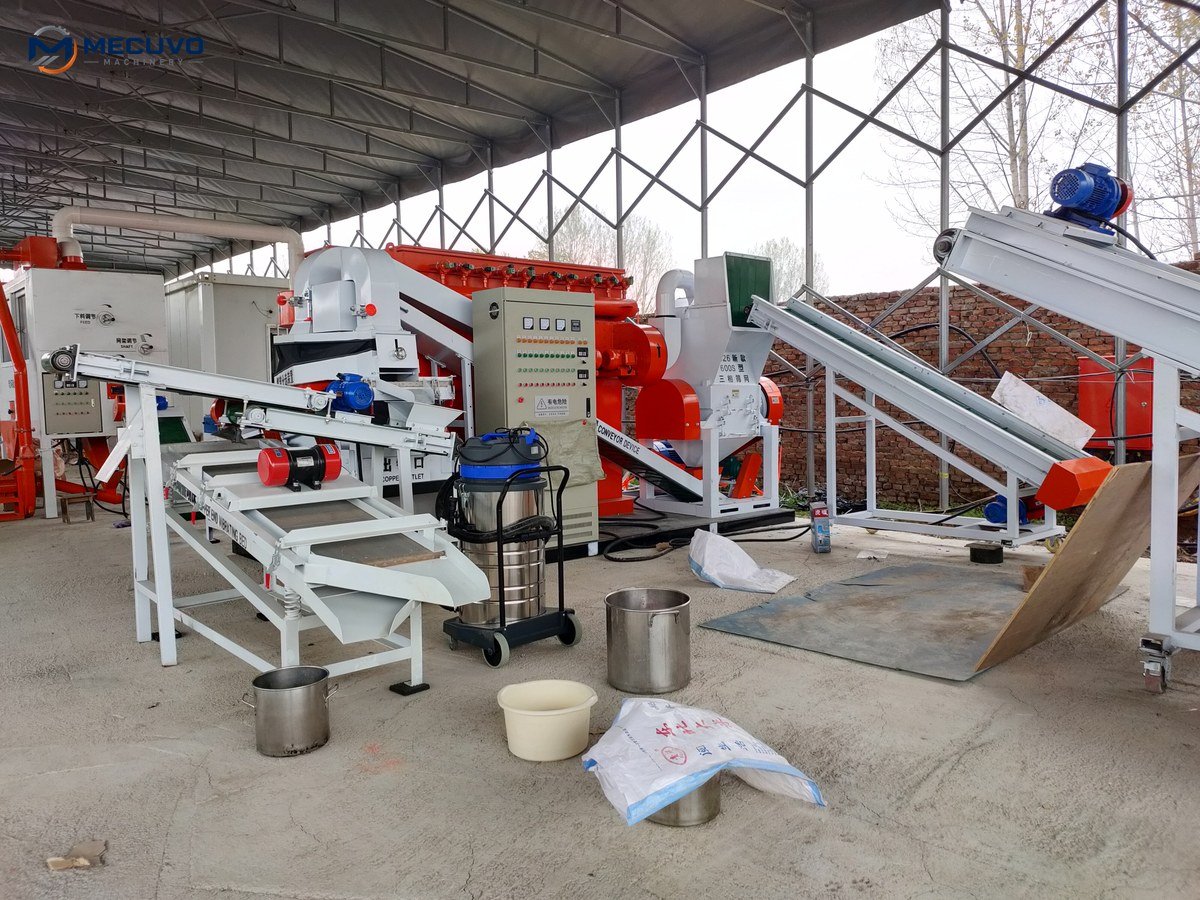
I explain why the mid-range commercial tier represents over 70% of global recycling machinery installations. The 250–350 kg/h tier processes 8 to 25 tons monthly, handles tough automotive harness cable easily with a 28–37 kW powertrain, fits a 3.5m x 2.2m footprint, and achieves rapid 2.5-month payback.
Core commercial workhorse, automotive harness capability, and heavy rotor inertia
The 300 kg/h class is the definitive sweet spot for active scrap yards:
- Target Monthly Volume: Designed for yards processing 8.0 to 25.0 metric tons monthly. At 300 kg/hr, a full 10-ton batch is processed in just 33 operational hours.
- Powertrain & Infeed: Features a heavy solid forged 40Cr rotor powered by a 22 kW to 30 kW main cutting motor, coupled with a secondary pneumatic conveyor and heavy magnetic separation drum. The massive flywheel inertia powers through dense, tangled automotive wiring harness bundles without decelerating.
- Payback Economics: Priced at $26,000 to $34,000 turnkey, this machine pays for itself in under 2.5 months at 15 tons monthly volume.
When does your volume justify an industrial 500–800 kg/h pre-shredder line?
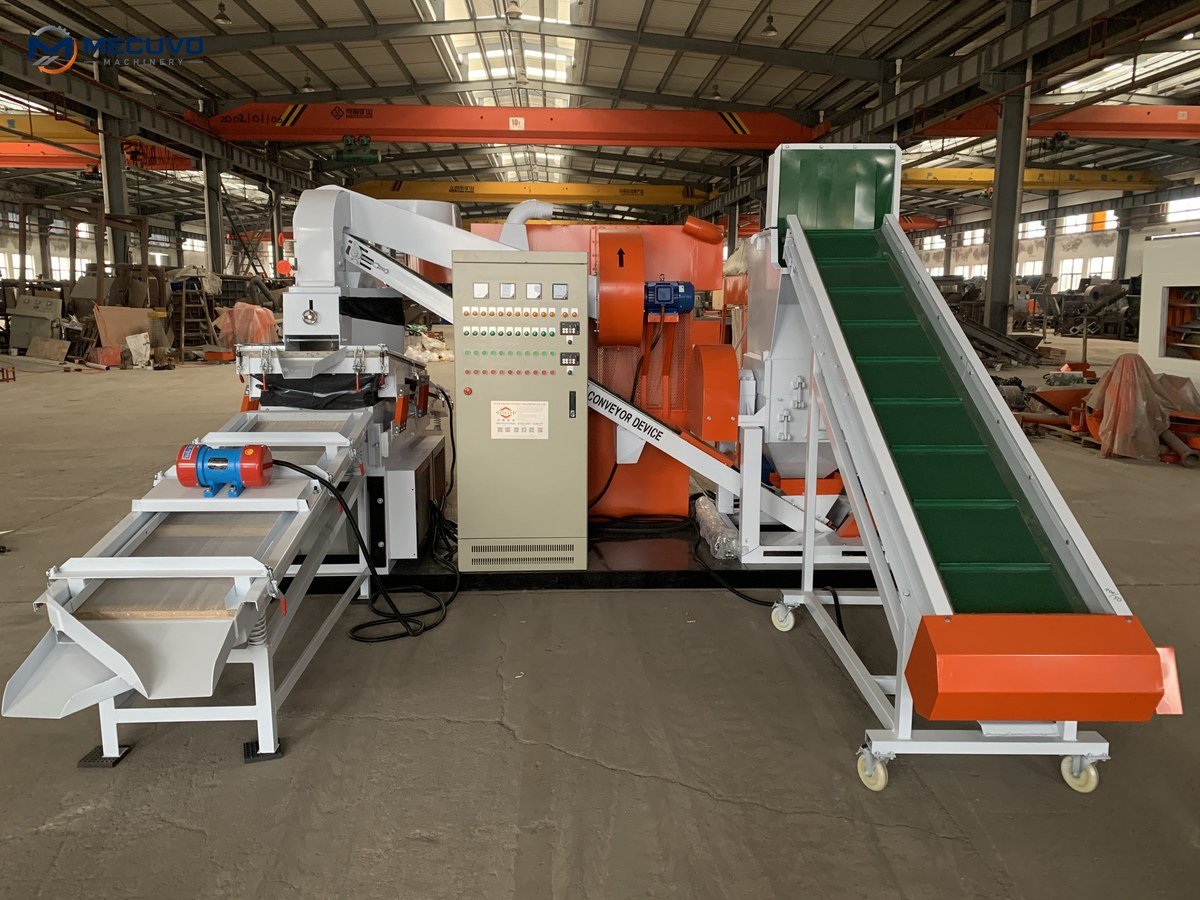
I examine the continuous 2-shift production demands that require industrial modular recycling plants. Volumes exceeding 30 tons monthly require an industrial 500–800 kg/h line with a dual-shaft pre-shredder and sorting conveyors, processing whole wire bales continuously with 55–75 kW power.
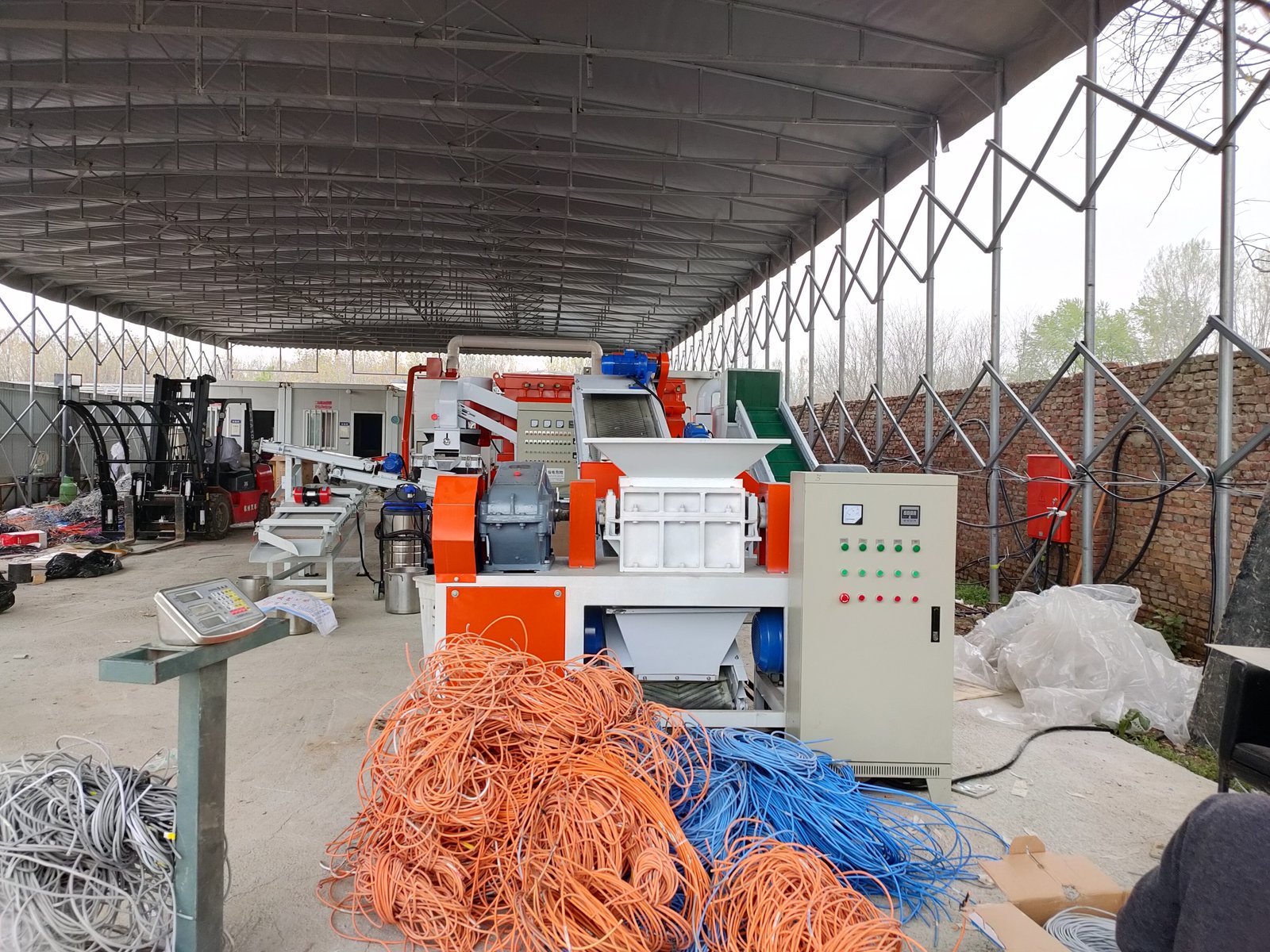
Dual-shaft pre-shredders, continuous conveyor infeed, and high-volume regional processing
Regional recycling operations require heavy industrial size reduction lines:
- Target Volume Threshold: Economical for facilities processing 30 to 80+ metric tons of wire monthly.
- Pre-Shredder Integration: Instead of hand-snipping long cables, entire bales of wire are dropped directly into a heavy dual-shaft shear pre-shredder (18.5 kW). The pre-shredder coarse-cuts cables into 50 mm lengths, which feed continuously across an overband cross-belt magnet into a secondary high-speed granulator mill.
- Capex Range: Complete turnkey modular lines range from $48,000 to $68,000, delivering industrial continuous processing.
How should recyclers match their growth projections to machinery capacity?
I provide a forward-looking sizing rubric to account for business growth over the next 36 months. Size your granulator for 150% to 200% of your current monthly wire volume; this accommodates 3-year business growth without requiring an early equipment trade-in.
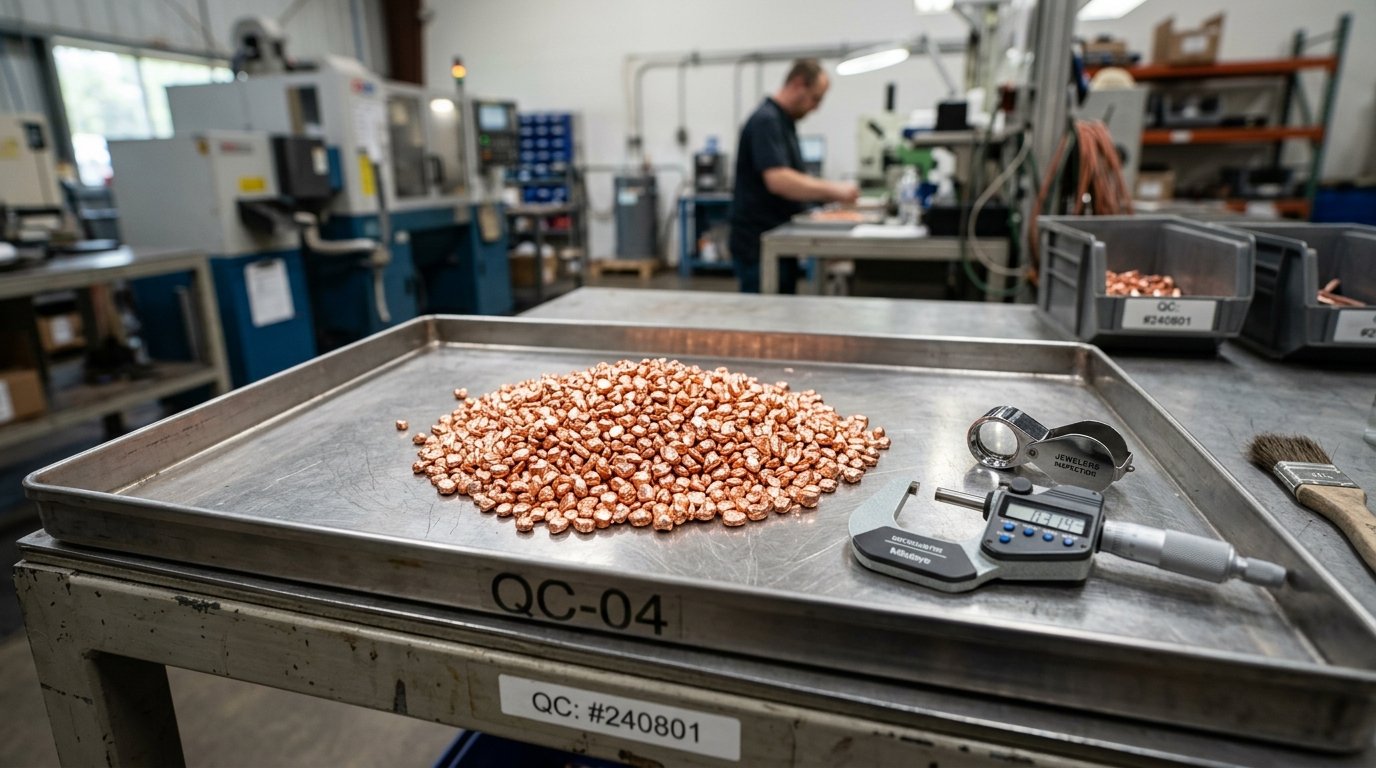
Future-proofing capacity sizing, utilization ratios, and equipment trade-in avoidance
When calculating capacity, never size solely for today’s volume:
- The Sizing Rule:
- Once local contractors and electricians learn that your yard granulates wire in-house and pays higher cash prices than brokers, your incoming scrap wire volume will double within 6 to 12 months. Buying a machine that can comfortably scale prevents you from outgrowing equipment prematurely.
Size Your Ideal Granulator with MECUVO
- Free Capacity Sizing Assessment: Contact MECUVO engineering with your current and projected monthly wire tonnage. We will provide an exact equipment sizing recommendation and electrical blueprint.
- Free Factory Sample Testing: Ship 20–50 kg of your scrap wire to MECUVO to test throughput across our compact and commercial machines on live video.
- Direct Factory Price & Spec Sheet: Review complete technical specifications across all three capacity tiers on our MECUVO copper granulator machines overview page.
Key Takeaways
Size your granulator for growth: compact 100–150 kg/h units serve operations under 5 tons; commercial 250–350 kg/h workhorses provide the fastest payback for 8–25 tons; and industrial 500+ kg/h pre-shredder lines dominate regional hubs.
— YOUR RECYCLING PROJECT
Find the right machine for your material.
Tell us your material and required capacity.
Or email sales@mecuvo.com