Table of Content
Prospective buyers frequently assume that owning a copper wire granulator requires processing industrial freight-car volumes of 20 to 50 tons of cable every month to remain profitable. Under the illustrative table assumptions of $22,000 investment and $1,410 additional margin per feed tonne, simple payback is about 7.8 months at 2 tonnes/month or 5.2 months at 3 tonnes/month, before omitted costs. Compare volume scenarios, complete incremental costs and price sensitivity to estimate whether the investment fits your operation; there is no universal tonnage threshold.
What is the minimum monthly tonnage threshold to justify a granulator?
There is no single minimum volume at which granulating beats selling raw wire. The decision depends on incremental margin per feed tonne, fixed costs, installed capital, financing and the target payback period. The 2-tonne example below illustrates the calculation under assumed recovery and sales terms; it does not establish that 1.5 to 2.0 tonnes/month will cover all ownership costs.
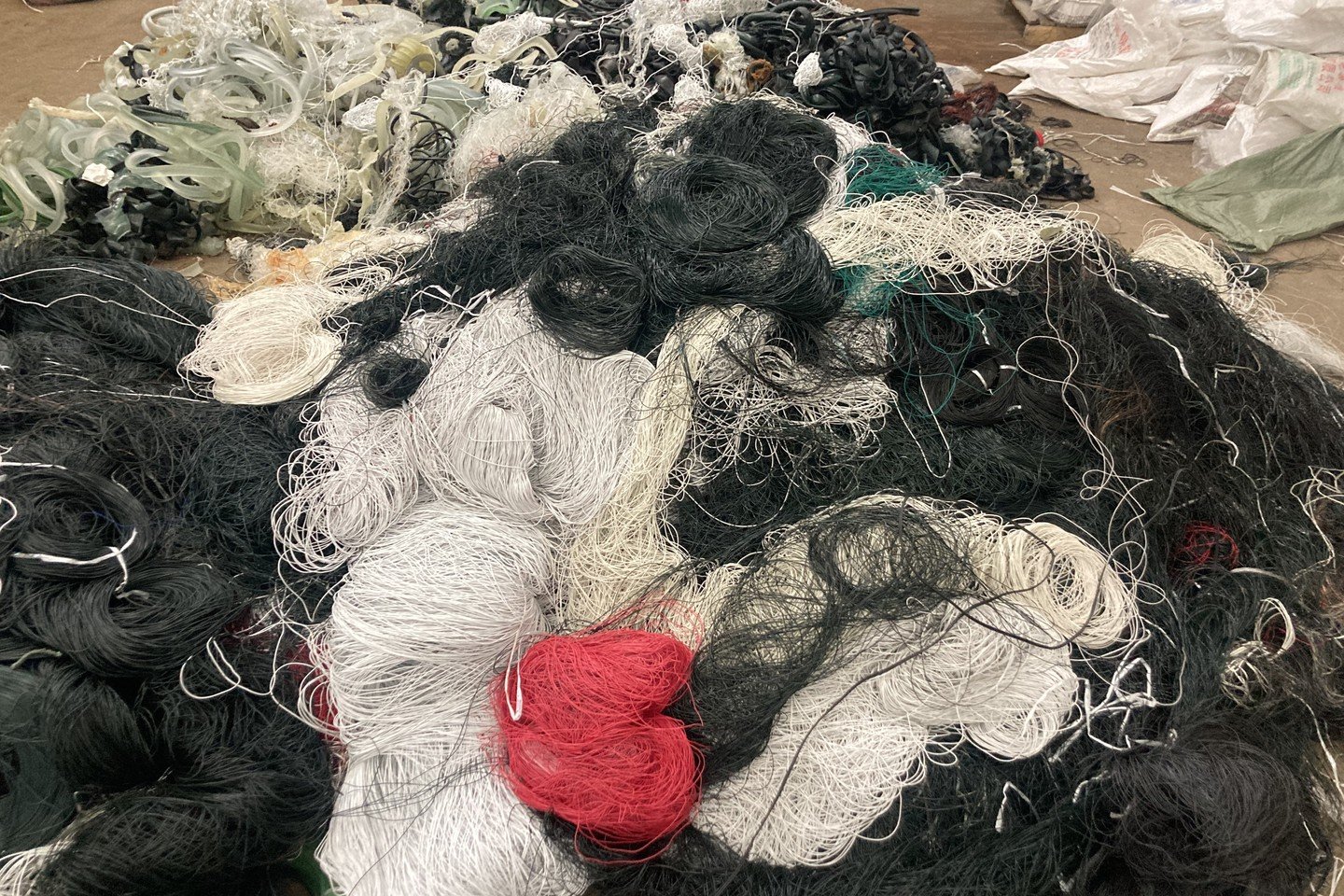
Minimum commercial processing volume, margin spread equation, and fixed overhead allocation
The following 2.0-metric-ton monthly scenario assumes 50% saleable copper yield, the stated buyer settlement and polymer credit. These are illustrative inputs rather than current market quotes. Include actual buyer deductions, labor, handling, downtime, losses and fixed costs before using the result.
- The Raw Wholesale Baseline: Selling 2.0 metric tons of unstripped wire to a broker at $1.35/lb ($2,976/T) generates $5,952 in gross revenue.
- The Illustrative In-House Scenario:
- 2.0 Tons Cable @ 50% Cu Recovery = 1.0 Ton (2,204 lbs) No. 1 Clove Copper
- Direct Foundry Settlement (98% COMEX Spot @ $4.10/lb): $8,855 Gross Revenue
- Plus 1.0 Ton Clean PVC Regrind Byproduct: +$200
- Less Operating Expenses (Power, SKD-11 Blade Wear, Routine Maintenance): -$280
- Modeled Receipts Less Listed Operating Costs: $8,775, before raw-wire opportunity value and omitted costs.
- Modeled Monthly Difference: Subtracting the $5,952 sell-raw baseline from $8,775 gives $2,823 in this scenario, before omitted incremental costs. This is not a guaranteed monthly profit.
- Illustrative Run Time: At a sustained feed rate of 200 kg/hr, 2 metric tons requires 10 processing hours per month. Add preparation, handling, cleaning, maintenance and downtime; a rated feed rate does not establish total labor time or available shop capacity.
How does payback time scale across 2, 5, and 10-ton volume tiers?
The table models simple payback using a $22,000 capital cost and a rounded $1,410 incremental margin per feed tonne. At 2 tonnes/month it gives about 7.8 months, at 5 tonnes about 3.1 months, and at 10 tonnes about 1.6 months, before omitted costs. Simple payback is not a loan-amortization schedule or a guarantee of debt repayment.
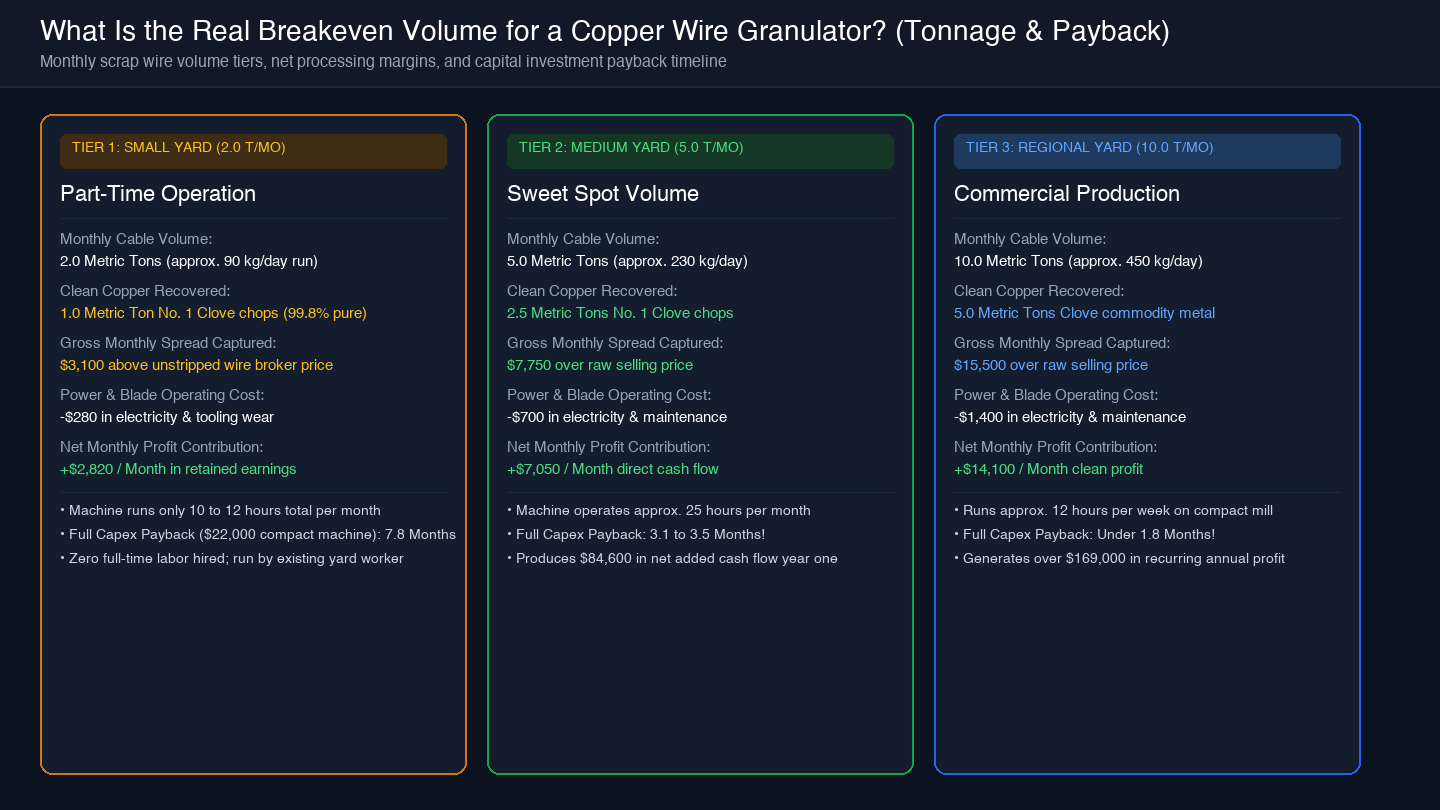
Illustrative incremental cash flow and simple capital payback
The following table assumes $22,000 of installed capital and unchanged volume and unit margin for 12 months. All amounts exclude omitted costs and taxes; the year-one figures are modeled contribution less that capital amount, not audited net profit or a supplier quotation:
| Monthly Scrap Wire Volume | Clean Copper Yield (50%) | Modeled Monthly Contribution Before Omitted Costs | Payback Timeline ($22k Capex) | Year-One Modeled Contribution Less Capex |
|---|---|---|---|---|
| 2.0 Metric Tons / Mo | 1.0 Ton Cu | +$2,820 / Month | 7.8 Months | +$11,840 Net Cash |
| 5.0 Metric Tons / Mo | 2.5 Tons Cu | +$7,050 / Month | 3.1 Months | +$62,600 Net Cash |
| 10.0 Metric Tons / Mo | 5.0 Tons Cu | +$14,100 / Month | 1.6 Months | +$147,200 Net Cash |
| 20.0 Metric Tons / Mo | 10.0 Tons Cu | +$28,200 / Month | 0.8 Months | +$316,400 Net Cash |
At the table’s assumed $1,410 per feed tonne, averaging 3 tonnes/month gives about $4,230/month and 5.2 months’ simple payback on $22,000 before omitted costs. Seasonal supply, costs and sale prices can change this result; it is not an assured recovery date.
What impact does copper price volatility have on your breakeven safety margin?
The following stress test assumes copper sale prices change from $4.10/lb to $3.25/lb (about a 21% decline) and raw-wire prices from $1.35/lb to $0.95/lb (about a 30% decline). These are different percentage changes, not an automatic proportional hedge; actual purchase prices and inventory exposure may behave differently.
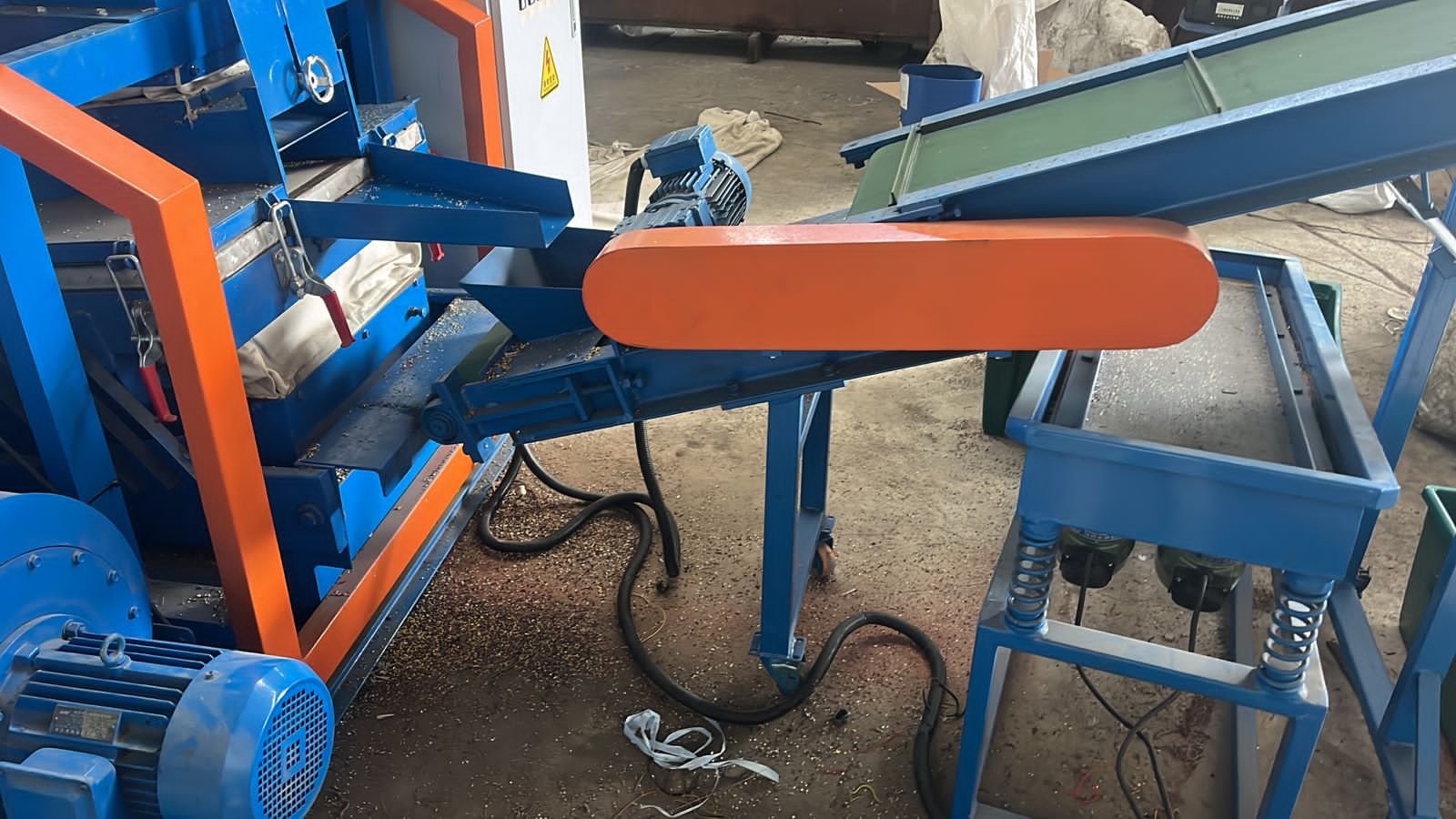
Separate purchase-price and sale-price assumptions in a downside scenario
A common fear among first-time buyers is *’What happens if copper prices crash right after I buy the machine?’*:
- The Assumed Price Changes: This example assumes 50% copper recovery, 98% spot settlement, the two stated price changes, $100 polymer receipts per feed tonne and $140 operating cost per feed tonne. These are scenario inputs, not guaranteed market terms.
- The Calculated Margin Change: Before polymer receipts and processing costs, margin per raw pound changes from 0.5 × 0.98 × $4.10 − $1.35 = $0.659 to 0.5 × 0.98 × $3.25 − $0.95 = $0.6425: a $0.0165 decrease.
- The Stress-Test Result: At 5 metric tonnes/month, those exact inputs give approximately $7,064/month before the price change and $6,882/month afterward. Simple payback on $22,000 changes from about 3.11 to 3.20 months, before omitted costs. The table uses rounded baseline figures; this calculation does not guarantee protection against price changes.
How should recyclers calculate their specific breakeven timeline?
Estimate simple payback by dividing installed capital by positive monthly incremental contribution, using the formula below. Use your measured yield, confirmed sales and purchase terms, and complete costs rather than assuming a $1,400-per-tonne margin. If contribution is zero or negative, this model does not yield a finite positive payback period.
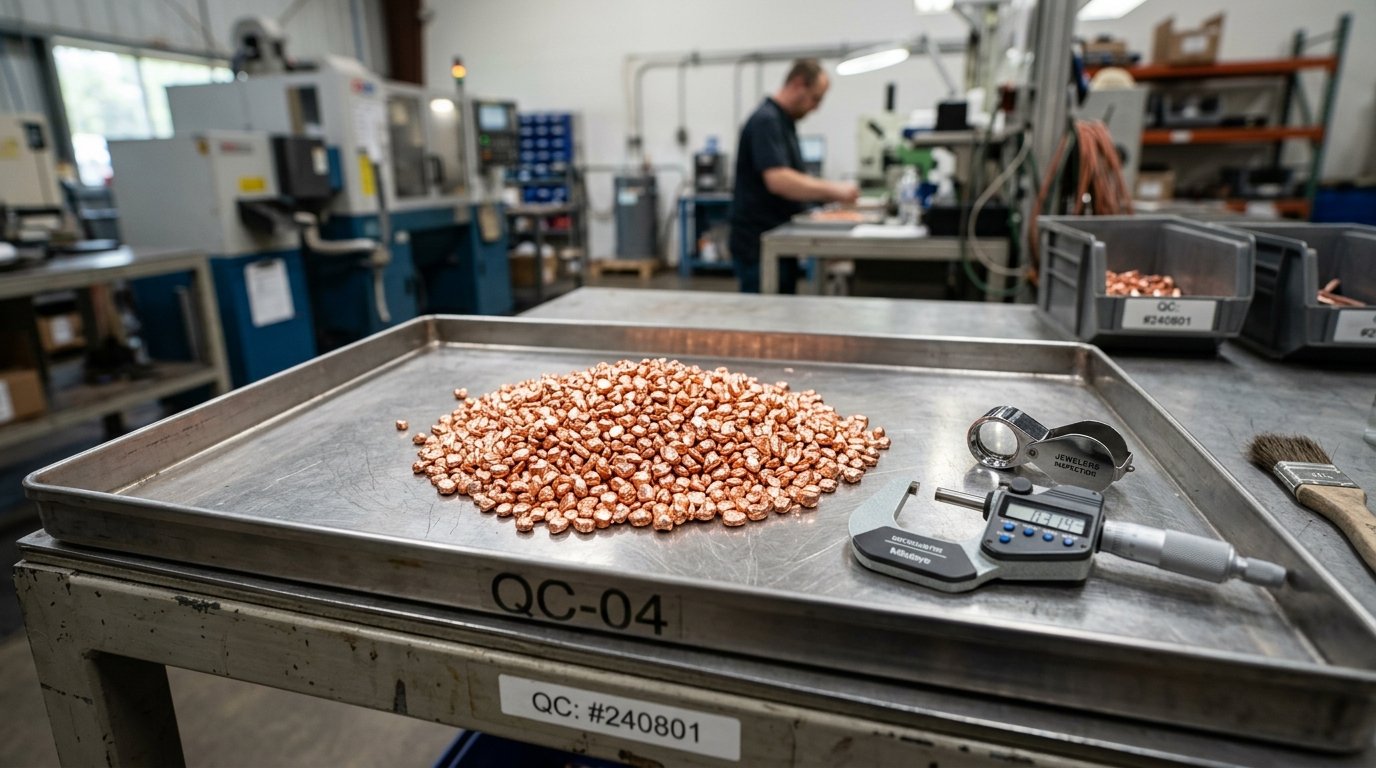
The breakeven formula, local utility rate inputs, and turn-key landed cost modeling
Apply this straightforward mathematical equation to your specific business:
Monthly incremental contribution = feed tonnes × [saleable copper tonnes per feed tonne × copper sale price per tonne + net polymer receipts per feed tonne − raw-wire opportunity value per feed tonne − variable processing cost per feed tonne] − incremental fixed monthly costs. Simple payback = installed capital cost / positive monthly incremental contribution. For a feed-purchasing model, use acquisition cost and clearly identify the comparison baseline. Include labor, handling, losses and other relevant costs; do not subtract both acquisition cost and the same material’s sell-raw opportunity value.
If mixed cable costs $1.25/lb and saleable copper sells at $4.00/lb with 50% yield, the modeled gross difference is $0.75 per raw pound ($1,653 per metric ton). Deducting the assumed $140/ton in power and blade wear leaves $1,513 per ton before labor, handling, maintenance, buyer deductions and other omitted costs. These purchase and sale terms must be verified locally.
Request Inputs for a MECUVO Payback Comparison
- Ask About Factory Testing: Confirm availability, sample requirements, test charges and shipping and customs arrangements with MECUVO in writing before sending scrap. Request measured recovery, product purity, throughput and test conditions; a sample result does not guarantee future production performance.
- Request Modeling Inputs: Contact MECUVO engineering for specifications and a written quotation, and ask whether cost-modeling assistance is available. Any forecast should show its assumptions and sensitivity to volume, yield, prices and complete operating costs; an exact breakeven month cannot be promised.
- Request Price and Specifications: Review the MECUVO copper granulator machines overview page and confirm the selected model’s configuration, installed-cost scope and included services in a written quotation.
Key Takeaways
At the article’s illustrative $1,410-per-tonne margin and $22,000 capital cost, 2 tonnes/month gives about 7.8 months’ simple payback and 3 tonnes/month about 5.2 months. Replace the assumptions with your actual recovery, buyer terms and complete incremental costs before deciding.
— YOUR RECYCLING PROJECT
Find the right machine for your material.
Tell us your material and required capacity.
Or email sales@mecuvo.com