Table of Content
During continuous production shifts, mechanical friction generated by shearing copper and plastic insulation elevates cutting chamber temperatures. Managing process heat is critical to prevent polymer softening, maintain shearing efficiency, and protect mechanical components. Depending on machine design and duty cycle, manufacturers utilize high-volume air aspiration cooling, closed-loop water jackets, or combined cooling methods to maintain stable operating temperatures.
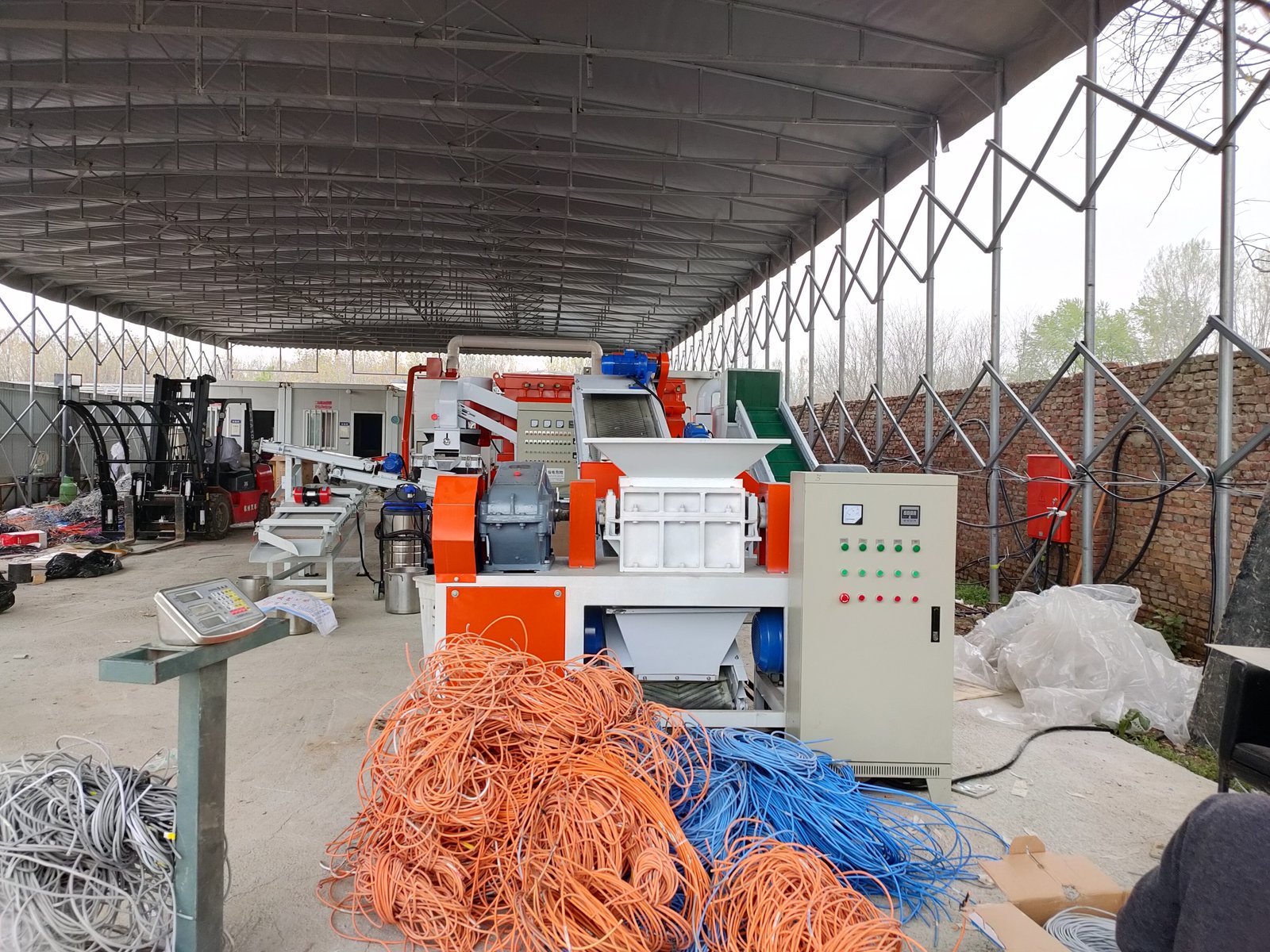
Why does friction heat build up so rapidly inside a copper granulator?
Mechanical granulation converts electrical motor energy into cutting force, with a significant fraction dissipating as thermal energy in the cutting chamber. Understanding heat dissipation mechanics helps recyclers manage operating temperatures across extended processing runs.
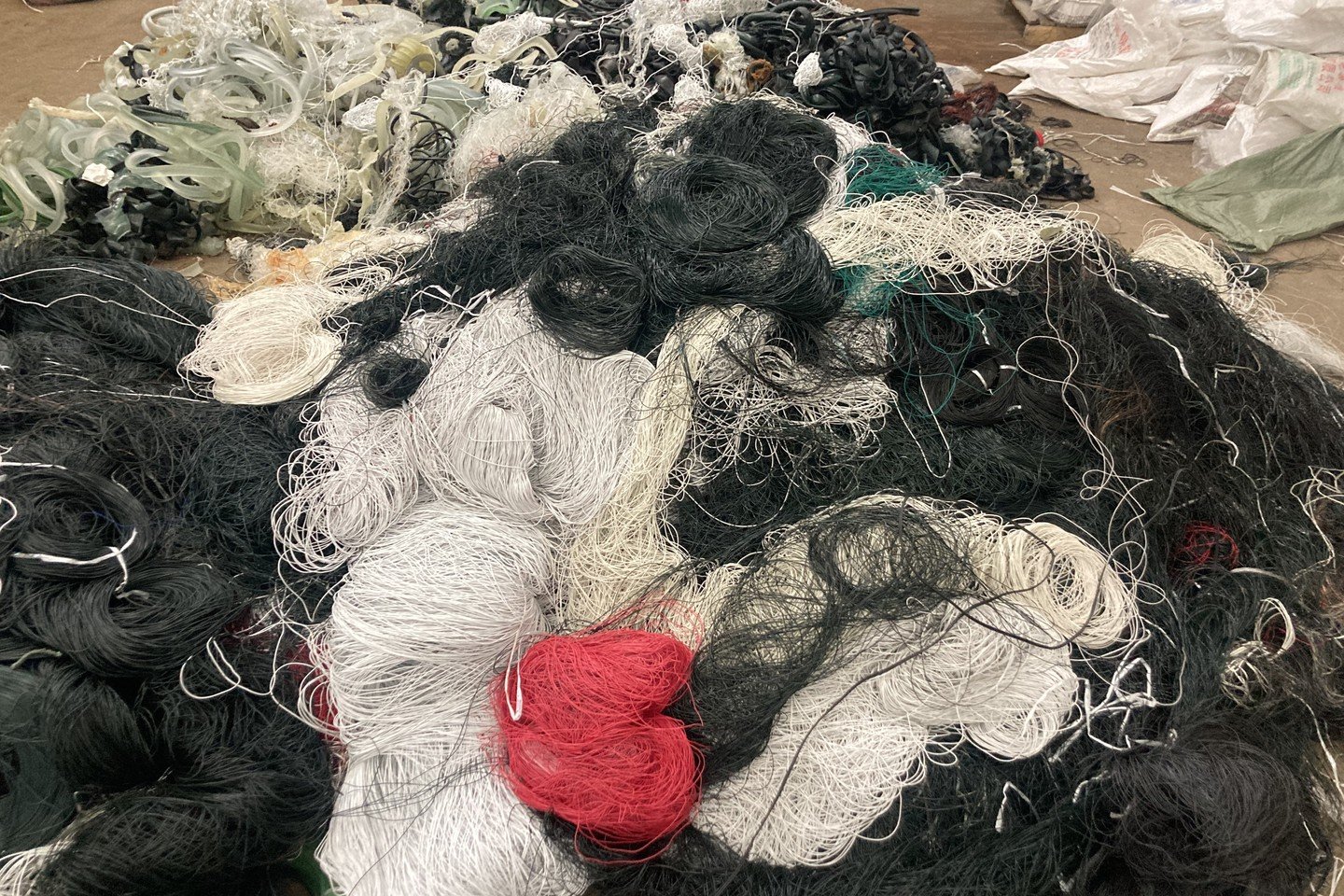
Mechanical shearing kinematics, thermal conversion, and polymer glass transition
A copper wire granulator is not merely a cutting mill; it is a high-intensity energy dissipation chamber. A 30 kW (40 HP) electric motor drives a 400 kg steel rotor at 550 RPM. As cables enter, knives strike conductors thousands of times per minute. In accordance with thermodynamic and recycling benchmarks in the European IPPC Bureau Waste Treatment Reference Document, heat generation follows strict physical principles:
- Mechanical Friction & Energy Dissipation (Theoretical Assumption): Mechanical shearing of ductile metal conductors and polymer jackets converts shaft power into localized frictional heat. In high-speed dry granulators, a substantial portion of motor energy dissipates into the cutting chamber and material stream, requiring active thermal management during sustained operation.
- Polymer Softening & Insulation Dynamics: Flexible cable insulations, particularly plasticized PVC, soften as chamber temperatures rise. Unlike rigid unplasticized PVC (which exhibits a higher glass transition around 70°C to 80°C), plasticized formulations soften at lower thresholds. Excessive cutting heat causes softened insulation to stick to knife edges and blind screen perforations, generating agglomerated granules that compromise air table separation.
- Thermal Dimensional Changes & Knife Clearances: Rotor, knives, bearings and housing change dimensions as their temperatures change. The effect on working clearance depends on the design and the relative temperatures of these components. Cooling can limit temperature rise but does not eliminate thermal expansion. Set and verify knife clearances only by the exact machine manufacturer’s procedure and specified temperature condition; do not use a generic clearance or assume a water jacket prevents contact.
How does high-volume air suction cooling function, and what are its limits?
I teach technicians how aspiration suction fans cool the rotor and why high ambient summer heat limits air cooling capacity. Air cooling pulls 3,500 to 4,500 m³/h of ambient air through the cutting chamber to evacuate convective heat, stabilizing single 8-hour shifts at 58°C–65°C, but loses effectiveness when summer ambient warehouse temperatures exceed 35°C.
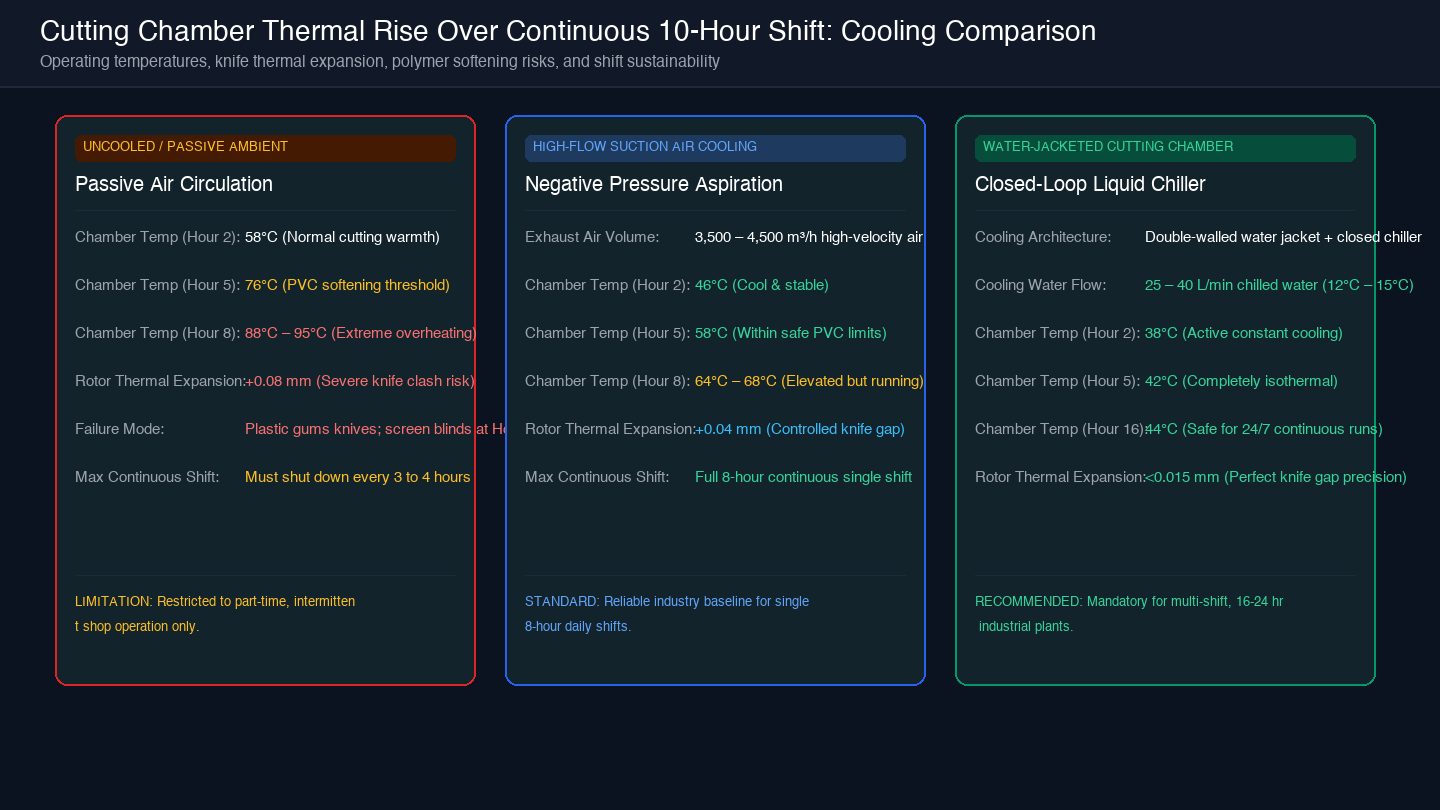
Convective heat transfer, airflow velocity, and ambient psychrometric constraints
Most compact and mid-sized copper wire granulators rely on Negative Pressure Aspiration Suction for thermal regulation:
- Convective Cooling Mechanics: A high-pressure centrifugal fan pulls ambient room air into the granulator infeed hopper, across the rotating rotor knives and screen cradle, and out through the bottom discharge plenum into the cyclone. At an air volume of 3,500 to 4,500 m³/h, convective heat transfer carries away between 12 kW and 18 kW of thermal energy continuously.
- The Psychrometric Limitation: The cooling capacity of air is governed by temperature differential ($\Delta T = T_{\text{chamber}} – T_{\text{ambient}}$). In a winter climate with 15°C ambient air, convective air cooling works brilliantly, keeping chamber temperatures below 50°C indefinitely. However, during hot summer months when warehouse temperatures climb to 35°C to 40°C (95°F–104°F), the reduced $\Delta T$ drops convective heat transfer by 40%. Chamber temperatures escalate past 78°C within 3 to 4 hours of continuous running, forcing operators to shut down the machine and wait for the rotor to cool.
- Screen Open Area Interference: Air suction cooling relies entirely on air passing through the perforated screen. If processing hairy automotive wire that partially restricts 25% of screen holes, cooling airflow drops proportionally, triggering a runaway thermal feedback loop.
Why is closed-loop water cooling essential for multi-shift commercial plants?
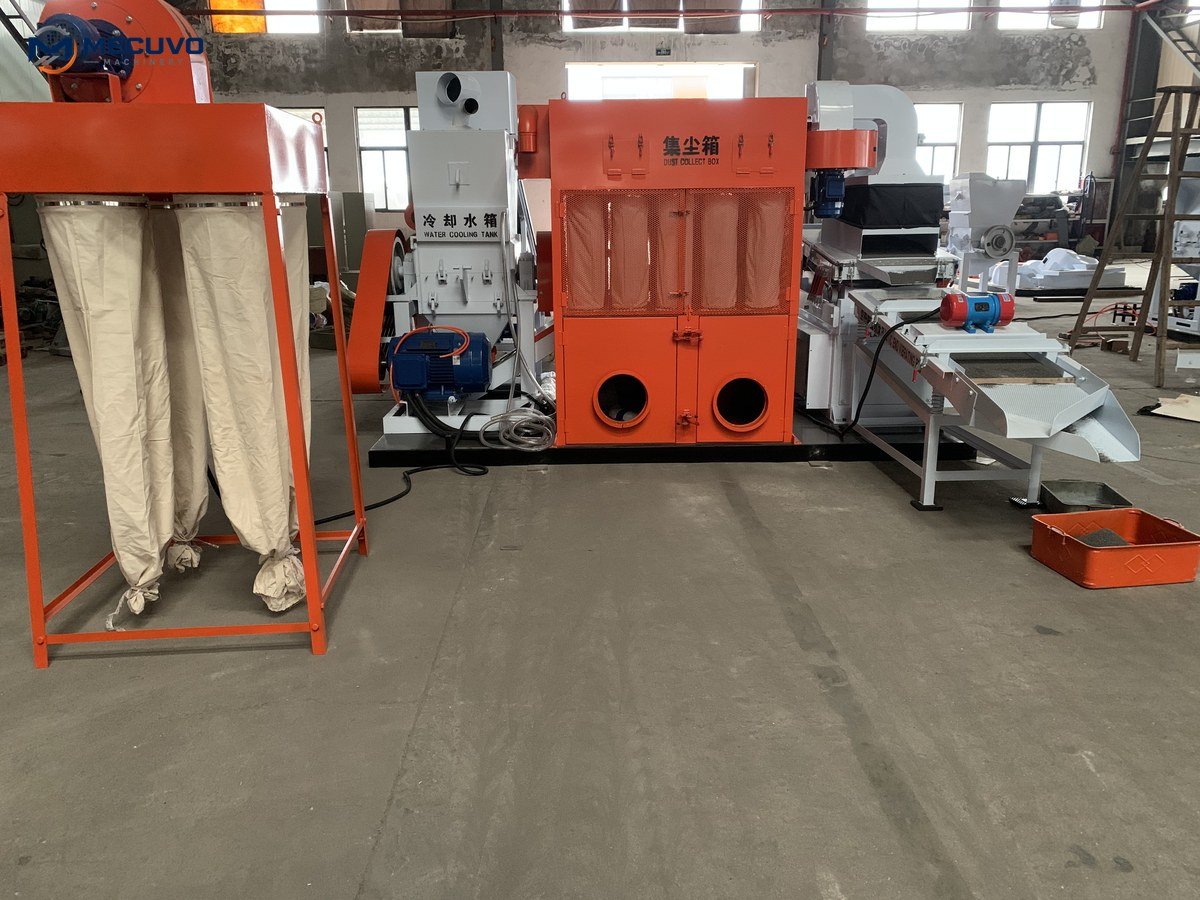
For operations running extended multi-shift schedules or processing heat-sensitive polymers, equipment manufacturers offer closed-loop water-jacketed cutting chambers. Water cooling provides conductive heat removal directly through chamber sidewalls and knife beds.
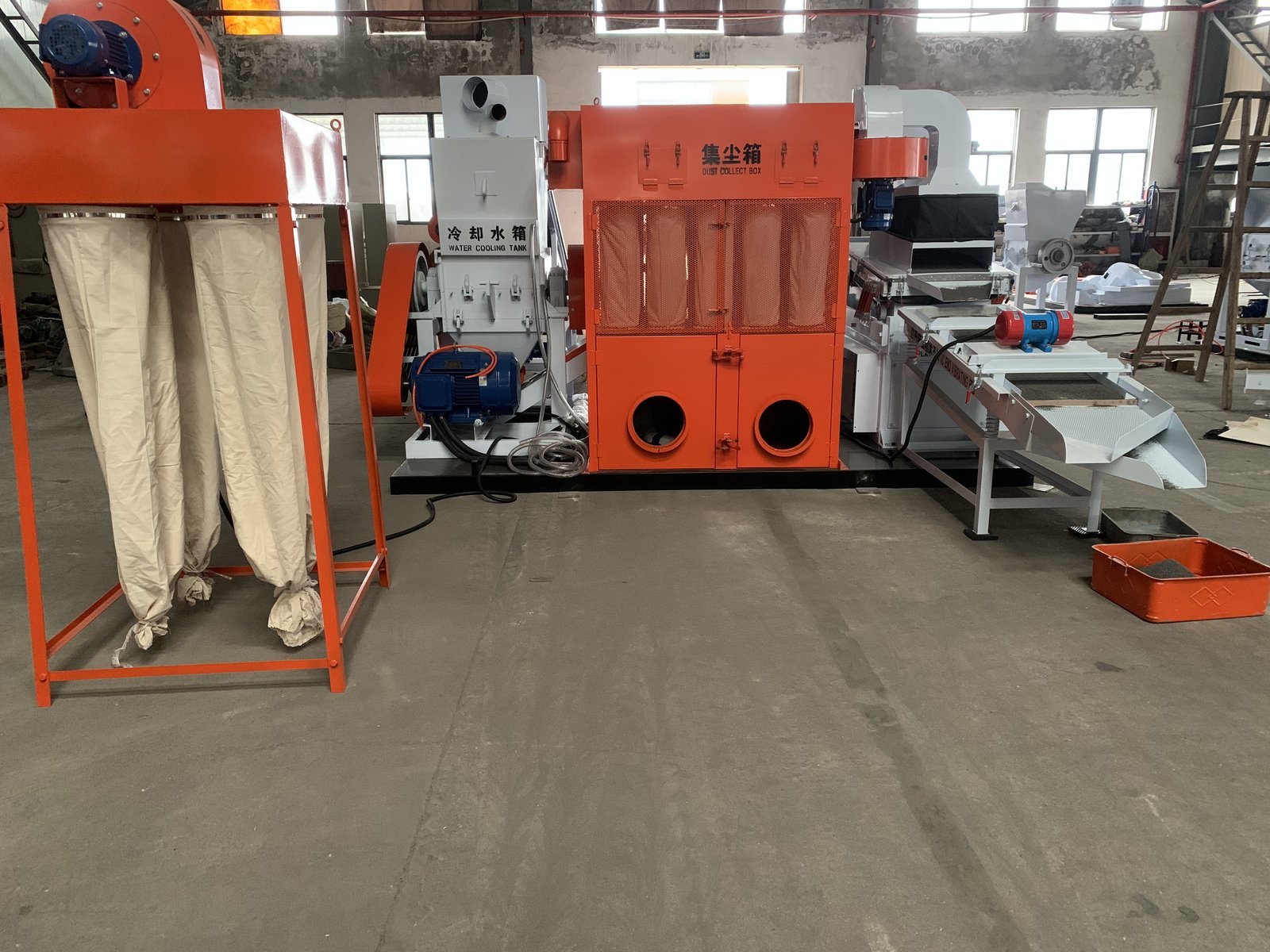
Conductive heat flux, water jacket design, and 24/7 continuous duty cycles
For industrial metal recycling plants running two or three 8-hour shifts daily, water cooling is not an optional luxury; it is a mandatory engineering standard. Water has a specific heat capacity ($4,184\text{ J/kg}\cdot\text{K}$) over four times higher than air, making it the ultimate industrial heat sink:
- Double-Walled Water Jacket Design: Water-cooled granulators incorporate cast or fabricated fluid passages within the cutting chamber housing, positioned behind stationary bed knife seats. Cooling fluid circulates through internal baffles to transfer heat away from the cutting zone.
- Conductive Heat Removal: Continuous circulation of regulated cooling fluid assists in removing thermal energy generated at the bed knives. By moderating chamber housing temperatures, water cooling helps keep polymer temperatures below softening thresholds during extended runs.
- Clearance Verification & Operating Manuals: While water cooling reduces overall machine frame temperature rise, thermal gradients still exist across rotating components. Knife gaps must always be adjusted, torqued, and verified in strict accordance with the machine manufacturer’s manual at the specified reference temperature.
- Closed-Loop Fluid Management: Commercial installations typically connect water jackets to closed-loop chillers or cooling towers with automated temperature control and corrosion inhibitors, minimizing water consumption and preventing discharge concerns.
What is the maintenance protocol for water jackets and air cooling ducts?
Maintaining cooling equipment ensures reliable heat dissipation and protects chiller components from dust and mineral fouling.
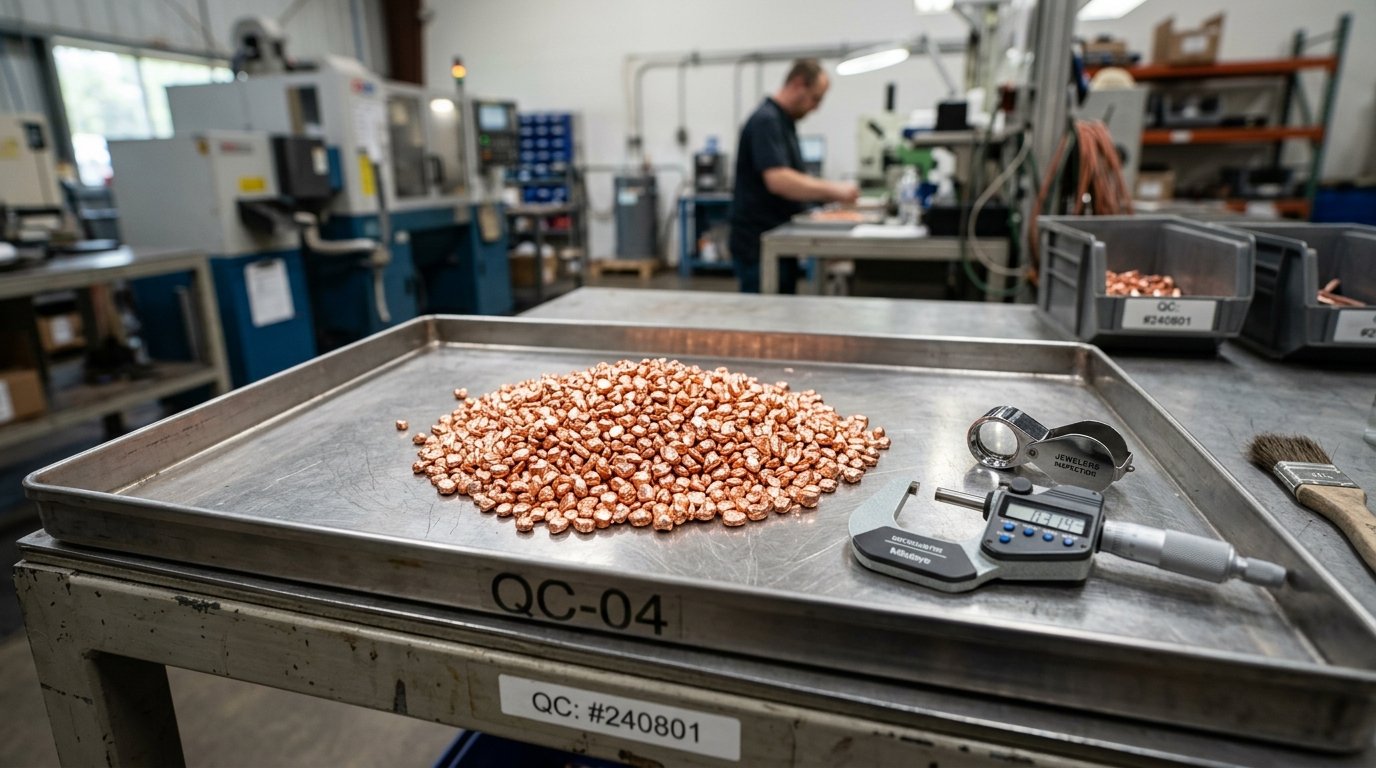
Scale prevention, glycol chemistry, and duct airflow maintenance
To ensure cooling systems operate at peak thermodynamic efficiency, maintenance crews must follow three routine maintenance rules:
- Cooling Fluid Quality: Follow chiller and granulator manufacturer specifications regarding coolant quality, corrosion inhibitors, and glycol ratios. Operating with untreated water can lead to mineral scale deposition on heat transfer surfaces, reducing thermal efficiency and restricting internal passages.
- Chiller Condenser Maintenance: In dusty recycling plant environments, chiller air-cooled condensers accumulate airborne dust. Clean external condenser fins regularly following facility safety guidelines, using appropriate PPE and low-pressure cleaning tools or vacuum systems that comply with applicable workplace safety standards (such as OSHA guidelines for compressed air cleaning under 30 psi with chip guarding).
- Aspiration Ducting Inspection: In air-cooled aspiration circuits, inspect ductwork, elbows, and cyclone inlets periodically following lockout/tagout procedures to remove any accumulated hair wire or stringy debris that could restrict airflow.
To explore heavy-duty machinery engineered with integrated water cooling jackets and automated chillers, review our full line of MECUVO copper granulator machines, or consult with MECUVO engineering to evaluate your thermal cooling requirements.
Key Takeaways
Managing granulator operating temperature requires matching cooling architecture to production demands and cable characteristics. Adhering to OEM-specified knife clearances, verifying thermal limits during representative material trials, and maintaining air aspiration and liquid cooling systems protects equipment reliability and recovery yield.
— YOUR RECYCLING PROJECT
Find the right machine for your material.
Tell us your material and required capacity.
Or email sales@mecuvo.com