Table of Content
Machinery specification sheets in the recycling industry are often rife with marketing exaggerations, ambiguous metrics, and omitted operational requirements. A spec sheet claiming ‘200 kg/h capacity and 28 kW power’ leaves critical questions unanswered: Does that figure measure raw infeed cable or recovered copper chops? Does the electrical rating include auxiliary dust extraction blowers? To accurately audit a copper cable granulator spec sheet, buyers must dissect five critical engineering areas: whether throughput (kg/h) refers to raw mixed infeed cable or clean recovered copper output, total connected electrical load versus main rotor motor kW, screen mesh perforation sizing and rotor knife geometry, separation table fluidization area, and commonly omitted facility prerequisites such as pulse-jet compressed air volume (CFM), dynamic foundation load ratings, and decibel noise levels. Below, we provide a line-by-line engineering audit framework to help you read between the lines of any granulator technical datasheet.
Throughput Deconstruction: Raw Infeed Capacity (kg/h) vs Recovered Copper Output
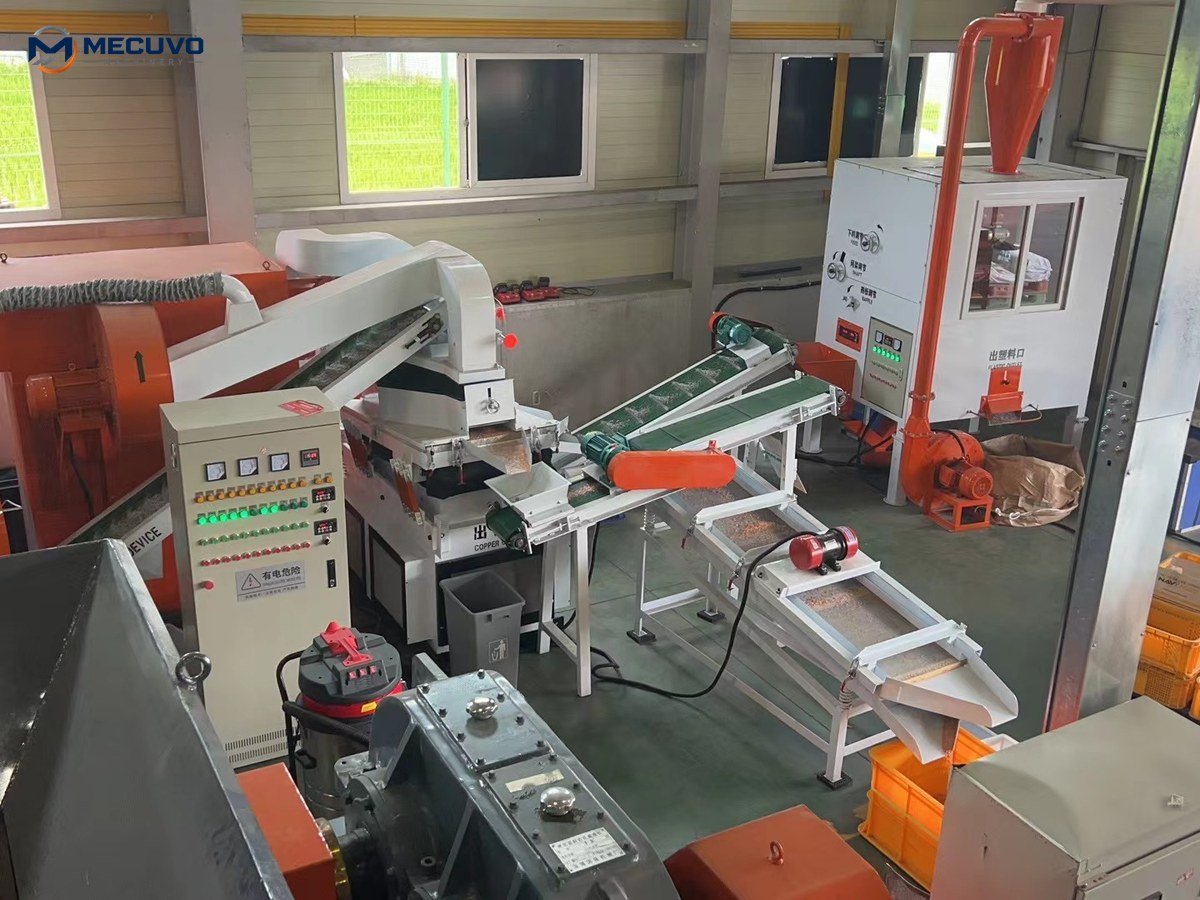
We decode the single most misunderstood line item on any recycling spec sheet: processing capacity. Capacity figures denote raw mixed infeed cable, not copper output; a 200 kg/h machine yields ~100 kg/h of copper chops based on 50% average wire yield.
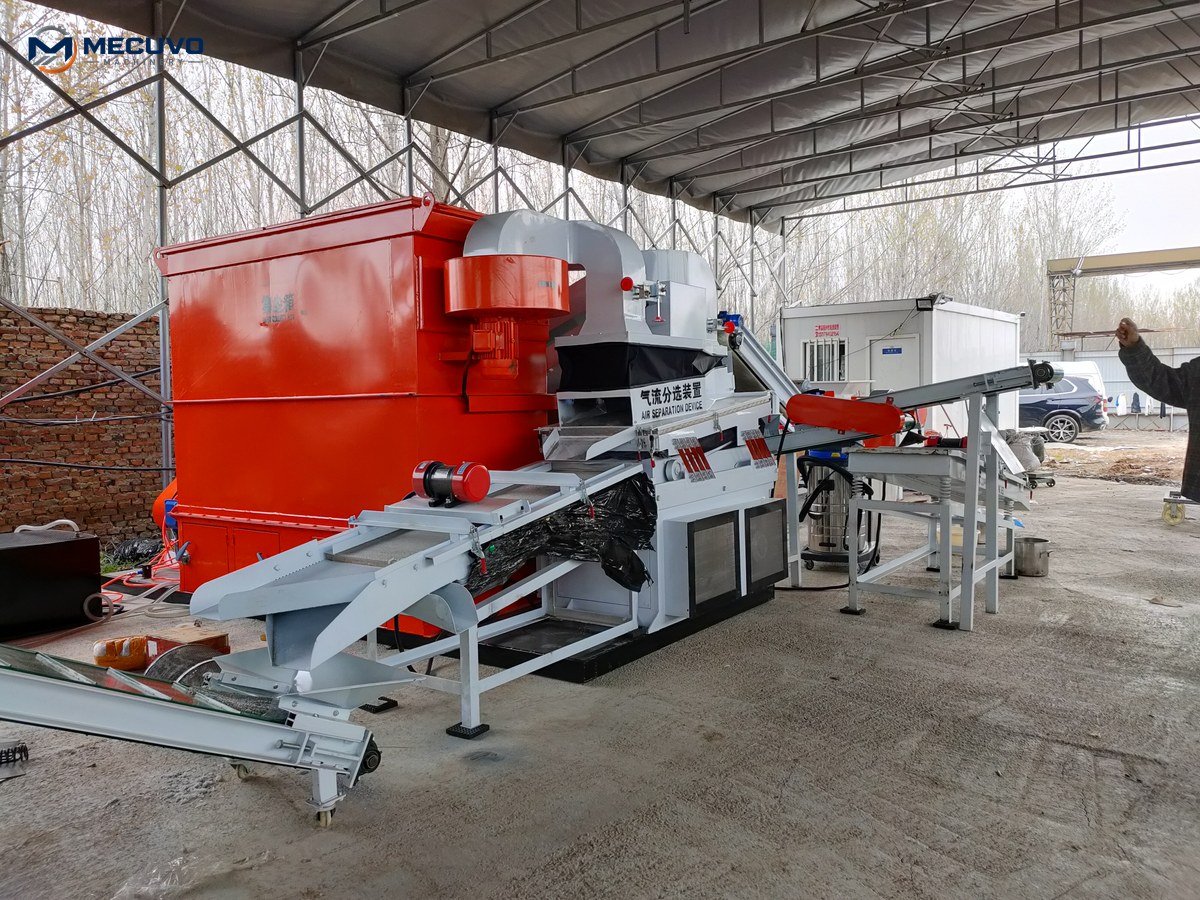
Deciphering processing capacity claims and copper recovery yields
When a manufacturer lists a throughput rating of ‘200 kg/h’ or ‘500 kg/h’, what does that number actually signify? In commercial recycling machinery specifications, hourly capacity almost universally refers to the gross mass of raw infeed cable fed into the machine hopper per hour, not the net mass of copper chops discharged into the collection tote.
Because insulated electrical cables consist of a metallic copper core surrounded by plastic or rubber insulation, net metal recovery is governed by the copper yield ratio:
Recovered Copper Output (kg/h) = Raw Infeed Capacity (kg/h) × Copper Content (%) × Recovery Efficiency (%)
Consider how different scrap cable streams alter actual copper production on a machine rated at a reference capacity of 200 kg/h (such as the MECUVO CG-200):
- Single-Conductor Building Cable (Romex / THHN, ~65% Copper Yield): Feeding 200 kg of building wire per hour yields approximately 130 kg/h of clean copper chops and 70 kg/h of plastic flakes.
- Mixed Automotive Wiring Harnesses (~50% Copper Yield): Feeding 200 kg of harness scrap yields approximately 100 kg/h of copper chops and 100 kg/h of plastic fluff and tape.
- Multi-Strand Category 5/6 Data Cable (~40% Copper Yield): Feeding 200 kg of network wire yields approximately 80 kg/h of copper chops and 120 kg/h of high-volume PVC/PE tailings.
Furthermore, beware of spec sheets quoting capacity ranges based on ‘clean industrial copper wire with zero insulation’. In real-world scrap yard operations, you are buying insulated cable, and your processing throughput will track real-world feedstock bulk density.
Connected Power Analysis: Main Rotor Motor vs Total Line kW vs Starting Inrush
We explain how to audit total electrical loads, calculate branch circuit sizing, and prevent electrical substation overloads. Always request the full motor schedule; auxiliary blowers and fans add 35-50% more power than the rotor motor alone (e.g., 28 kW total vs 18.5 kW rotor).
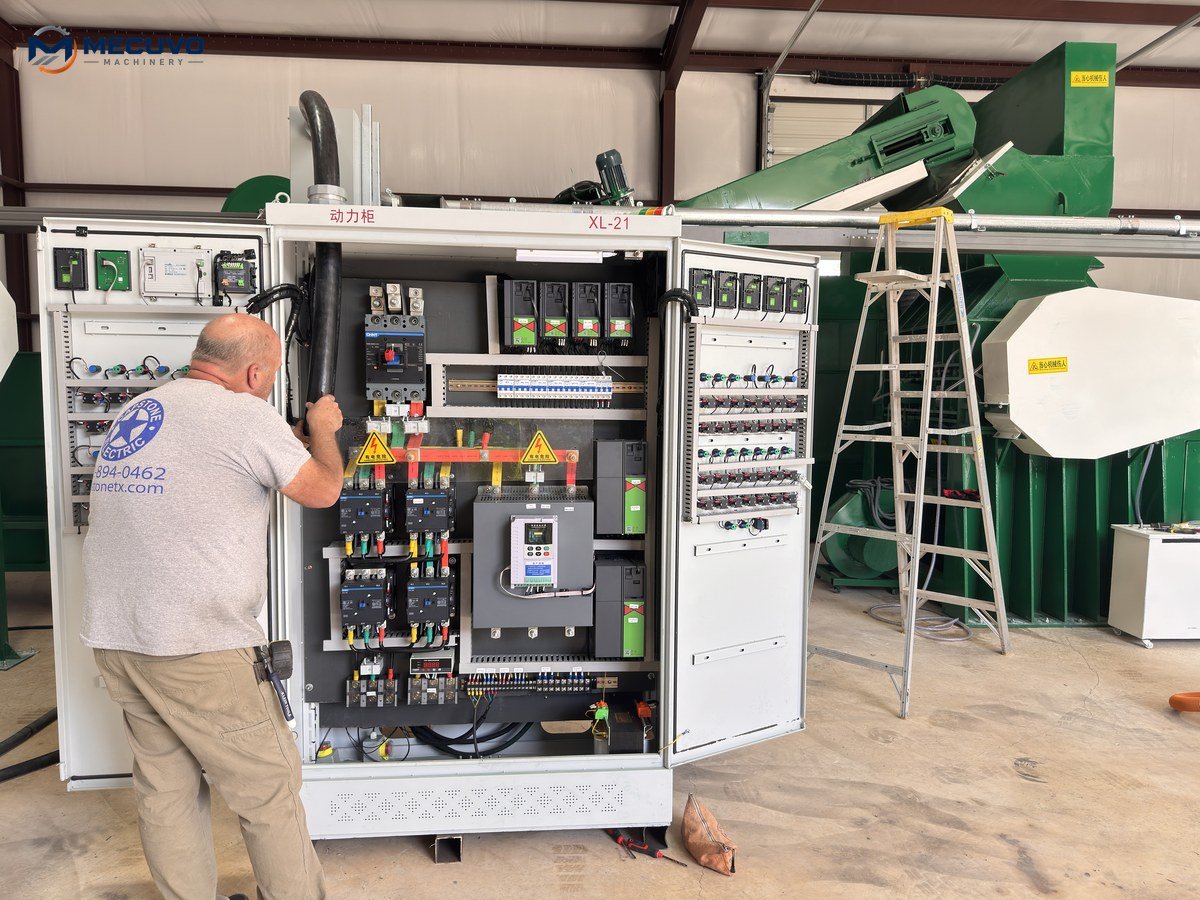
Auditing electrical power schedules, auxiliary motors, and transformer capacity
Another common trap on machinery spec sheets is the conflation of the main granulator rotor motor power with the total system connected electrical load. A spec sheet advertising ’15 kW’ may refer solely to the cutting chamber drive, while omitting another 9 kW of auxiliary blowers, separation motors, and dust extraction fans.
When reviewing a granulator proposal, insist on reviewing the complete electrical connected load schedule. The table below illustrates how total installed power is distributed across the MECUVO CG series:
| Model | Main Rotor Motor | Air Table Blower | Dust Exhaust Fan | Vibrator Motors | Infeed Conveyor | Total Connected Load |
|---|---|---|---|---|---|---|
| CG-100 | 15.0 kW | 4.0 kW | 3.0 kW | 0.4 kW × 2 | Optional (1.5 kW) | ~24.0 kW |
| CG-200 | 18.5 kW | 4.0 kW | 4.0 kW | 0.55 kW × 2 | Integrated (1.5 kW) | ~28.0 kW |
| CG-300 | 22–30 kW | 5.5 kW | 5.5 kW | 0.75 kW × 2 | Integrated (1.5 kW) | ~37.2 kW |
| CG-500 | 30–37 kW | 7.5 kW | 5.5 kW | 1.1 kW × 2 | Integrated (2.2 kW) | ~48.0 kW |
Table Note: Reference parameters cited from mecuvo.com public catalogs; final motor configurations are confirmed per customer order.
Continuous Running Load vs Starting Inrush Current
Under National Electrical Code (NEC Article 430) and international electrical safety rules (IEC 60204-1), industrial motor branch circuits must be sized for start-up inrush current. An induction motor started direct-on-line (DOL) draws 5 to 7 times its rated full-load amperage (FLA) during initial rotor acceleration. If your spec sheet does not specify soft-starters or variable frequency drives (VFDs), starting a 28 kW or 37.2 kW granulator can cause severe voltage sags or trip main facility breakers.
Mechanical Core: Screen Apertures, Knife Metallurgy, and Cutting Chamber Dimensions
We examine the physical dimensions, rotor blade quantities, and tool steel alloys that dictate actual shearing ability and durability. Audit rotor diameter, knife count (e.g. 14 rotating / 4 bed), knife steel (D2/SKD-11 at 58-60 HRC), and screen wrap angle to verify real throughput capacity.
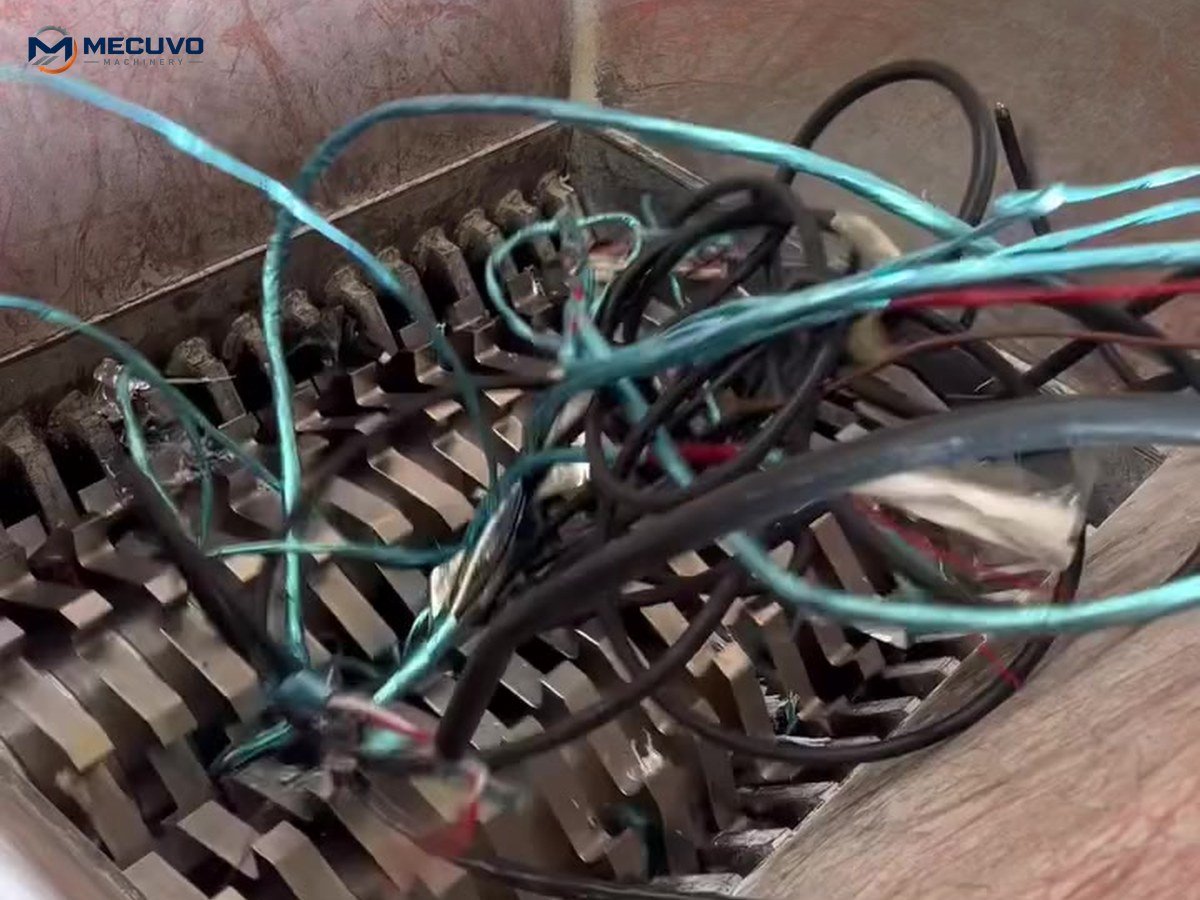
Cutting chamber geometry, rotor inertia, and tool steel metallurgy
The mechanical heart of any granulator is its cutting chamber. Two machines with identical 18.5 kW drive motors can deliver vastly different throughput depending on their cutting chamber geometry and knife arrangement.
1. Rotor Knife Configuration and Stator Bed Blades
Audit the specific knife configuration:
- Rotating Knives: Look for machines with segmented rotating knives staggered along the rotor shaft rather than full-length single blades. Segmented knives divide cutting resistance into rapid, sequential scissor cuts, reducing peak shock loads on the drive motor.
- Stationary Bed Blades: Commercial machines utilize 2 to 4 stationary bed blades mounted in the upper and lower chamber walls. Additional bed blades double the shearing frequency per rotor revolution.
- Knife Metallurgy & Clearance: Verify that knives are manufactured from authentic high-alloy cold-work tool steel (D2/SKD-11) vacuum heat-treated to 58–60 HRC. Blade clearances must be adjusted per OEM guidelines according to processed wire gauge, strictly under Lockout/Tagout (LOTO) energy isolation.
2. Screen Hole Sizing and Wrap Angle
The curved screen beneath the rotor governs particle discharge: Screen Hole Diameter: Ensure the quotation includes the proper screen aperture for your target wire mix (typically 2.5 mm for harness/telecom wire, 3.0 mm for building wire). Screen Wrap Angle: Heavy-duty granulators feature a wide 180-degree screen wrap angle. Larger screen surface area allows shredded material to evacuate the chamber rapidly, preventing friction overheating that melts PVC insulation.
The Missing Specifications: Compressed Air, Foundation Anchoring, and Acoustic Levels
We reveal the critical operational parameters routinely omitted from commercial granulator spec sheets and explain how to audit them. Ask for compressed air CFM (0.6-0.8 MPa for pulse-jet bags), concrete slab thickness (150-200mm), and noise ratings (typically 80-85 dBA requiring hearing protection).
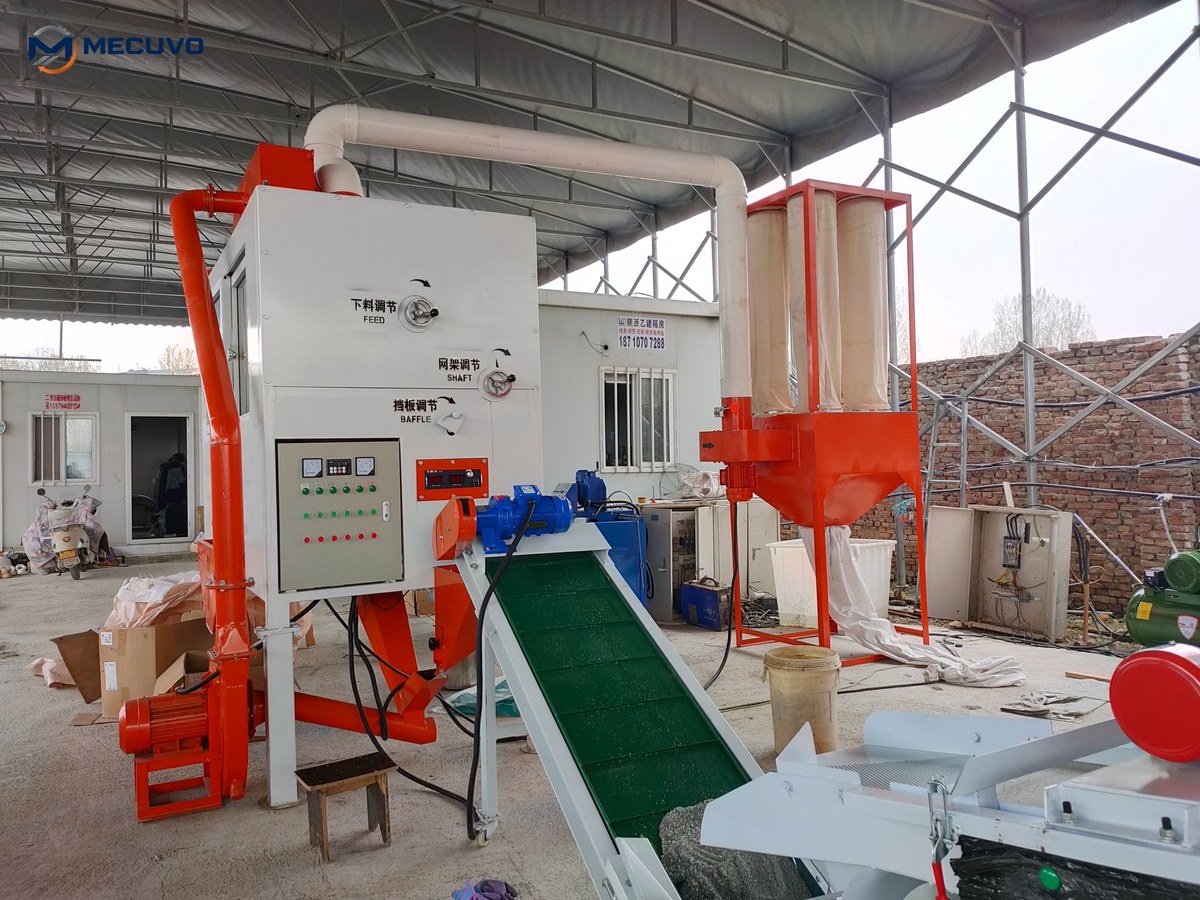
Identifying omitted facility requirements before placing a machine order
What a manufacturer leaves off the spec sheet is often more consequential than what is included. Reviewing dozens of generic factory brochures reveals three critical operational prerequisites routinely omitted:
1. Compressed Air Supply for Pulse-Jet Dust Collection
If the granulator features an automated pulse-jet cartridge dust collector, it requires a continuous supply of clean, dry compressed air to operate its reverse-pulse solenoid cleaning valves:
- Required Pressure: Typically 0.6 to 0.8 MPa (85 to 115 PSI).
- Air Volume Demand: Approximately 0.2 to 0.4 m³/min (7 to 14 CFM).
- Utility Requirement: If your recycling workshop lacks a centralized industrial air compressor with a refrigerated air dryer, plan for dedicated clean compressed air supply to operate the filtration system reliably.
2. Civil Foundation and Floor Loading Specifications
Dry specific-gravity air separation tables function by imparting continuous rhythmic lateral vibrations at 10 to 20 Hz: Dynamic Structural Load: A machine weighing 2,500 kg exerts continuous dynamic oscillating forces. Installing the machine on asphalt, paving stones, or a cracked concrete floor causes frame resonance, fastener loosening, and erratic copper separation. Foundation Requirement: Facilities must anchor the machine to a reinforced concrete pad at least 150 mm to 200 mm thick (C25/30 grade) using chemical epoxy anchor bolts.
3. Acoustic Emission Levels (Noise Ratings)
Granulating heavy copper cable generates substantial acoustic energy: Operating Noise Level: High-speed rotor cutting and centrifugal separation blowers typically generate 80 to 85 dBA at 1 meter distance under load. Compliance Requirement: In accordance with ISO 12100 and OSHA occupational noise exposure standards (29 CFR 1910.95), operators within the processing zone must wear approved hearing protection.
Request an Audited Technical Specification Sheet
To receive complete engineering datasheets, certified motor electrical schedules, and civil installation drawings for the MECUVO CG product line, send your equipment specifications through the contact page.
Key Takeaways
Audit copper granulator spec sheets by confirming infeed vs recovered copper output, calculating total connected kW across all blowers and motors, and verifying omitted facility requirements including compressed air, 150mm concrete foundations, and acoustic safety.
— YOUR RECYCLING PROJECT
Find the right machine for your material.
Tell us your material and required capacity.
Or email sales@mecuvo.com