Table of Content
Colombian scrap metal enterprises modernizing wire recycling operations must master national customs valuation rules, foreign trade single-window approvals, and mandatory electrical safety regulations before shipping machinery overseas. Importing a copper wire granulator into Colombia requires registering in the RUT as an importer with DIAN, filing an electronic import declaration via VUCE through a licensed customs agency, paying applicable customs tariffs plus 19% IVA, and confirming RETIE electrical compliance. I examine the statutory import chain, tax calculations, seaport procedures, and grid voltage compatibility across Colombia below to ensure smooth capital equipment importation.
What Are the DIAN Customs Procedures and VUCE Import Requirements in Colombia?
Importing industrial capital equipment into Colombia requires strict procedural compliance with national customs and trade registries. Importers must possess an updated RUT registered with DIAN as an importer, process trade registrations through the VUCE digital portal, and retain a licensed customs agency (Agencia de Aduanas) to handle cargo clearance.
The Administrative Import Framework in Colombia
Before committing capital to an overseas equipment purchase, Colombian businesses must ensure their corporate tax profile is authorized for foreign trade. The Dirección de Impuestos y Aduanas Nacionales (DIAN) requires the company’s Registro Único Tributario (RUT) to include code 23 (Importador) under Box 54 (Usuarios Aduaneros). Operating without active importer registration prevents customs agents from submitting electronic declarations through the Siglo XXI system.
Furthermore, all commercial imports must interface with the Ventanilla Única de Comercio Exterior (VUCE), managed by the Ministry of Commerce, Industry, and Tourism (MinCIT). Through the VUCE Import Module, your customs broker files an electronic import registration (Registro de Importación). Under current trade rules, general size-reduction and sorting machinery classified under Chapter 84 of the Andean Tariff Nomenclature generally falls under the Free Import Regime (Régimen de Libre Importación); however, prior registration remains mandatory for statistical tracking and foreign exchange control.
Because commercial granulator systems exceed USD $1,000 in value, Colombian statutory regulations prohibit direct self-clearance by individuals. You must grant legal customs power of attorney (Poder Especial Aduanero) to a certified Level 1 or Level 2 Agencia de Aduanas, which prepares the preliminary import declaration (Declaración Andina del Valor – DAV) and manages container inspections at the port of entry.
How Are Colombian Import Tariffs, 19% IVA, and Port Clearance Fees Calculated?
Budgeting for an imported copper granulator requires calculating sequential customs duties, national sales taxes, and seaport terminal charges. Customs duties (arancel, typically 0% to 5%) are levied on CIF value, followed by 19% IVA calculated on CIF value plus duty paid, along with terminal handling and inland transport charges.
The Statutory Tax Calculation Chain and Seaport Logistics
Under Colombian customs law, the taxable customs value is established on a CIF (Cost, Insurance, and Freight) basis at the arriving Colombian maritime port. For machinery arriving from international ports, typical destination terminals include Buenaventura on the Pacific coast (serving Cali, the Coffee Axis, and southwest Colombia) or Cartagena, Barranquilla, and Santa Marta on the Caribbean coast (serving Bogotá, Medellín, and northern industrial corridors).
The statutory cost accumulation proceeds through three mandatory stages:
- Customs Duty (Arancel): Applied to the CIF customs value. For industrial recycling machinery classified under HS Heading 8479, Most Favoured Nation tariffs typically range from 0% to 5% (verified as of October 2026; always consult your licensed customs broker for binding classification).
- Value Added Tax (IVA): Under Article 468 of the Colombian Tax Statute, standard IVA is 19%. Crucially, the tax base for IVA is the CIF value plus the customs duty paid: IVA Base = CIF Customs Value + Arancel; IVA = IVA Base × 19%.
- Port Terminal & Drayage Charges: Seaport operators (such as SPRB in Buenaventura or Contecar in Cartagena) charge port handling, container crane lifts, security scanning, and temporary warehouse fees.
| Financial Element | Statutory Basis | Commercial Implications for Colombian Scrap Yards |
|---|---|---|
| CIF Customs Value | Invoice price + maritime freight + insurance | Baseline taxable value established on shipping documents |
| Arancel (Customs Duty) | 0% to 5% ad valorem on CIF | Border protection tariff; confirmed by customs broker |
| IVA (19%) | 19% on (CIF Value + Arancel) | Major liquidity cash outlay; recoverable as tax credit by registered firms |
| Agencia de Aduanas Fee | 0.5% to 1.0% of CIF (or flat fee) | Licensed professional broker fee for electronic clearance |
| Inland Freight (Port to City) | Distance & mountain corridor drayage | Heavy trailer transport over Andean mountain passes (La Línea) |
For VAT-registered Colombian corporations, the 19% import IVA is not an absolute cost; it is credited as an input tax credit against sales tax liabilities on your bimonthly DIAN IVA returns. However, your business must maintain sufficient cash reserves to settle the tax upfront at the bank prior to container release.
What RETIE Electrical Standards and 60Hz Grid Rules Apply in Colombia?
Connecting overseas machinery to the Colombian power grid requires strict adherence to national frequency, voltage, and workplace electrical regulations. Colombia operates on a 60 Hz electrical grid supplying three-phase 220V or 440V, governed by the RETIE technical regulation, requiring factory-fitted 60 Hz motors and industrial circuit protection.
The 60 Hz Frequency Imperative and RETIE Installation Rules
The single most hazardous technical error made by Colombian machinery buyers is ordering equipment configured for European or Asian 50 Hz grids. Under the Ministerio de Minas y Energía technical code RETIE (Reglamento Técnico de Instalaciones Eléctricas), Colombia’s national power grid operates strictly at 60 Hz.
Connecting a standard 50 Hz induction motor to a 60 Hz power supply causes the rotor to spin 20% faster than designed (Synchronous Speed: n = 120f / p). For a high-speed granulator cutting rotor, a 20% overspeed drastically increases dynamic centrifugal forces, accelerates blade dulling, causes severe aerodynamic turbulence that disrupts air-table density separation, and leads to motor thermal overload. When placing your order with MECUVO, you must explicitly specify 60 Hz dual-rated electric motors.
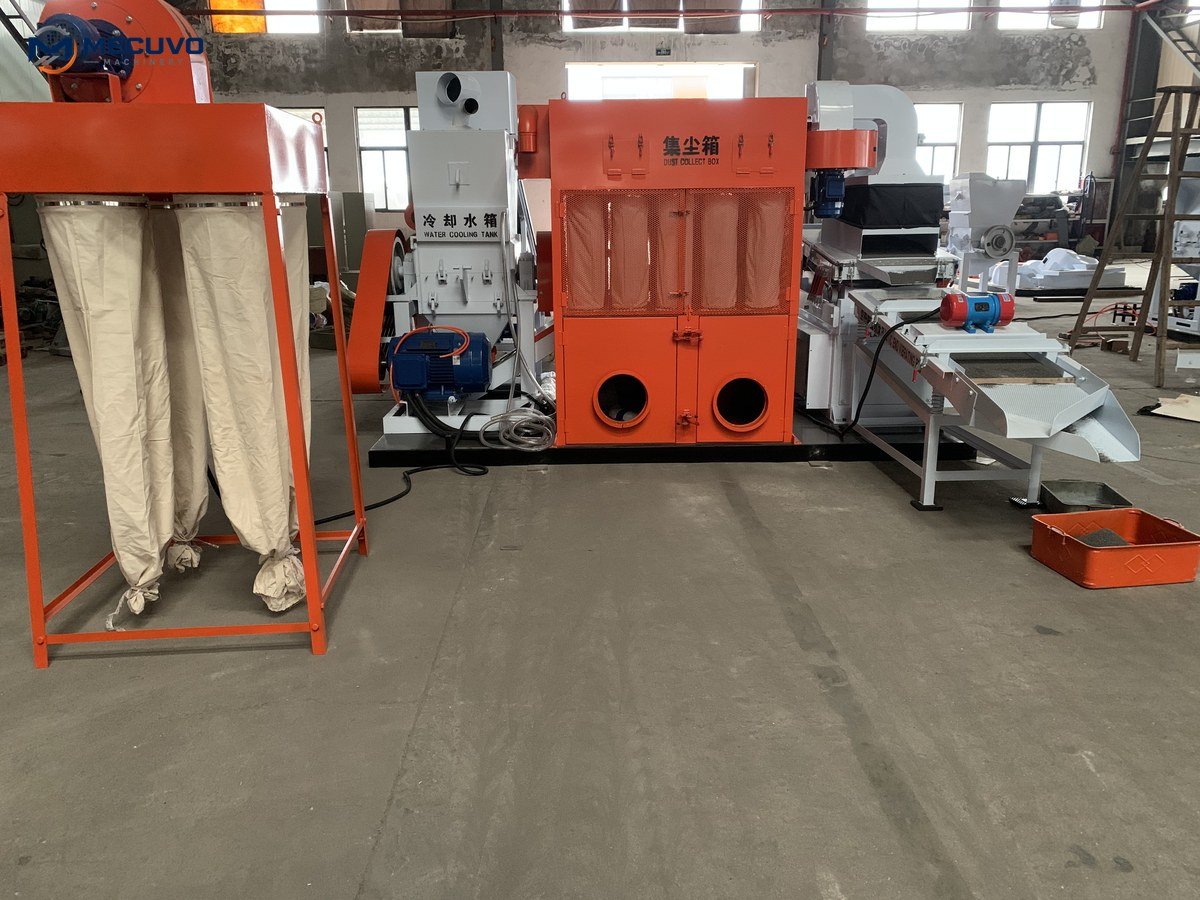
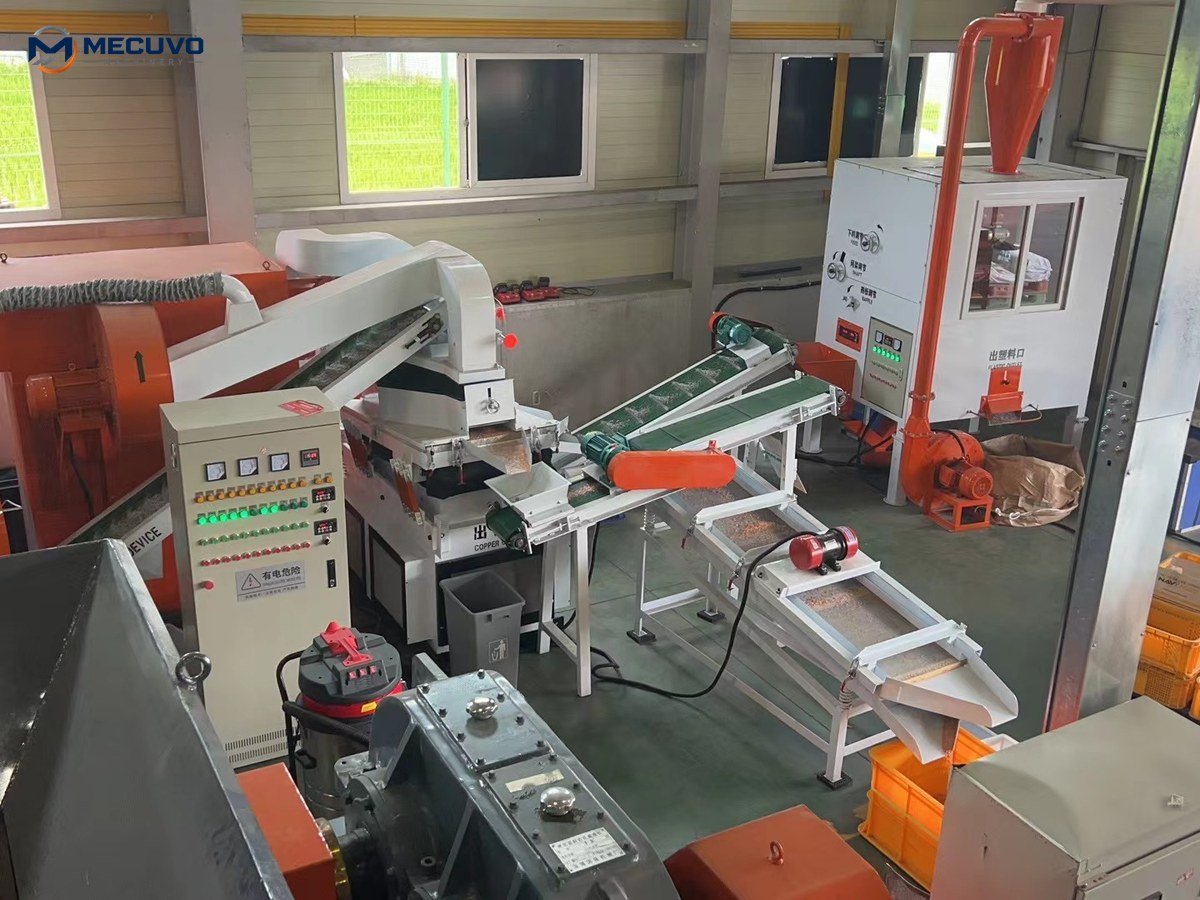
Furthermore, industrial voltages vary across Colombian utility zones (such as Enel in Bogotá, EPM in Antioquia, or Celsia in Valle del Cauca). While small workshops utilize 220V three-phase power, commercial scrap operations installing systems like the CG-200 (28 kW installed power) or CG-500 (48 kW installed power) generally require a dedicated transformer delivering 440V or 480V three-phase 60Hz supply to minimize cable cross-section requirements and line voltage drops.
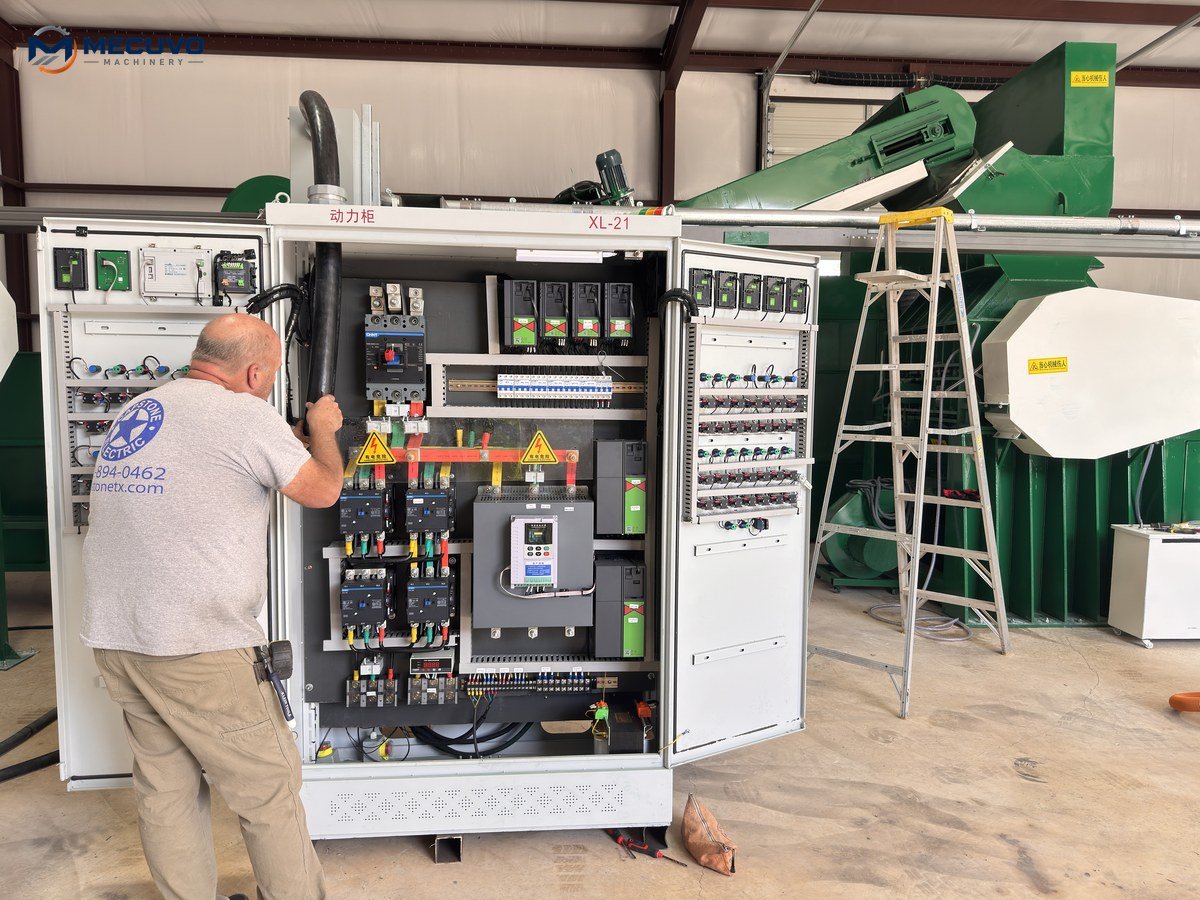
Under RETIE requirements, your on-site electrical installation must feature an external padlockable main circuit breaker within sight of the machine, certified earthing rods achieving under 10 ohms ground resistance, and Class F motor insulation rated for tropical ambient operating temperatures.
To request detailed technical drawings, 60 Hz motor options, and container crating specifications for Colombian delivery, contact our engineering sales group via the MECUVO inquiry portal.
Key Takeaways
Importing a copper granulator into Colombia succeeds when scrap yards coordinate DIAN customs registration, verify 19% IVA financing, and enforce 60 Hz electrical compatibility with national RETIE standards.
— YOUR RECYCLING PROJECT
Find the right machine for your material.
Tell us your material and required capacity.
Or email sales@mecuvo.com