Home / Equipment / Dual-Shaft Shredders
— Industrial size-reduction equipment
Dual-shaft shredders.
Break down bulky feed. Keep material moving.
Reduce suitable bulky material for handling, sorting or the next recycling stage. Choose the cutting system, loading arrangement and discharge around the material your operation needs to move.
MECUVO / EQUIPMENT SERIES
RECYCLING MACHINERY
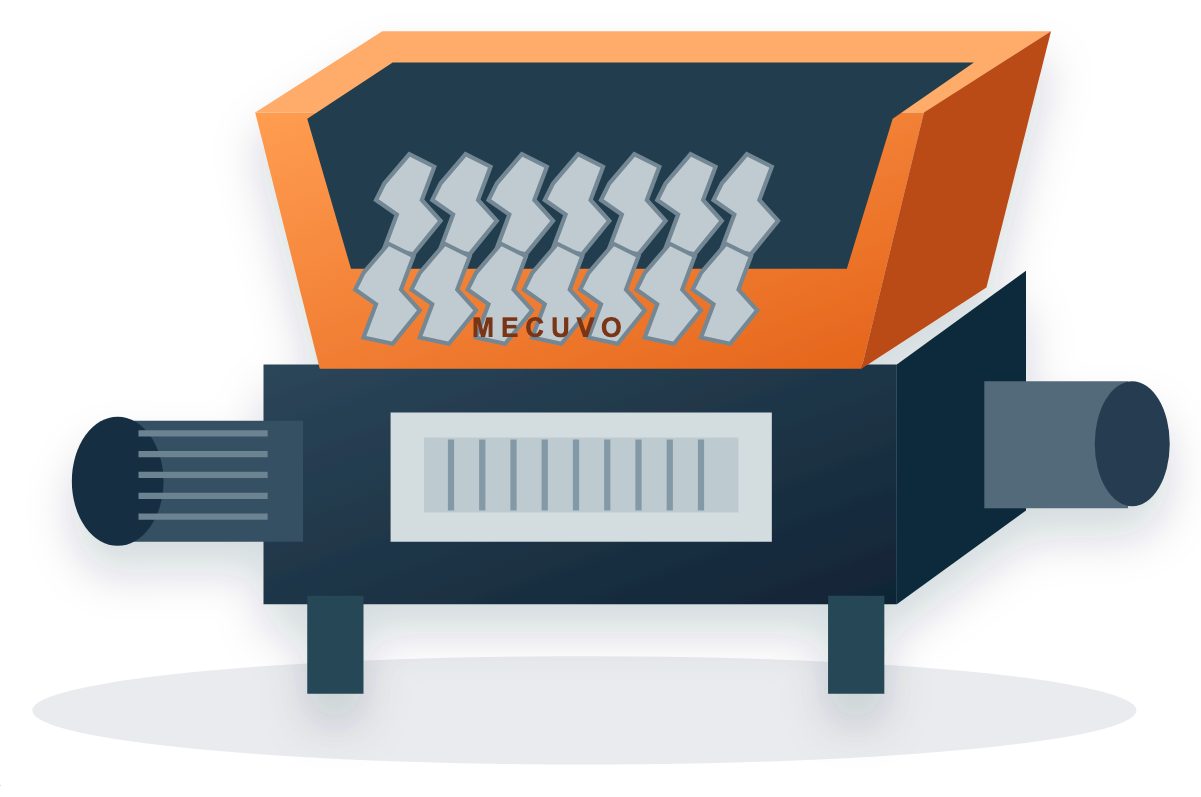
— Solve the bottleneck before the next machine
Reduce bulky scrap for the next recycling stage.
Oversized or awkward feed can make handling and downstream processing harder than they need to be. A suitable shredder creates a preparation step between the incoming load and the work you want to do next.
Prepare material for your conveyor, sorter, granulator or collection system with a shredder matched to the feed and output you need.
MECUVO supplies dual-shaft shredders from China. Tell us what goes in, how it will be loaded and where the output must go. Build the equipment selection around that complete task.

Match your shredder to the input and output.
Tell us what you feed in and how the shredded material will be used.
— MACHINE VIDEOS
See the equipment at work.
Follow the incoming feed through the cutting chamber and into collection or the next process.

Complete shredding run
Loading and feed behaviour
Discharge and next-stage transfer
Cutting-element maintenance
— Where size reduction adds value
Make the next stage easier to feed.
01
Prepare bulky material
Reduce suitable feed into more manageable pieces for handling or further processing. The useful result is determined by the next operation, not by an impressive-looking pile.
02
Connect the process stages
A shredder can serve as upstream preparation for a suitable downstream machine. Review transfer, buffering and controls together instead of treating each machine as an isolated purchase.
03
Target a specific operating problem
Too much manual preparation, oversized pieces or an inconsistent feed stream call for different solutions. State the bottleneck first so the equipment choice has a clear purpose.
— Can it shred my material?
What material do you need to shred?
Different material constructions need different cutting and feeding arrangements. Hollow or thin-walled items, dense sections, flexible pieces and mixed loads do not present the same job.
Share the normal material mix, the largest pieces and any contaminants so we can assess a suitable configuration.
| Your feed group | What matters | Selection focus |
|---|---|---|
| Suitable metal offcuts or thin-walled scrap | Material grade, thickness, dimensions and bulk behavior. | Cutting arrangement and drive matched to the actual section. |
| Cable or prepared radiator material | Construction, attachments, length and the needs of the next stage. | Preparation limits, discharge form and downstream compatibility. |
| Bulky plastic or mixed industrial items | Material composition, flexibility, dimensions and contaminants. | Application-specific feeding and cutting review. |
| Dense, hard or unusually heavy pieces | Peak loading and construction outside the normal feed. | Separate assessment; do not infer suitability from motor power. |
| Batteries, pressurized vessels or unidentified hazardous contents | Fire, pressure and contamination hazards. | Exclude from normal feed; use an approved identification and removal process. |
— MATERIAL GALLERY
Which materials do you process?
Send photos of your material, including its size and condition, so we can help select a suitable configuration.

Bulky incoming feed
Prepared feed dimensions
Typical production mix
Difficult or excluded items
— Choose the shredder’s role
Choose a standalone shredder or a connected line.
Handling and volume reduction
A standalone shredding station
Evaluate a defined feed and practical loading and collection arrangement. Match the discharge to the storage or handling task you need to improve.
Feeding another machine
A preparation stage
Match the shredder to the receiving equipment. The next machine’s inlet, permissible feed and capacity should shape the discharge and transfer plan.
A connected recycling project
An integrated shredding line
Review the shredder with conveyors, separation or further reduction stages. Make each supplier’s interfaces and site responsibilities explicit before the layout is settled.
— MACHINE & LAYOUT
Machine configurations and layouts
Explore the machine, feeding equipment and collection area for your planned setup.
Complete shredding unit
Feeding and discharge arrangement
Connection to the next stage
— From bulky intake to usable feed
From loading to shredded material

Define and prepare
Identify accepted material, normal variation and excluded contents before it reaches the loading area.

Present the feed
Use the loading method and preparation suitable for the selected machine and material.
Reduce the material
The cutting arrangement breaks down the feed. Output form depends on the material and selected configuration.

Transfer or collect
Move the discharge into the planned bin, conveyor or downstream process without creating a new bottleneck.
— Will the next process accept it?
Shredded material for your next process
A typical dual-shaft primary-shredding process can produce pieces with variation in length and shape. Cutter width alone should not be treated as a guarantee that every piece has the same final dimensions.
When a downstream stage requires a controlled size range, make that requirement explicit. The complete route may need additional reduction or classification rather than assuming the primary shredder can deliver the finished product by itself.
Show the intended receiving equipment and its limits. Evaluate the actual discharge against those limits, including awkward pieces and material behavior during transfer.
A complete result
Discharge form
Inspect piece dimensions, length variation and any material that remains difficult to handle.
Transfer behavior
Check whether the material can move through the intended conveyor or collection route.
Next-stage acceptance
Judge the output against the inlet and process requirements of the receiving machine.
— FROM INPUT TO OUTPUT
See what reaches your next process.
Review the incoming batch alongside every relevant output. Material, machine configuration and test conditions belong together.

Defined incoming feed
Size-reduced discharge
Typical output variation
Material at the next stage
— More than a motor-power number
Choose a cutting system for your material.
| Selection detail | Why it matters | Useful information |
|---|---|---|
| Cutting chamber and feed opening | The material must be presented to the cutting system, not just fit inside a large hopper. | Normal dimensions, largest pieces and intended loading method. |
| Cutters and shaft arrangement | The selected cutting action must suit the feed construction and output objective. | Representative feed and acceptable discharge. |
| Drive and load management | Demand changes with material, section and loading behavior. | The proposed drive, operating limits and controls. |
| Service design | Worn or damaged cutting elements need a practical replacement plan. | Part references, access, lifting requirements and maintenance information. |
— INSIDE THE EQUIPMENT
Machine features and service access
Inspect the working areas, collection points and service access that affect day-to-day use.
Cutting chamber
Drive assembly
Discharge interface
Cutter access
— Will it feed my line consistently?
Choose capacity for your daily workload.
Feed density, shape, construction and loading continuity influence a shredding run. Include real loading pauses and any reversal or clearing events shown by the offered machine when judging its useful output.
A larger shredder can still be limited by the loader, discharge conveyor or receiving equipment. Compare the rate across the system rather than maximizing one machine’s number.
| Production constraint | What to review |
|---|---|
| Incoming feed | Normal material and the difficult pieces that occur in regular production. |
| Loading | Presentation method, refill intervals and bulky-item behavior. |
| Machine operation | Material-specific rate, interruptions and the control features actually included. |
| Discharge and downstream process | Transfer capacity, buffering, collection and the next stage’s limits. |
— Make the investment solve the right problem
Reduce handling work and prepare material for recycling.
Define what changes after size reduction. The benefit might be less manual preparation, a more workable feed for another machine or a different material-handling arrangement. Do not count the same benefit twice in your investment review.
Then include loading equipment, electricity, cutting-element wear, maintenance, downstream work and site installation. A low equipment price can be a poor comparison when the missing transfer or preparation stages are essential.
Give the project a clear boundary: one standalone task, preparation for existing equipment or an integrated line. That makes both the quotation and the business case easier to compare.
What is slowing down your process?
Tell us the current bottleneck and the output your next machine needs. We’ll help you assess a suitable shredder.
— Technical scope for your project
Request shredder specifications
Request current information for the proposed configuration, not just a generic model sheet. Include the site’s actual voltage, phase and frequency and the documents your facility team requires for the installation review.
Dual-Shaft Shredders
Accepted feed
Material, dimensions, construction and exclusions.
Cutting system
Chamber, cutting arrangement and application limits.
Drive and controls
Offered drive, operating logic and included protection features.
Output objective
Required discharge form and any downstream treatment.
Line interfaces
Loading, conveyors, buffers and control responsibilities.
Maintenance access
Cutting elements, lifting access and service requirements.
— Your MECUVO project
Find a shredder for your material
01
Start with a defined task
Tell us the accepted feed and the next operation. A focused enquiry supports a more useful equipment review than a request for the biggest available motor.
02
Review connected equipment together
MECUVO’s range includes shredding and metal-recovery equipment. An upstream preparation task can be discussed alongside the relevant downstream equipment.
03
Include help at your location
MECUVO can assist at the customer’s site by agreement. Bring installation, start-up and operator-support needs into the scope before shipment.
— PROJECT & SITE GALLERY
Equipment layout and installation
See the space needed for the equipment, incoming scrap and finished material.
Installed equipment layout
Material flow at the site
Start-up and operator handover
— What does the quoted price cover?
Get a quote for a complete shredding setup.
Request the machine, handling interfaces and optional equipment as separate items. A multi-machine enquiry should identify quantities and whether power, loading or discharge is shared.
| Quotation item | What to define |
|---|---|
| Main shredder | Model, quantity, cutting and drive configuration for the agreed feed. |
| Loading and discharge | Hopper, support arrangement, conveyors and collection scope. |
| Parts and interfaces | Cutting-element references, initial parts and control boundaries. |
| Delivery and site services | Packing, delivery point, installation tasks and any on-site assistance. |
— BEFORE DISPATCH
Inspection, packing and shipping
From equipment checks to container loading, see how machines are prepared for shipment.
Pre-dispatch equipment check
Packing and protection
Loading and shipment

From China.
To your operation.
Ask about installation and start-up support at your site.
Equipment supply / Site assistance
— A workable installation
Leave room to feed it, empty it and maintain it.
Allow for loading equipment, incoming storage, discharge collection and service access. The machine footprint alone does not describe the operating area. Your facility team also needs to assess guarding, dust, noise and the material-specific hazards.
MECUVO can assist overseas at your location by project agreement. Define the equipment interfaces, installation-related tasks, start-up work and operator support, together with the site readiness, schedule and visit costs.
— PARTS & MAINTENANCE
Spare parts and maintenance
Find the wear parts and service access points for your machine. Contact us for model-specific parts information.
Cutting elements
Spacers and wear items
Inspection and replacement access
— Your shredding purchase
Dual-shaft shredder FAQs
Have a question about your material or project?
— Get the next stage moving
What goes in—and what needs to come out?
Tell us your material and the task after shredding. Request an equipment option and quotation for a standalone station or a connected process.
Get a quote for your equipment
Tell us what you recycle and leave your email. Photos and technical details can follow.
Dual-Shaft Shredders
We use these details to handle your enquiry.