COPPER CABLE RECYCLING MACHINERY

Copper Granulator Machines for Profitable Cable Recycling

Turn household wire, automotive cable, communication wire and mixed insulated cables into separated copper and plastic granules with a configuration matched to your material, capacity and local power supply.

  • Dry physical separation without water or chemicals
  • Models for small batches through industrial production
  • Customized voltage, frequency and control systems
  • Material review and machine testing before shipment
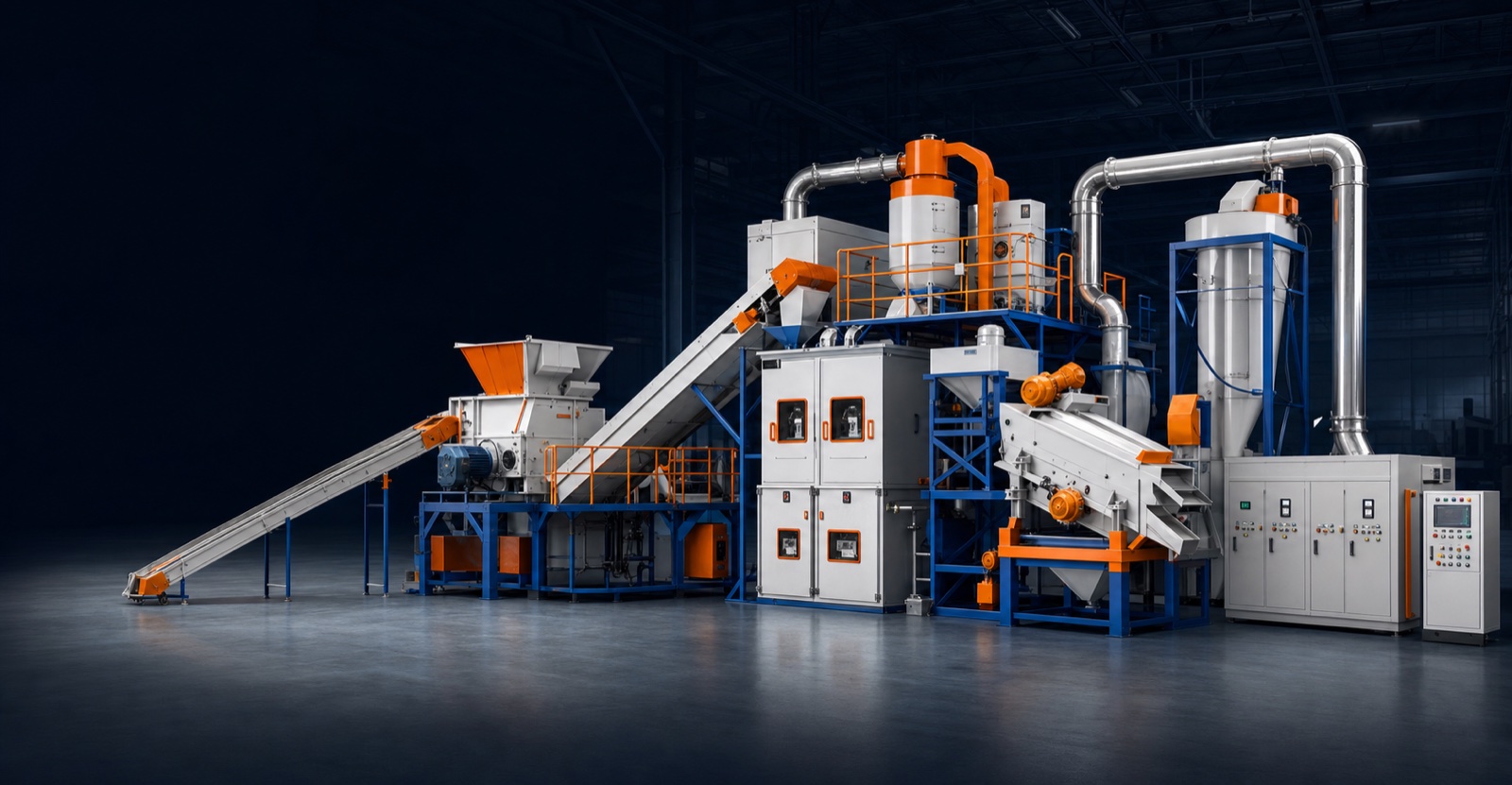
Complete copper cable granulator recycling line

Factory-Direct Supply

Production, testing and technical support from one team.

Customized Voltage

Electrical systems matched to your destination market.

Testing Before Shipment

Running and output checks available before delivery.

Export Packing

Protective packing and container-loading support.

Technical Support

Remote installation, operation and troubleshooting guidance.

Spare Parts Support

Wear-parts planning for long-term operation.

THE BUYER PROBLEM

Are You Losing Profit in Scrap Cable Recycling?

Scrap cables contain valuable copper, but inefficient processing can leave copper inside plastic, increase labor costs and reduce the selling value of the final output.

A correctly selected copper granulator helps process mixed cables more consistently and reduces dependence on manual stripping.
  • Manual stripping is too slow for thin and tangled wires
  • Labor costs rise while throughput remains limited
  • Incomplete separation reduces copper value
  • Burning creates pollution and may be restricted
  • Plugs, iron and mixed insulation complicate processing
  • Choosing only by price can create unstable results
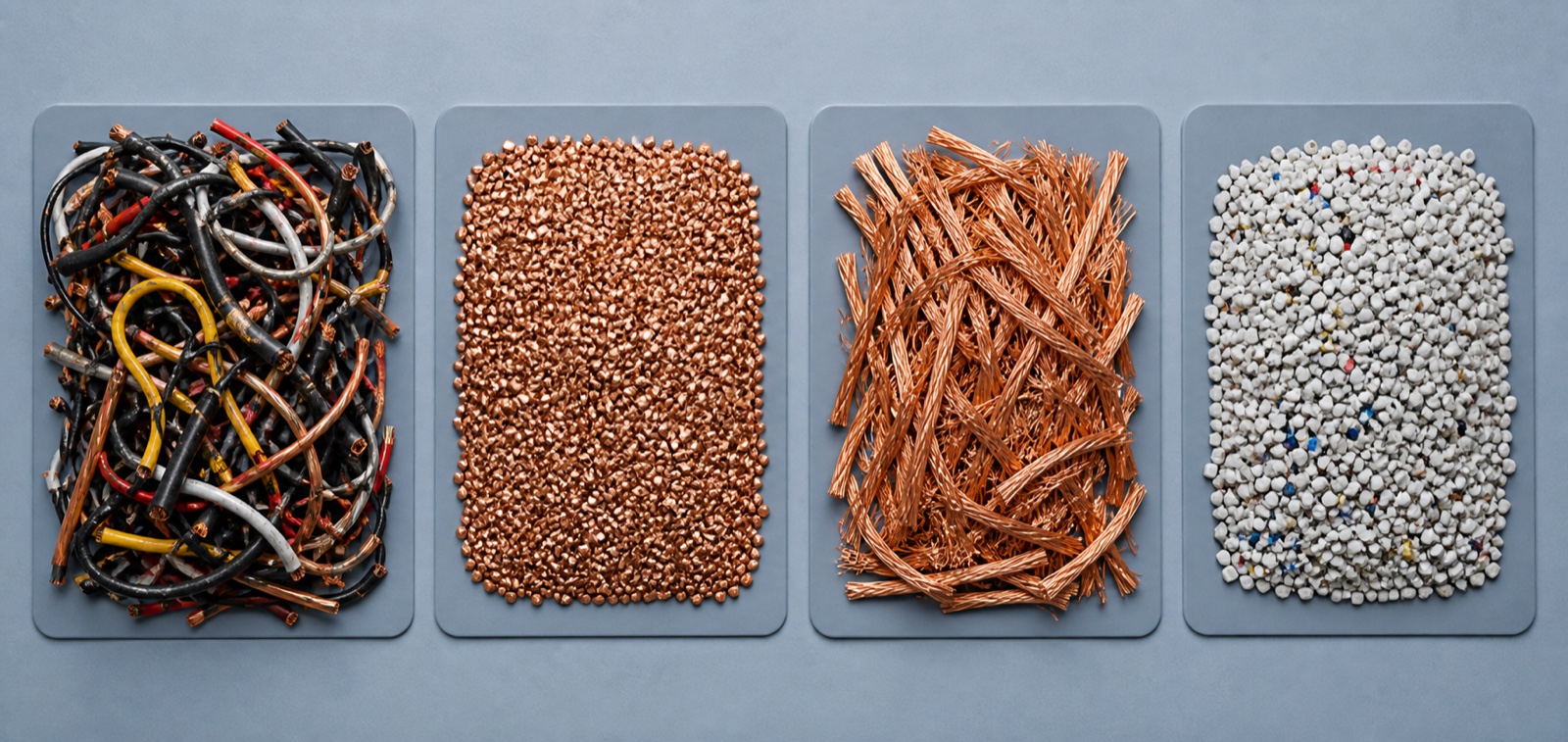
Mixed cable, copper granules, copper strands and separated plastic granules

INPUT → SEPARATION → OUTPUT

What Is a Copper Granulator Machine?

A copper granulator is a dry-type recycling machine that crushes insulated cable into small particles, then separates copper or aluminum from plastic insulation.

Air separation and vibration separation sort the particles by weight, density and movement. The result is separated metal granules for resale or refining and plastic granules for recycling or controlled disposal.

  • Suitable for thin, mixed, tangled and irregular cables
  • Continuous batch processing instead of one-by-one stripping
  • Dry physical process without a wet separation system

Wire stripping machine: removes insulation from individual regular cables.
Copper granulator: crushes mixed cables and separates metal from plastic in continuous batches.

MODEL RANGE

Choose the Right Copper Granulator for Your Business

Start with cable type, required capacity, operating hours, floor space and local power supply. Final specifications and configuration are confirmed after material review.

20–40 kg/h

BS-S05

Mini Cable Separator

Small cable batches, repair shops, electricians and starter recycling businesses.

Approx. 70 kg/h

BS-D70

Compact Copper Granulator

Small recycling businesses that need a compact automatic granulating and separation system.

Approx. 300 kg/h

BS-D30

Standard Copper Granulator

Scrap yards and cable recyclers processing mixed insulated wires every day.

Approx. 300–500 kg/h

BS-N125

Medium-Capacity Recycling Line

Commercial recyclers processing larger volumes, plug wire and more complex cable materials.

Up to approx. 1,000 kg/h

ECO1000

Industrial Granulator Line

Established facilities planning continuous industrial cable-recycling production.

Approx. 2,000–3,000 kg/h

BS-A1300

Heavy-Duty Recycling Line

Large recycling stations and industrial plants processing high-volume cable streams.

Not Sure Which Model Fits Your Material?

Send cable photos, target capacity and local voltage. We will compare suitable models and explain the trade-offs.

SIDE-BY-SIDE TECHNICAL COMPARISON

Copper Granulator Model Comparison

Use this table for initial model screening. Final cable range, installed power and configuration are confirmed from your material, capacity, voltage and operating conditions.

Model Capacity Cable Range Power Suitable Material Best For Options
BS-S05 20–40 kg/h Confirm Confirm Small thin wire Starter business Confirm
BS-D70 Approx. 70 kg/h Confirm Confirm Automotive and communication wire Small workshop Additional separation accessories
BS-D30 Approx. 300 kg/h Confirm Confirm Mixed insulated cable Scrap yard Magnetic or electrostatic separation
BS-N125 Approx. 300–500 kg/h Confirm Confirm Plug wire and mixed cable Commercial recycler Pre-shredder and magnetic separator
ECO1000 Up to approx. 1 t/h Confirm Confirm High-volume cable Large facility Complete feeding and separation line
BS-A1300 Approx. 2–3 t/h Confirm Confirm Industrial mixed cable Recycling plant Customized heavy-duty line

Capacity varies with cable composition, feeding size, operating method and optional equipment.

Application: Small cable batches, repair shops, electricians and starter recycling businesses.

Voltage: Customized for the destination market.

Cable range and power: Confirm from the actual material.

Application: Small recycling businesses that need a compact automatic granulating and separation system.

Voltage: Customized for the destination market.

Cable range and power: Confirm from the actual material.

Application: Scrap yards and cable recyclers processing mixed insulated wires every day.

Voltage: Customized for the destination market.

Cable range and power: Confirm from the actual material.

Application: Commercial recyclers processing larger volumes, plug wire and more complex cable materials.

Voltage: Customized for the destination market.

Cable range and power: Confirm from the actual material.

Application: Established facilities planning continuous industrial cable-recycling production.

Voltage: Customized for the destination market.

Cable range and power: Confirm from the actual material.

Application: Large recycling stations and industrial plants processing high-volume cable streams.

Voltage: Customized for the destination market.

Cable range and power: Confirm from the actual material.

MATERIAL RANGE

What Materials Can Be Processed?

The best machine and configuration depend on cable diameter, metal content, insulation type, plugs, iron and other impurities.

Household & Communication Wire

Appliance wire, renovation cable, telephone wire, network cable and selected data cable.

Automotive & Plug Wire

Vehicle harnesses and plug wire; iron-containing plugs may require magnetic separation.

Computer & Mixed Cable

Electronic connection wires and mixed insulated cable with different sizes and insulation.

Copper & Aluminum Cable

Copper- or aluminum-core insulated cable within the recommended processing range.

Mixed cable, copper granules, copper strands and separated plastic granules

CONFIRM BEFORE FEEDING

Some Cable Materials Require a Different Setup

Some materials require pre-sorting, pre-shredding, magnetic separation or additional separation equipment.

  • Armored cable with steel reinforcement
  • Oil-filled or contaminated cable
  • Very thick cable requiring cutting or pre-shredding
  • Cable with large plugs or excessive iron
  • Fine hair wire requiring precise airflow adjustment
  • Highly mixed cable with large size differences

How the Copper Granulator Works

The exact configuration varies, but a standard dry cable-recycling process follows four decision-ready stages.

Technicians testing a copper cable granulator line

TEST BEFORE YOU CHOOSE

Real Material Tests Reveal the Right Configuration

Before recommending a machine, review the cable material and required capacity. A controlled test can verify feeding, crushing, separation and final output.

Review continuous feeding, copper-plastic separation, final copper condition and plastic output.
Review iron removal, plug-wire preparation, magnetic separation and stable feeding.
Review pre-shredding, continuous production, line stability, final output and dust collection.
Mixed cable, copper granules, copper strands and separated plastic granules

OUTPUT QUALITY

How We Evaluate the Separation Result

Final output should be judged from the actual cable material, not a universal purity claim. A structured inspection shows whether airflow, vibration or secondary separation needs adjustment.

  • Copper remaining in the plastic output
  • Plastic remaining in the copper output
  • Iron or other metal contamination
  • Particle-size consistency
  • Dust level and dust-collection performance
  • Feeding stability during continuous operation
  • Need for secondary or electrostatic separation

Material testing provides more useful buying evidence than a theoretical purity number.

MACHINE ANATOMY

Core Components of a Copper Granulator

Machine performance depends on the complete system, not one headline specification.

Complete copper cable granulator recycling line
The crusher reduces insulated cable into particles. Blade condition, clearance and feeding consistency affect output and power use.
Airflow separates heavier copper or aluminum particles from lighter plastic.
The vibrating stage improves separation and helps reduce copper loss in plastic output.
Air ducts and filters collect fine particles and help maintain stable airflow.
The control cabinet manages motors, line components and selected safety systems.
Optional feeding and size-reduction equipment support larger, tangled or continuous material flows.
Magnetic separation removes iron from plug wire and contaminated mixed cable.

CONFIGURE FOR THE MATERIAL

Optional Equipment for Different Recycling Requirements

Optional equipment is selected according to cable size, impurities, required capacity and the final separation standard.

Supports controlled material feeding and continuous production on medium and industrial lines.
Reduces large, tangled or heavy cable before granulation and improves feeding consistency.
Removes iron from plugs, connectors and contaminated mixed cable.
Can improve separation of fine metal particles from plastic in selected applications.
Adds another separation stage for fine or complex materials when the first pass is not sufficient.
Recommended for larger production lines and materials that create more fine dust.
Can include blades, screens, belts, bearings and selected electrical components for planned maintenance.

INSTALLATION PLANNING

Plan the Site Before Ordering

  • Machine dimensions, maintenance access and material storage
  • Voltage, phase, frequency and available transformer capacity
  • Operators, feeding method and raw-material preparation
  • Copper, plastic, dust and magnetic-output collection
  • Ventilation, floor load, forklift and lifting access

OPERATION & WEAR PARTS

Protect Capacity and Separation Performance

  • Daily checks for blades, screens, belts and bearings
  • Airflow and vibration adjustment for each material
  • Regular dust-system and duct cleaning
  • Operator training and documented maintenance
  • Planned stock of blades, screens, belts and selected electrical parts

PROCESSING METHOD

Granulation vs Stripping and Burning

Low initial investment, but slow and labor-intensive; unsuitable for thin and highly mixed wires.
Effective for thick, regular cables; less suitable for thin, tangled or highly mixed materials.
Creates pollution, may be restricted, can damage material quality and is not recommended.
Supports dry, continuous processing of mixed and tangled cable, but requires correct selection and operator adjustment.

PROFITABILITY WITHOUT HYPE

Is a Copper Granulator Profitable?

Profitability depends on stable cable supply, copper content, local metal prices, machine utilization and operating cost.

Daily cable input × recoverable copper content × local selling price − cable purchase − electricity − labor − maintenance = estimated processing margin.

  • Scrap cable buying price and copper percentage
  • Local copper and plastic selling value
  • Electricity, labor and operating hours
  • Actual machine capacity for your material
  • Blade, wear-parts and maintenance cost

We do not provide unrealistic payback promises without knowing your local prices and cable material.

TYPICAL APPLICATIONS

Who Uses Copper Granulator Machines?

Scrap Metal Yards

Upgrade mixed scrap cable into separated copper and plastic outputs.

Cable Recycling Companies

Process automotive, communication, industrial and mixed cable.

Demolition & Electrical Contractors

Recover value from cable removed during projects and maintenance.

Metal Traders & Waste Processors

Add processing capacity instead of reselling unprocessed cable.

PROJECT CONFIGURATION EXAMPLES

Copper Granulator Project Profiles

These profiles show how material, volume and site conditions guide configuration. Customer names, countries and operating results are only published after verification and permission.

Mixed cable, copper granules, copper strands and separated plastic granules

CASE PROFILE 01

Small Recycling Business

Country & power standard: Confirmed during inquiry
Material: Household wire, communication cable and selected automotive wire
Daily volume: Small prepared batches
Model range: BS-S05 or BS-D70 after material review

  • Compact installation for limited floor space
  • Lower entry capacity for a small operating team
  • Electrical configuration matched to the destination
  • Output and feeding verified with representative cable

Result record: Capacity, output condition and operating settings are documented from the confirmed material test.

CASE PROFILE 02

Commercial Scrap Yard

Country & site conditions: Confirmed before quotation
Material: Automotive wire, plug wire, household cable and mixed insulated cable
Required capacity: Regular daily commercial production
Model and options: BS-D30 or BS-N125 with magnetic separation when iron is present

  • Continuous feeding and stable separation
  • Plug and iron content reviewed before selection
  • Optional conveyor or pre-processing equipment
  • Output inspection from the buyer’s cable mix

Result record: Final model, options and operating range are confirmed in the pre-shipment test report.
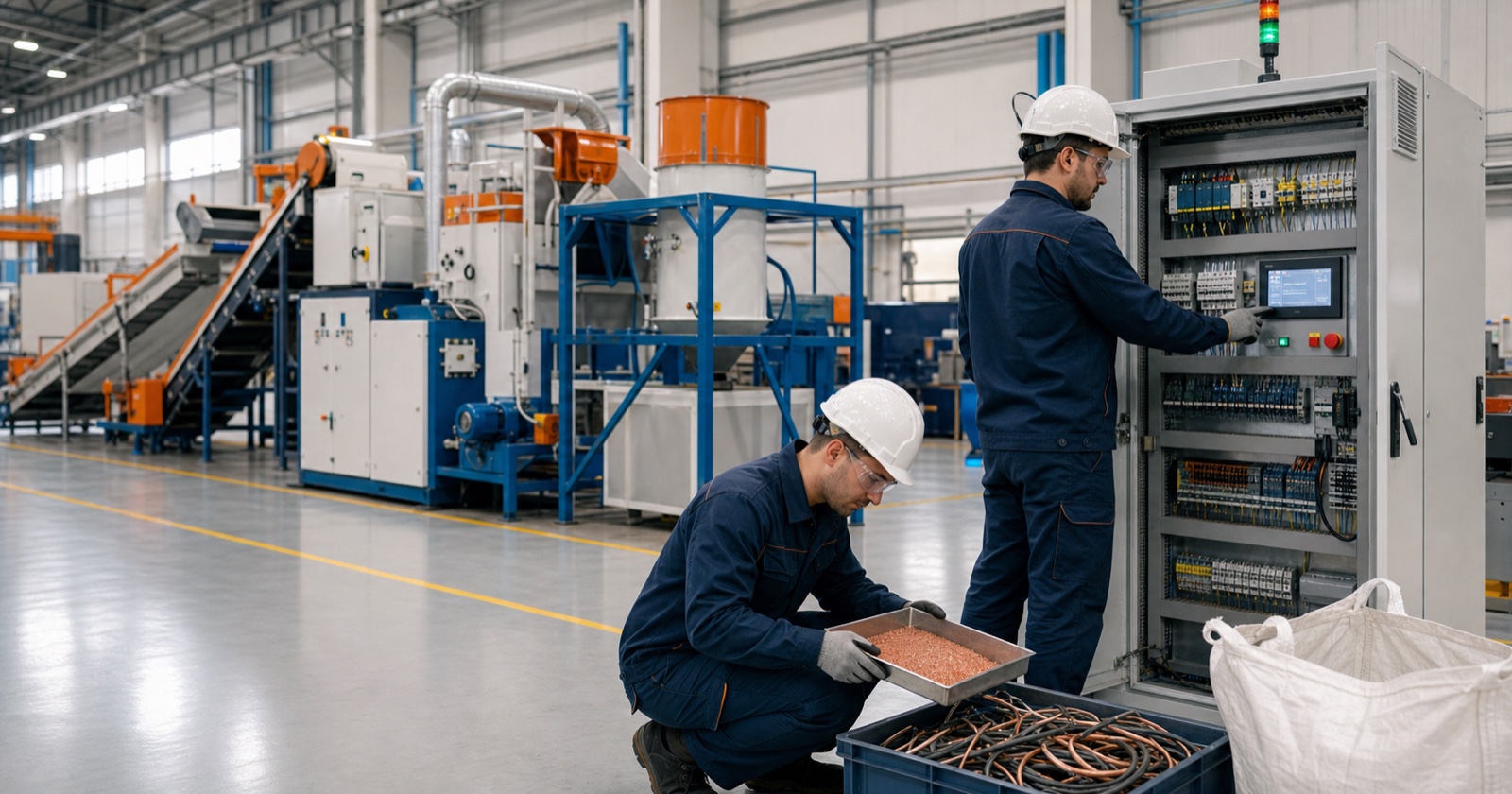
Technicians testing a copper cable granulator line
Complete copper cable granulator recycling line

CASE PROFILE 03

Industrial Cable Recycling Plant

Country & installation standard: Confirmed during project planning
Material: High-volume mixed copper or aluminum cable
Complete line: ECO1000 or BS-A1300 range with feeding, pre-shredding and multi-stage separation as required

  • Complete line layout and electrical planning
  • Continuous feeding and dust-control review
  • Pre-shredder and separation stages matched to material
  • Remote or selected on-site installation support

Result record: Throughput, separation condition and line stability are documented against the confirmed acceptance material.

Factory Production and Quality Control

Production, assembly, electrical inspection, running tests, output inspection and export preparation should be verified before shipment.

Factory team preparing industrial equipment for export delivery

EXPORT PREPARATION

Export Packing and International Delivery

Machine size, weight and destination determine whether equipment is packed in wooden cases, secured on reinforced frames or loaded directly into a container.

Confirm the main machine, optional equipment, voltage and final line layout before production is closed.
Check machine quantity, accessories, wear parts, tools and technical documents against the confirmed order.
Protect control cabinets, exposed components, motors and machine surfaces from transport damage and moisture.
Select protective wooden cases, reinforced steel frames or direct container securing according to machine dimensions.
Plan forklift or crane access, equipment position, weight distribution and internal securing before loading.
Prepare the agreed commercial, packing and technical documents for international delivery.
Technicians testing a copper cable granulator line

MATERIAL-BASED SELECTION

Why Buyers Choose MECUVO

Machine selection begins with your cable material, required capacity and operating conditions.

  • Model recommendation based on cable type and impurities
  • Range from compact separators to industrial lines
  • Customized electrical and optional equipment
  • Machine testing and output review before shipment
  • Export packing, loading and delivery preparation
  • Remote and selected on-site technical support
  • Wear-parts and maintenance guidance

From Cable Photos to Machine Delivery

A clear buying process reduces technical and commercial uncertainty.

BEFORE DELIVERY

Technical Planning and Testing

  • Pre-sale material review
  • Configuration and voltage confirmation
  • Machine-running and output testing
  • Line-layout and installation planning

AFTER DELIVERY

Operation and Long-Term Support

  • Installation and electrical guidance
  • Remote troubleshooting and adjustment
  • Operator and maintenance training
  • Selected on-site technical support
  • Spare-parts identification and supply

BUYER QUESTIONS

Frequently Asked Questions

A stripping machine removes insulation from individual thick or regular cables. A granulator crushes mixed cable and separates metal from plastic, making it more suitable for thin, tangled and irregular wires.
Yes. If the material contains plugs, iron or other impurities, magnetic separation or pre-sorting may be recommended.
Selected machines can process aluminum wire after airflow, vibration and material settings are adjusted for aluminum density.
Some plug wire can be processed with magnetic separation. Armored cable requires material confirmation and may need pre-treatment.
A pre-shredder may be recommended for thick, tangled, heavy or high-volume cable. Small prepared wires may feed directly into selected machines.
Cable type, diameter, copper content, insulation, feeding size, operating method, machine condition and optional equipment all affect capacity.
Output depends on material and adjustment. A controlled material test is more reliable than applying one purity promise to every cable.
Standard dry-type systems use crushing, air separation and vibration separation without a wet processing system.
Voltage, phase, frequency and selected electrical components can be configured for the destination country and project.
Provide cable photos or video, diameter, material composition, target capacity, voltage, destination country or port and any special requirements.

GET A QUALIFIED RECOMMENDATION

Get a Copper Granulator Recommendation

Send your cable material and production requirements. The team can compare suitable models and prepare a factory quotation.

  • Recommended machine model and configuration
  • Capacity, voltage and optional-equipment guidance
  • Testing, packing and shipping information

Ready to Start or Upgrade Your Cable Recycling Business?

Send cable photos and required capacity. Compare suitable machines, confirm the configuration and prepare a factory quotation.